
By Coral Gables Gazette staff
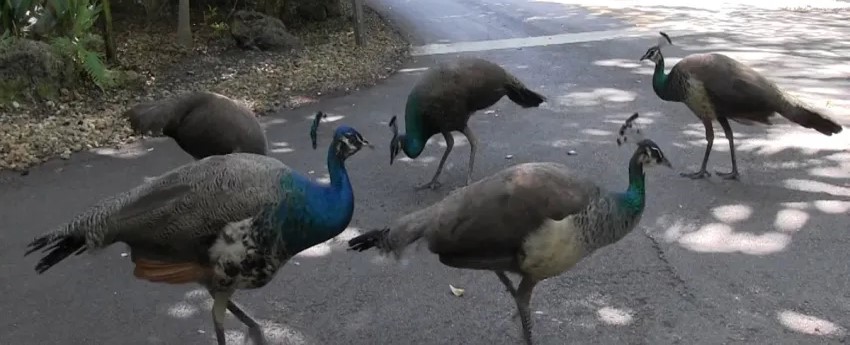
Bids are now in for a City of Coral Gables contract that will determine how peafowl, chickens, and roosters are removed from public spaces—a long-running quality-of-life issue that has stirred debate across neighborhoods for years.
The bid window, which seeks a vendor to provide humane nuisance pest removal and relocation services, closed Dec. 23. City officials are now reviewing submissions to identify the lowest responsive and responsible bidder, as required under the invitation-for-bids process.
The contract will govern how non-native birds—including peafowl and feral chickens—are captured, transported, and relocated from public rights-of-way and City-owned property, with an emphasis on animal welfare and public safety.
A policy decision enters its execution phase
The procurement implements authority granted by the City Commission, which affirms the city’s ability to intervene in response to the growing presence of peafowl and chickens within city limits. The resolution cites property damage, noise disturbances, traffic disruptions, parasite transmission, and environmental impacts tied to non-native species.
With bids now submitted, the issue shifts from policy debate to execution. The selected contractor will be responsible for carrying out removals in a manner that is non-lethal, humane, and minimally disruptive to residents.
What the contract covers
Under the bid specifications, the contractor must perform hand-capture only, ensuring that animals are not harmed during removal. Captured birds must be safely transported and relocated to appropriate destinations such as animal rescues, farms, or wildlife sanctuaries.
The scope of work also includes:
- Site assessment and inspection
- Sanitation of affected areas to reduce disease risk
- Follow-up monitoring
- Written reporting documenting the number of animals removed and the steps taken to relocate them
Initial removals are expected to take one to three days, with follow-up visits within one to two weeks, depending on conditions.
How bids will be evaluated
Because the solicitation was issued as an Invitation for Bids, the City must award the contract based on price, not subjective scoring. The winning bidder must meet all qualification requirements and submit pricing on all required line items through the City’s electronic procurement system.
Price escalations are prohibited, and the City is not obligated to purchase a minimum quantity of services. The City also retains the right to reject all bids if doing so serves the public interest.
A Cone of Silence remains in effect until the City Commission approves an award.
What happens next
City staff will review bid submissions for responsiveness and responsibility before making a recommendation. Once a proposed award is ready, the contract will return to the City Commission for approval at a future meeting.
At that point, bid totals, vendor identities, and contract terms will become public, offering residents a clearer view of how the City intends to manage a problem that has reshaped daily life in some neighborhoods.

Author: Coral Gables Gazette News Staff
Originally established in 1996 and relaunched as a digital publication in February 2025, the Coral Gables Gazette is an independent local news organization dedicated to factual, objective and accountable community journalism. Our newsroom reports on the people, policies, institutions and events shaping Coral Gables, Florida, providing residents with timely, informative coverage of the issues affecting their community. Our reporting includes City Hall, local government, municipal elections, public spending, real estate development, business, education, arts and culture, and neighborhood affairs throughout the City Beautiful. We follow City Commission decisions, examine public records and report on the businesses, organizations and individuals contributing to Coral Gables. We believe informed residents are essential to a healthy, engaged community. Stories published under the Coral Gables Gazette News Staff byline are prepared or compiled by the publication's editorial team. We strive for accuracy, fairness, transparency and clear distinctions between news reporting, opinion and advertising. Readers are encouraged to submit news tips, corrections, editorial inquiries and story suggestions through our Contact page and learn more about our standards through our Editorial Policy.










The tax paying Gables residents OPPOSE the removal ! Who is requesting this ? And Why?
I agree. I do not agree with removal. They will always come back. An frankly I see them as a beautiful part of our community. If they poop, hose it down. I have a few evil neighbors who i know are hurting these beautiful creatures. They have no life and are bitter. They should enjoy GODs gifts.
Finally! This has been a problem for a long time and is only worsening.
How does it affect you? Do you speed on streets that are 5-15 miles per hour? They are gorgeous site to the eye. They beautify the city and they eliminate the unnecessary rodents on the area.
Take them out. If more come back, take them out too. They are an embarrasing nuisance and make us look third-world and or post-apocalyptic.
Birds making us look like a third world country??You are really “showing your feathers”…..
Hope you are not against bycicles and people walking and conversing in the street
That might be also third world country for you…..
Those birds are beautiful, but the City most place them to a secure place since the streets are dangerous, and by the way they come to our area every day. Please try to do something. Thanks