
By Coral Gables Gazette staff
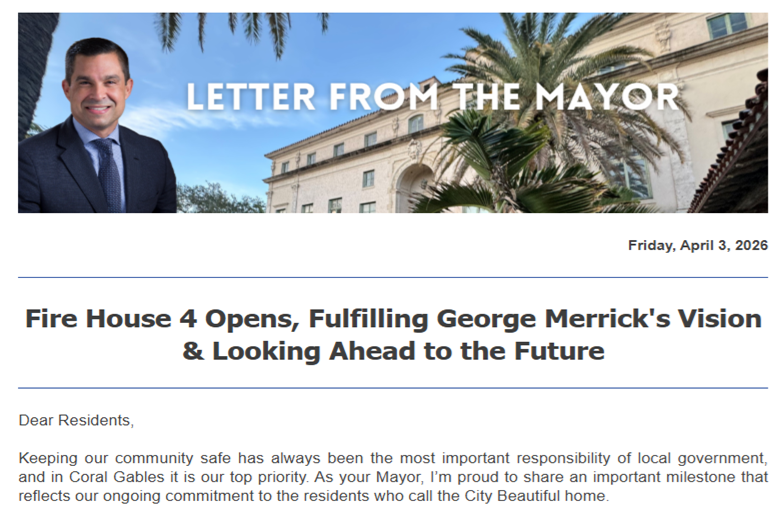
The April 3 letter to residents from Coral Gables Mayor Vince Lago begins as a familiar civic update. It highlights the recent completion of Firehouse 4 on Sunset Drive, links the milestone to founder George Merrick’s original vision for a city served by four fire stations, and places the project within a broader record of public safety investment.
It then turns to something else.
The letter presents detailed figures on firefighter compensation, retirement benefits, and pension funding — including average pay of approximately $117,000, deferred retirement payments averaging more than $750,000, and total retirement benefits that can reach into seven figures. Those figures appear in a public communication to residents as the city approaches negotiations on a new contract with the union representing its firefighters.
That sequence defines the document.
In Coral Gables, the mayor does not sit at the bargaining table. Contract negotiations are conducted by city staff and labor counsel. The April 3 letter is not part of that negotiation process. It is addressed to residents.
That distinction matters. It separates the forum in which negotiations will occur from the forum in which they will be understood. The residents who open the mayor’s monthly letter are among those who follow city government most closely — and who will evaluate the outcome once it is announced.
Public-sector labor negotiations typically unfold out of view. Terms are debated privately, proposals are exchanged, and agreements are reached before the details are presented publicly. In that structure, public communication often follows the outcome.
The April 3 letter places a different kind of information into the public record before that process begins.
The figures it contains are old to those directly involved in bargaining. City negotiators, union representatives, and financial advisors work with these numbers as a matter of course. What is different is their placement — in a resident letter framed around a civic milestone, distributed citywide and read by residents engaged in how the city is governed.
The letter follows a sequence. It begins with civic identity — a founding vision fulfilled. It moves through infrastructure investment — approximately $118 million over the past decade. It arrives at compensation and retirement figures — the cost of maintaining that system. It closes with fiscal context, including pension funding and the potential impact of state-level property tax changes.
Each element stands on its own. Together, they describe a progression: from achievement, to investment, to cost, to constraint.
The city’s pension trajectory provides additional context. According to the letter, the firefighter pension plan has improved from 52 percent funded in 2013 to 74.5 percent today, supported in part by an accelerated paydown policy and annual supplemental contributions that exceeded $9 million in 2025. That progression reflects a sustained financial commitment over more than a decade.
Placed alongside the compensation figures, it frames the financial system within which any new agreement will be reached.
The letter does not determine the outcome of those negotiations. It does not establish terms, set wages, or resolve differences between the city and its firefighters. Those decisions will be made through the bargaining process in the months ahead.
What the letter does is establish context.
It places specific figures into public view before negotiations begin. It situates those figures within a broader account of investment and fiscal management. And it introduces that context in a forum where it will shape how the eventual outcome is evaluated once it is announced.
That dynamic is not unique to Coral Gables. In municipal governance, the understanding of policy outcomes often forms alongside the decisions themselves. The way information is presented — what is emphasized, when it is introduced, and how it is framed — becomes part of the environment in which those outcomes are received.
In this case, the environment is being defined in advance.
The negotiations between the city and its firefighters will take place in the coming months. The terms of any agreement will emerge from that process. The context in which those terms will be understood is already taking shape.


This Post Has One Comment
For the 1st time in 4+ yrs, Vince Lago has done something I not only agree with, but think is actually pretty smart: provided factual context for what is sure to be a debate. historically, press coverage of Labor contract negotiations is notoriously incomplete. it is as if in J-School, journalism students are told “people won’t understand numbers, so don’t bother.”. Lagos’ numbers (I’m assuming they’re correct) are revealing. $117k average wages, $750k+ lump sums at retirement are numbers that got my attention, as are the facts that 100 applicants line up as soon as vacancies are known and there’s a 250 applicants cap. knowing all this is helpful, so that when the inevitable pissing match starts between city staff and Union, we can set it in proper context. how many of us retire with a near-million dollar lump sum payment? I can’t wait for the union to ask for more. (I’m sure they wont be giving any back!). can’t believe I’m actually going to type this: thank you Vince Lago, for making us a little smarter.