By Coral Gables Gazette staff
Imagine spending days placing colored sawdust, flower petals, pine needles, and fruit on the ground, spoonful by careful spoonful, building a work of art so precise and so vivid that people stop in the street to photograph it. Then imagine that the whole point is for it to be walked over and destroyed.
That paradox is at the heart of the alfombra de aserrín — the sawdust carpet of Antigua Guatemala — and it arrives at the Coral Gables Museum this Thursday. On Thursday, March 26 from 1 to 5 p.m., artists will build a full alfombra live at 285 Aragon Avenue, allowing visitors to watch and participate in its creation. The completed carpet will remain on exhibition from March 27 through April 16 — its survival, in this context, a departure from the tradition’s original purpose.
Five centuries of devotion, dyed sawdust at a time
The tradition of the alfombra arrived in Guatemala with the Spanish conquest in 1524. In Spain and the Canary Islands, it was customary to lay carpets of flowers and petals on the street before a sacred procession passed — an act of offering, of beautifying the ground that the holy would walk upon. When the Spanish encountered the Maya, they found a culture with its own parallel practice: the laying of flowers, herbs, candles, and sacred objects as passageways for nobility and ceremony. The two traditions merged, producing something neither culture had made before: elaborately designed carpets of dyed sawdust, flowers, fruits, and seeds, built directly on cobblestone streets and designed to be destroyed.
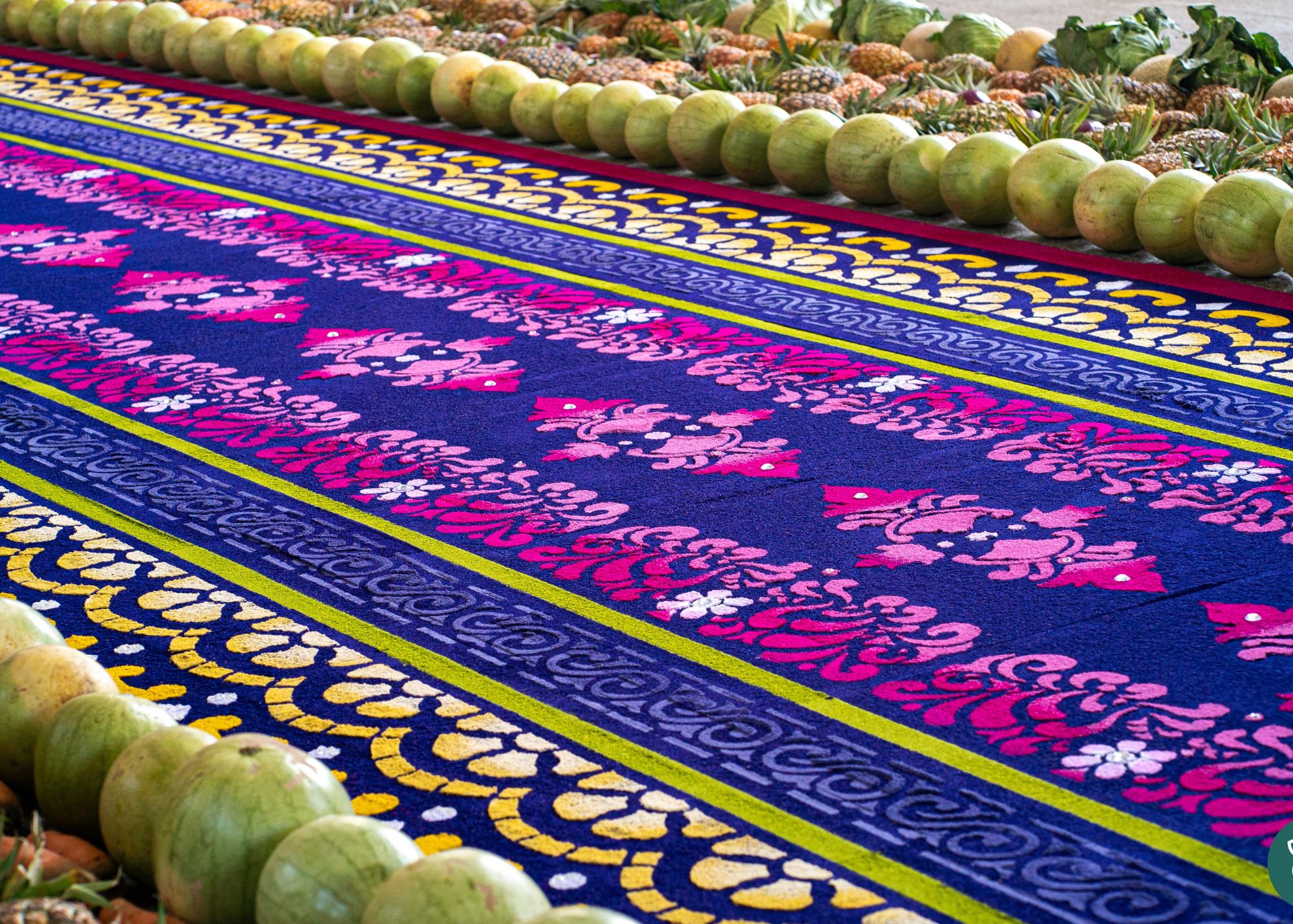
In Antigua Guatemala, the colonial city that is the tradition’s epicenter, the carpets appear every year during Semana Santa — Holy Week. Families begin planning months in advance. The actual construction begins in the early morning hours of Holy Thursday, with neighbors and strangers working together through the night, placing sawdust through stencils, building intricate geometric patterns, religious symbols, and natural imagery in colors that only exist in Guatemala: blues, purples, deep reds, and a particular orange derived from achiote, a dye sourced from a native shrub. Some carpets stretch for an entire city block. Some take 24 hours to complete.
On Good Friday, beginning at 4 a.m., the procession comes through. Thousands of people dressed in black and purple carry enormous wooden floats depicting scenes from the Passion of Christ. They walk directly over the carpets. Within hours of a creation that took days, there is nothing left but colored dust on stone.
<It is kind of sad that it goes by so fast for all the time that you invest in it,” one Antigua resident told a journalist documenting the tradition. “But there’s also a deep satisfaction. We’re celebrating one more year. We made it.” In 2022, UNESCO inscribed Guatemala’s Holy Week celebrations — including the alfombra tradition — on its Representative List of the Intangible Cultural Heritage of Humanity.
From Antigua to Aragon Avenue
Thursday’s demonstration at the Coral Gables Museum is not a recreation or an approximation. It is an act of cultural transmission — artists carrying the practice itself across borders and presenting it intact. The event has been organized by the City of Coral Gables, the Municipalidad de Antigua Guatemala, and the Consulado General de Guatemala in Miami, with the support of the museum. That organizational partnership reflects a formal relationship between the two cities, described by the organizers as a sisterhood — a civic bond between Antigua’s colonial architecture and civic identity and Coral Gables’ own Mediterranean-influenced founding.
Visitors who arrive on Thursday will be able to watch the carpet being built from the ground up and, organizers say, participate in its creation. The materials are the same as those used in Antigua: dyed sawdust, flowers, fruits, seeds, and natural elements. The designs represent religious, natural, and cultural symbols. The scale, within the museum setting, will be smaller than a street-length Antigua carpet — but the process and the intention are the same.
What will not happen here, at least not this time, is the destruction. The completed carpet will remain on exhibition through April 16 — the week after Easter. In Antigua, that survival would be impossible: the procession is the point, and the destruction is the offering. In Coral Gables, the carpet becomes something slightly different: a document as well as a devotion, a thing to be looked at by people who did not make it and may not share its faith but can still understand what it means to build something beautiful and then let it go.

Author: Coral Gables Gazette News Staff
Originally established in 1996 and relaunched as a digital publication in February 2025, the Coral Gables Gazette is an independent local news organization dedicated to factual, objective and accountable community journalism. Our newsroom reports on the people, policies, institutions and events shaping Coral Gables, Florida, providing residents with timely, informative coverage of the issues affecting their community. Our reporting includes City Hall, local government, municipal elections, public spending, real estate development, business, education, arts and culture, and neighborhood affairs throughout the City Beautiful. We follow City Commission decisions, examine public records and report on the businesses, organizations and individuals contributing to Coral Gables. We believe informed residents are essential to a healthy, engaged community. Stories published under the Coral Gables Gazette News Staff byline are prepared or compiled by the publication's editorial team. We strive for accuracy, fairness, transparency and clear distinctions between news reporting, opinion and advertising. Readers are encouraged to submit news tips, corrections, editorial inquiries and story suggestions through our Contact page and learn more about our standards through our Editorial Policy.