
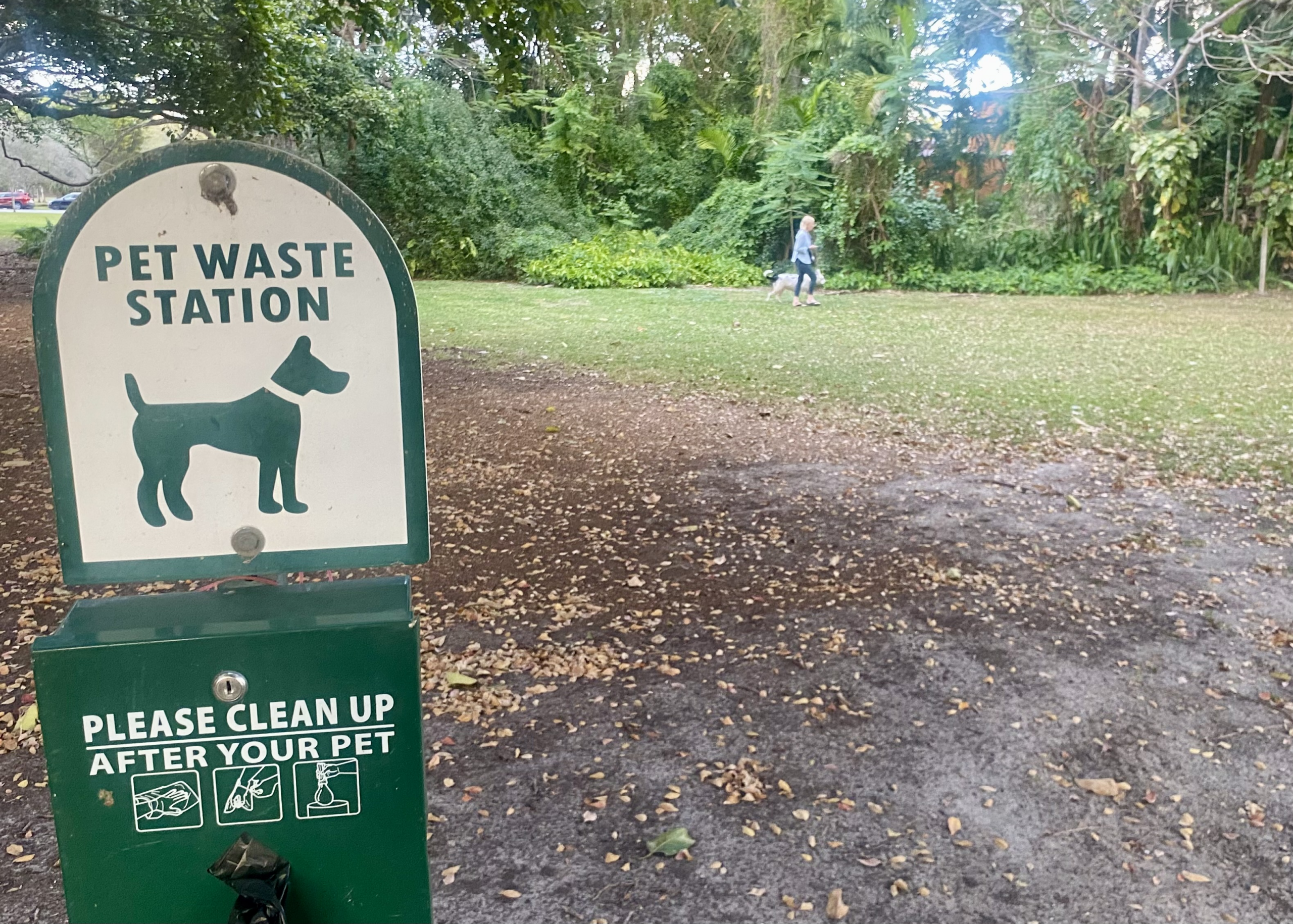
Neighbors fighting a planned dog park at 520 University Drive have taken their case to Florida’s Third District Court of Appeal as the underlying Sunshine Law lawsuit, previously expected to reach trial this year, is now set for September 2027.
A scheduling order signed Aug. 25 sets a two-week jury trial period beginning Sept. 7, 2027, with a calendar call six days earlier. The court also ordered the parties to complete mediation beforehand, with the stated purpose of either resolving the case or narrowing the issues before trial.
The same day, the University Green Neighbors Association and resident Jose Val Cohen filed an appellate brief challenging a July 10 order that denied their request to halt work on the dog park while the lawsuit proceeds.
The appeal argues that the Miami-Dade circuit court wrongly refused to issue a temporary injunction despite testimony that Vice Mayor Rhonda Anderson had told a neighboring resident in 2024 that the project would not move forward without neighborhood support.
The underlying lawsuit, filed in February, contends that the City Commission violated Florida’s Sunshine Law when it voted Nov. 18, 2025, to direct staff to build a standalone off-leash dog park on the city-owned parcel across from the Coral Gables Library. The city has disputed that the vote was unlawful.
The appeal does not ask the Third District to decide the entire Sunshine Law case. Instead, the neighbors are asking the appellate court to review the decision allowing the project to proceed while the lawsuit remains unresolved.
Appeal focuses on Anderson’s 2024 assurance
A central part of the neighbors’ argument involves a conversation about a year before the commission vote.
According to the appellate brief, Anderson visited the Cadima Avenue home of Dr. Sara Cortes in November 2024 and showed her a drawing of the proposed dog park. Cortes, an emergency-room physician whose property borders the city-owned site, objected.
Cortes testified at a July evidentiary hearing that Anderson told her the city would not move forward with the dog park without neighborhood support, according to the brief. The city did not cross-examine Cortes about that testimony.
The brief says Cortes later spoke with residents who had opposed an earlier dog-park proposal on nearby property in 2021 and came to understand that neighborhood support had been required in that instance as well.
The appellants also point to remarks Mayor Vince Lago made during an October 2022 commission meeting. According to the brief, Lago said the city is “thoughtful and careful to respect the neighborhood” before developing city-owned property.
Cortes testified that she did not know about the Nov. 18, 2025, commission item or a petition supporting the dog park until after the vote.
The trial court, however, characterized Anderson’s statements as “generalized” and too remote in time from the November 2025 meeting to support an injunction. The neighbors argue on appeal that the court gave too little weight to that testimony and to the city’s prior outreach practices.
Resolution was added days before the vote
The timing and notice surrounding the Nov. 18 meeting form another major part of the appeal.
According to the brief, the dog-park resolution was added to the commission agenda at 7:44 p.m. Thursday, Nov. 13, following the Veterans Day holiday. It appeared as the 42nd of 42 items on a 13-page agenda.
The appellants say no community meeting was held beforehand, surrounding property owners received no mailed notice and nothing was posted at the University Drive site alerting neighbors that the commission was about to consider the project.
The brief also says the scheduled time for the item was changed from noon to 6 p.m. the day before the meeting and that two commissioners later said they had not received notice of the change.
Dog-park supporters attended the Nov. 18 meeting. One cited a petition containing roughly 220 signatures.
The neighbors argue, however, that the petition did not identify 520 University Drive as the proposed location and that residents living immediately adjacent to or across from the property had neither been asked to sign it nor knew it existed.
Cohen testified that after the commission vote he canvassed the surrounding neighborhood and found that none of the neighbors he contacted had known the item was coming before the commission, according to the appeal. The city did not cross-examine him.
City testimony becomes part of appeal
The neighbors also rely on testimony from city officials at the July injunction hearing.
According to the brief, the city clerk testified that three business days is the city’s internal “drop dead” deadline for adding items to a commission agenda but could not identify a city-code provision establishing that standard.
The appellants also say the clerk acknowledged that an earlier statement he had made on the record about the change in meeting time was incorrect.
The city’s planning and zoning director testified that 520 University Drive does not appear on the city’s official list of parks or in its parks master plan, according to the brief.
An assistant city manager testified that the city’s community-outreach policy applies only to newly acquired property. On cross-examination, however, he acknowledged that Coral Gables had sought neighborhood input when it previously considered putting a dog park at Catalonia Park, another city-owned site, the appellants say.
The circuit court nevertheless denied the temporary injunction.
According to the appeal, the judge concluded that the November resolution was administrative rather than a zoning action and that three business days of notice was reasonable because it conformed to the city’s internal practice.
The neighbors argue those conclusions were legal error. Their brief cites Florida cases they say support longer notice for regular municipal meetings and contends that the court did not adequately consider whether residents received a meaningful opportunity to participate before the commission acted.
City says later hearing cured any defect
Coral Gables has previously defended the November vote as an administrative action that did not require the notice associated with a zoning proceeding.
In seeking dismissal of the underlying lawsuit in April, the city also argued that the meeting was properly noticed under its regular procedures and that any procedural defect was cured when commissioners held another public hearing in January on an attempt to rescind the dog-park resolution.
The appellants reject that argument.
Their brief contends that the January proceeding did not provide a meaningful opportunity to reconsider whether a dog park should be built at 520 University Drive because the commission majority declined to rescind the earlier decision and discussion instead focused largely on details of the park’s design.
The new trial schedule means that, absent a settlement or another change in the court calendar, the underlying Sunshine Law case could remain unresolved for roughly another year.
Under the Aug. 25 order, mediation must be completed before the Sept. 1, 2027, calendar call. The order describes mediation as intended to “resolve the case or narrow the issues.”
A second legal challenge and another possible site
The appeal is separate from another challenge involving the University Drive property.
Last month, the same law firm representing the neighbors filed a petition asking the Third District to quash an ordinance that removed longstanding parking-only zoning restrictions from 520 University Drive, a case the Gazette previously reported.
At the same time, the future of the University Drive dog park itself has become less certain.
City staff told commissioners Aug. 25 that it is studying the feasibility of placing the dog park instead in a portion of the War Memorial Youth Center parking lot. The disclosure came after months of public debate over the University Drive proposal and a city-run public-input process that found more respondents supporting the park than opposing it.
Staff said it expected to return with more information after examining the alternative location.
That leaves two tracks moving at once: neighbors continue to challenge the process that produced the University Drive approval, while Coral Gables is studying whether the dog park should ultimately be built somewhere else.
The City of Coral Gables, represented in the appeal by Holland & Knight, had not filed its response to the Aug. 25 appellate brief as of publication.

Author: Coral Gables Gazette News Staff
Originally established in 1996 and relaunched as a digital publication in February 2025, the Coral Gables Gazette is an independent local news organization dedicated to factual, objective and accountable community journalism. Our newsroom reports on the people, policies, institutions and events shaping Coral Gables, Florida, providing residents with timely, informative coverage of the issues affecting their community. Our reporting includes City Hall, local government, municipal elections, public spending, real estate development, business, education, arts and culture, and neighborhood affairs throughout the City Beautiful. We follow City Commission decisions, examine public records and report on the businesses, organizations and individuals contributing to Coral Gables. We believe informed residents are essential to a healthy, engaged community. Stories published under the Coral Gables Gazette News Staff byline are prepared or compiled by the publication's editorial team. We strive for accuracy, fairness, transparency and clear distinctions between news reporting, opinion and advertising. Readers are encouraged to submit news tips, corrections, editorial inquiries and story suggestions through our Contact page and learn more about our standards through our Editorial Policy.










NIMBY – famous acronym learned when living in Maryland 26 years ago. I lived in a rural area, and the issues were about erecting Cell Towers. People with land would welcome it as they would make income from leasing a small patch, while neighbors did not like the eye-sore metal towers.
We needed the towers for better cell phone reception, but no one want it them in their backyard.
Same thing with this park. People want dogs parks, I for one wish there would be one closer to where I live. It it seems that no one, even ones with dogs want it near their homes. Traffic is probably one of the reasons, the other one, maintenance and the smell. I have been to one in Coconut Grove, and will never return. Dog woners don’t clean up, they expect the city to do so. Meantine, you have feces all over, some from days past.
I really don’t have an answer for the current debacle, but it seems that there should always be several sites to be recommended and then get the notifications out to the neigborhood.
But what I see instead in many of the Coral Gables debacles, is that the commissioners seems to always shoot from the hip and hope they hit the target. More often than not, they miss.
Commisioners, do the right thing and don’t get caught up in your egos. You work for us and maybe soon, some of you will not.
Promises and assurances given by some of our commissioners to the residents don’t mean a thing. “No dog park at 520 University if the adjacent property owners don’t want it” was swept under the rug. Anderson and Lago backed out of those promises, and Lara followed their lead.
Does anyone’s word mean anything any more?