By Coral Gables Gazette staff
The name Poiesis comes from the ancient Greek word meaning to make, and the ensemble that carries it has spent the past year making noise in the chamber music world. Fresh from winning the 2025 Banff International String Quartet Competition and the 2026 Cleveland Quartet Award from Chamber Music America, the quartet arrives in Coral Gables for one of the most anticipated evenings of this year’s Mainly Mozart Festival.
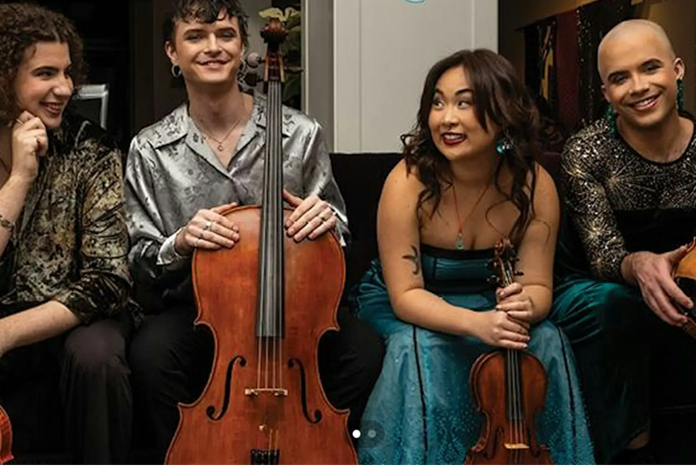
The Miami Chamber Music Society presents Poiesis Quartet on Friday, June 12, at 7:30 p.m. at Newman Recital Hall, 5513 San Amaro Drive. The ensemble features violinists Sarah Ying Ma and Max Ball, violist Jasper de Boor and cellist Drew Dansby.
A quartet shaped by living composers
The evening is structured as a genuine two-movement argument, not a warm-up followed by a centerpiece, but a program in which the first half earns the second and the second gives the first its stakes.
Poiesis opens with four works by living composers, each conceived as a kind of letter with its own atmosphere and emotional register. Daniel Lasaga’s Circus of the Mind and Max Lang’s Commonplace Little Perils bracket Maya Irizarry Lambright’s Forest of Taldeni and Calvin Ray Shawler’s Order, a sequence that reflects the ensemble’s identity as creators, collaborators and active champions of new music.
For a quartet that studied at the University of Cincinnati’s College-Conservatory of Music under the Ariel Quartet, that commitment to contemporary voices is not incidental. It is the core of what Poiesis does.
Brahms after intermission
After intermission, the temperature changes. Pianist Marina Radiushina joins the quartet for Brahms’s Piano Quintet in F minor, Op. 34, one of the most turbulent and searching works in the chamber repertoire.
Brahms did not arrive at Op. 34 easily. The work began in 1862 as a string quintet, a version he later destroyed, and was then recast as a sonata for two pianos. Clara Schumann admired the music but urged Brahms to rethink the two-piano version, believing its scale demanded a broader instrumental treatment. Brahms remodeled it again, combining the string sonorities of the original with the force of the piano to produce the final quintet, published in 1865.
The result is a work that rewards the patience and risk tolerance of two self-sufficient forces — piano and string quartet — that must find a way to speak in a single voice without either overwhelming the other.
In the best performances, the quintet can feel like a symphony compressed into five players: a first movement of restless forward momentum, a slow movement of unusual stillness, a Scherzo of almost orchestral breadth and a finale that moves through Brahms’s full emotional vocabulary before closing with an urgency that feels earned rather than imposed.
A pianist with local authority
Radiushina brings particular authority to this music. The Ukrainian-American pianist co-founded the Miami Chamber Music Society and has served as its artistic director since 2013. Her career has included appearances at Carnegie Hall, the Salzburg and Rotterdam festivals and the Mariinsky Theatre under Valery Gergiev.
That background suits the Brahms quintet, a work that punishes pianists who treat it as a showpiece and rewards those who listen as hard as they play. The piano part has power, but not permission to dominate. Its force matters most when it becomes part of the larger argument among the five musicians.
A meeting of old and new
The pairing of Poiesis with Radiushina is a thoughtful one. A quartet that has built its reputation on new music — commissioning, collaborating with and performing works by living composers — may bring a different kind of attention to Brahms than an ensemble formed entirely in the standard repertoire.
That background invites listeners to hear Op. 34 not as a monument, but as the work of a composer still searching for the right form. Brahms tried one version, destroyed it, tried another and then remade the piece again. The final quintet carries the force of that process. It is old music that still sounds like an act of invention.
For a festival built around chamber music’s intimacy and range, the program offers a clear proposition: new voices and canonical works do not have to sit in separate rooms. In the right hands, they can clarify one another.