
By Coral Gables Gazette staff
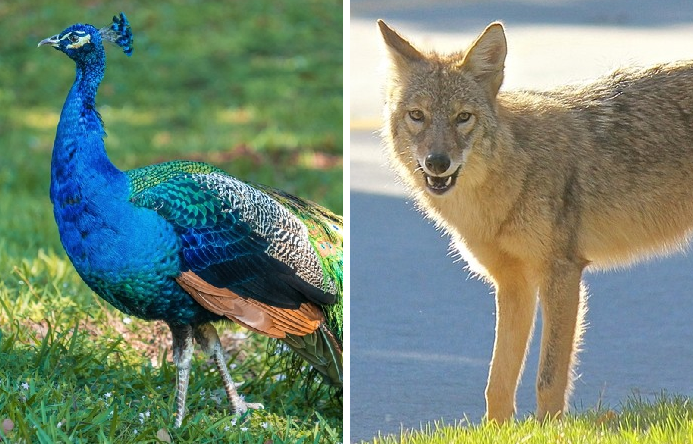
After spending more than $25,000 and removing 141 peafowl, Coral Gables is escalating the issue beyond City Hall — voting April 14 to push Miami-Dade County, all 34 of its municipalities and state officials to act.
The City Commission approved two resolutions unanimously. The first, that Mayor Vince Lago sponsored, urges Miami-Dade County to reexamine its approach to peafowl mitigation. The second, proposed by Commissioner Ariel Fernandez immediately after the first vote, formally added peafowl mitigation to the city’s official legislative priorities in Tallahassee — elevating it from a local policy matter to a formal lobbying position before the state.
Both resolutions passed 5-0.
City seeks broader response
The resolution directs staff to transmit the city’s request to all 34 municipalities in Miami-Dade County, the Miami-Dade League of Cities, state legislators, state senators, and the governor’s office.
Mayor Lago said the goal is to build consensus among local governments to address the issue across jurisdictional boundaries — because a city acting alone cannot solve a problem that migrates freely across municipal lines.
“We’re trying to build a coalition here,” Lago said. “They (the peafowl) are everywhere. We cannot handle the issue for other communities. We need to work with other cities and work in conjunction.”
He pointed to a specific geographic challenge: when neighboring municipalities do not manage their own peafowl populations, the birds move into Coral Gables through corridors such as LeJeune Road. “If our neighboring communities like the City of Miami do not address this, they just travel through LeJeune and come into the south side of the city,” the mayor said. “We’re having a major issue.”
Costs, removals, and contracting
City Manager Peter Iglesias confirmed that the city has removed 141 birds and spent more than $25,000 under its existing mitigation efforts — figures that had not previously been reported publicly.
The city is also moving forward with a formal contract for humane nuisance pest removal and relocation. Bids for the contract closed December 23, 2025, and staff are currently reviewing submissions. Once awarded, the contract will govern the capture, transport, and relocation of peafowl, as well as chickens and roosters, from public rights-of-way and city-owned property.
The work stems from the city’s Peafowl Mitigation Policy adopted in 2022, which followed a Miami-Dade County ordinance allowing municipalities to opt out of earlier protections that had prevented local removal efforts.
Commissioners cite impacts across neighborhoods
Commissioners described a range of impacts during the April 14 discussion — birds appearing on rooftops, blocking streets, and behaving aggressively toward pets and residents.
Lago said residents have reported sleep disruptions from early morning noise, property damage, and sanitation concerns. Vice Mayor Rhonda Anderson said the birds are also affecting local ecosystems. “A 40-pound bird can wipe out a lot more butterflies and a lot more little worms that are making very endangered butterflies than our native mockingbirds, cardinals, and woodpeckers,” she said.
Fernandez said the birds are appearing in areas where they had not previously been common, including parts of Little Gables, which he passed through on his way to the meeting. He also referenced a notable shift in perspective from a former county official who originally sponsored peafowl protections and has since described that position as the biggest mistake of her political career.
Commissioner Melissa Castro described a recurring presence of approximately 15 peafowl near her home — on the roof, in the front yard, and in the street — and said the birds have attacked her Yorkie during walks. “I think we need to do something about them but in a very humane way,” she said.
Lago acknowledged the political sensitivity of the issue following the vote. “Prepare to receive a lot of hate mail,” he told colleagues. “But we’ve got to do something.”
Separate concern: Coyote sightings
Commissioners also raised concerns about a separate and escalating wildlife issue: coyote sightings in the North Gables area east of Granada Boulevard, which Fernandez said have increased significantly over the past three to four months. Residents have expressed concerns about children playing outdoors.
Commissioner Richard Lara cited guidance from the Florida Fish and Wildlife Conservation Commission (FWC) recommending hazing techniques — motion-activated sprinklers, audible alarms, and assertive human behavior — as more effective and humane than removal. He noted that removing coyotes from an area typically results in other animals moving in to fill the territory.
Anderson said coyotes have been observed at Matheson Hammock Park and at a Girl Scout camp and noted reports of small dogs being taken during walks in other areas. She directed the city manager to investigate and report back. “We’re not used to this here,” she said.
Iglesias confirmed that coyotes are considered vermin under state law and can be hunted year-round with a standard hunting license — but acknowledged that hunting is not a practical option in an urban setting. He said the city is currently evaluating licensed trappers who may be able to assist.
The Gazette reported in February 2026 that coyotes are now established in all 67 Florida counties and that the city had begun coordinating with the FWC on the issue. Tuesday’s commission discussion reflects a more urgent tone, with Fernandez describing the North Gables sightings as requiring formal city response rather than monitoring alone.
What comes next
On peafowl, the city will transmit its resolution to county and state officials and continue the procurement process for a removal contract. The addition of the issue to the city’s legislative priorities means it will now be part of Coral Gables’ formal advocacy efforts in Tallahassee.
On coyotes, the city manager will investigate potential trapping options and report back to the commission. Residents who observe coyotes or concerning behavior are encouraged to contact the FWC at 561-625-5122.

Author: Coral Gables Gazette News Staff
Originally established in 1996 and relaunched as a digital publication in February 2025, the Coral Gables Gazette is an independent local news organization dedicated to factual, objective and accountable community journalism. Our newsroom reports on the people, policies, institutions and events shaping Coral Gables, Florida, providing residents with timely, informative coverage of the issues affecting their community. Our reporting includes City Hall, local government, municipal elections, public spending, real estate development, business, education, arts and culture, and neighborhood affairs throughout the City Beautiful. We follow City Commission decisions, examine public records and report on the businesses, organizations and individuals contributing to Coral Gables. We believe informed residents are essential to a healthy, engaged community. Stories published under the Coral Gables Gazette News Staff byline are prepared or compiled by the publication's editorial team. We strive for accuracy, fairness, transparency and clear distinctions between news reporting, opinion and advertising. Readers are encouraged to submit news tips, corrections, editorial inquiries and story suggestions through our Contact page and learn more about our standards through our Editorial Policy.












Not sure if the coyotes out in So Cal are the same species as the ones we have here, but as someone who spends time in BOTH areas, I can tell you that coyotes are way more aggressive than foxes. Two years ago, in North County San Diego, I had a coyote coming up behind me on a major street, as I was walking my Corgi. Had a driver not leaned on his car horn (something that isn’t typically done, over there, so it stood out), I would not have looked and that coyote would have probably at least made an attempt to grab my dog.
I’m all in favor or sharing our natural habitats with wild animals, but everyone should be aware that we do have coyotes in the area. There are many documented encounters between them and people in So Cal, something that will no doubt increasingly happen here. They do not hesitate to prey on small pets.
We frequently see multiple peacocks in our neighborhood in South Gables. The discussion above is a helpful first step. Beyond the measures outlined by the city, what additional actions can residents take?
Peacocks, fox and coyotes have lived in Coral Gables since inception of our city and they are important part of the ecosystem. My suggestion to all complaining is to MOVE!
Wow, what a nice neighborhood!
Sick and Tired of the peacocks. $4,000 having to fix my roof 3 different times because those pests broke the tiles.
The city needs to get a handle on this problem. What can I do to stop these pests from destroying my property.
Squirrels and birds chirping are not seen and heard on yard. Now all you can hear is that disgusting sound from
those pests. Most of the time there are 10- 15 peacocks at a time in my property and the sidewalk.
PLEASE DO SOMETHING !!!!!!
What a waste of our tax dollars! Any animal removed from an area is replaced by the same or others in several months, unless all of South Florida eradicates every single one of them. Even then there are no guarantees. Just sit in your backyard at night and watch all the rats go by along with the raccoons and opossums. I bet most of you have not done that. None of them mean any harm to humans. They don’t attack, unless they are attacked or threatened by us. They mind there own business. We are the ones that have invaded their territory. Where there is plenty of vegetation like we have, there is going to be plenty of different animals. That’s nature. Move to an area where they are no plants or trees.