By Coral Gables Gazette staff
In 1987, on the Hawaiian island of Kauaʻi, a researcher named David Boynton made a sound recording in the Alakaʻi Wilderness Preserve. What he captured was the last known vocalization of the Kauaʻi ʻōʻō — the Moho braccatus — a small Hawaiian honeyeater with black feathers, yellow legs, and a song built for two. By that point the last female of the species had been gone for five years, likely killed by Hurricane Iwa in 1982. The male did not know this. His haunting final song was a call searching for a mate that would never come. The species was declared extinct by the IUCN in 2000.
The story has been widely shared in recent years. Its power lies in its specificity — a single voice, in a forest, repeating a call that no longer has an answer.
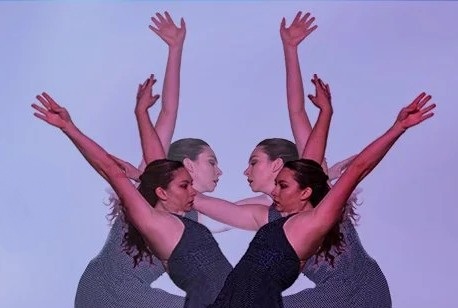
That recording — a duet sung into silence — is the subject of Hannah Baumgarten’s newest work, Love-less, last dance of the Moho braccatus, which receives its sneak preview on Friday, April 24, at 8 p.m. at the Sanctuary of the Arts, 410 Andalusia Avenue, as part of Dance NOW! Miami’s celebration of the venue’s fourth anniversary. Tickets are $18 to $28.
The work and its subject
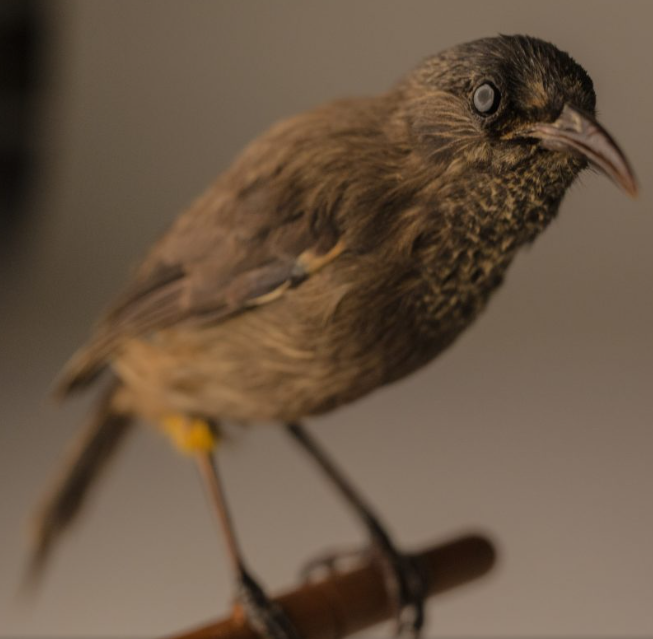
The Moho braccatus was the last of its family. Its extinction marked the first extinction of an entire avian family in over 500 years. The bird had survived for 15 to 20 million years, through the Miocene epoch and into the modern era, before rats, pigs, mosquito-borne avian malaria, and two hurricanes ended it. What remains is the 1987 recording — a male singing the call-and-response pattern his species evolved over millions of years, pausing in the places where a female voice should answer, and hearing only the forest.
Baumgarten’s work takes that story — loss, longing, the persistence of a biological drive toward connection in the absence of the one who could receive it — and renders it through contemporary dance. The title is exact: Love-less not as an absence of love’s capacity, but as love with nowhere to land. The last dance of a creature that continued after its purpose had vanished.
The work is in development and Friday’s performance is a sneak preview — an invitation to watch the creative process at an early stage and participate in a talk-back with the full creative team. Composer Federico Bonacossa, set designer Bruce F. Brown, and costume designers Haydee and Maria Morales will join Baumgarten after the performance for an open conversation about choreography, collaboration, and the creative process. That conversation is part of the evening’s design rather than an afterthought — Dance NOW! has made the exploration of process as much a part of its public identity as the work itself.
The company and the occasion
Dance NOW! Miami was founded in 2000 by Baumgarten and co-artistic director Diego Salterini, who arrived in Miami from different continents and built what the Miami New Times named the city’s best dance company in 2022. The company is in residence at three South Florida venues — the Little Haiti Cultural Complex, the Miami Beach Bandshell, and the Sanctuary of the Arts — and has performed in 16 states and on three continents. Its collaborators include the Limón Dance Company, Mexico City Ballet, and Opus Ballet of Florence, Italy.
Critics have described the company’s work as possessing “unabashed beauty” and “enough original vision here to make Dance NOW! worth watching more than ever.” Its choreography has been called “carnal and courageous, with an impressive range of movement and motion” and “not only elegant and fierce, but dedicated to its community.”
Friday’s performance also marks the fourth anniversary of the Sanctuary of the Arts, the Coral Gables performance and event space that has become one of the city’s most active cultural venues since opening in 2022. The evening combines anniversary celebration, world premiere preview, and creative conversation — a format that reflects both the company’s commitment to transparency about the artistic process and the Sanctuary’s identity as a space where art and community encounter each other without the usual distance between stage and audience.
The program will also include audience favorites from Dance NOW!’s 26th season.
Why this work, now
The Kauaʻi ʻōʻō’s story has circulated widely in recent years — the 1987 recording is one of the most shared natural history audio clips online — precisely because it makes extinction feel like something other than an abstraction. It is a male bird in a forest, singing a song that requires a response, waiting, and singing again.
What Baumgarten is building is a work about persistence — the way living things continue to reach for connection even when connection is no longer possible. Friday’s preview offers a first look at how that idea takes form in the body.