
By Coral Gables Gazette staff
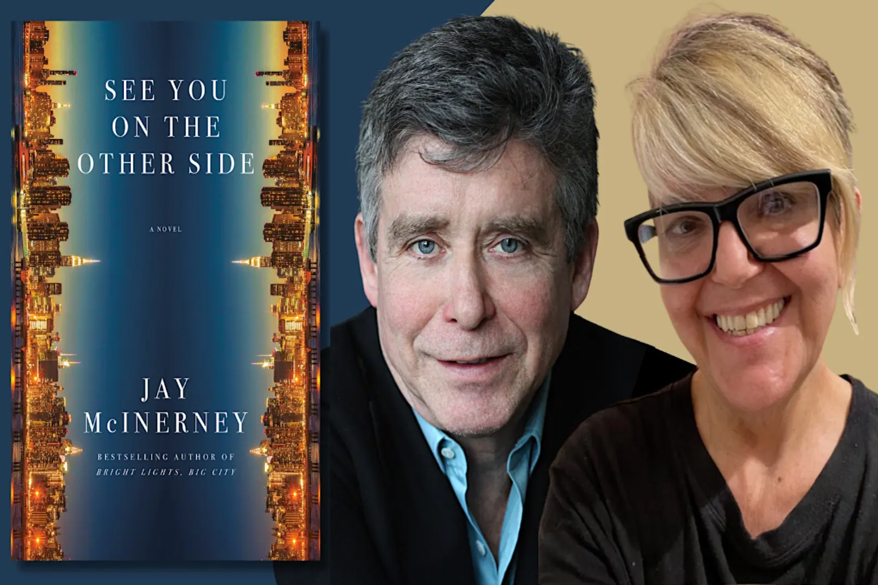
In the last days of March 2020, as New York shut down and the shape of what was coming became clear, Jay McInerney walked past a coffee shop and saw a handwritten sign taped inside its window. It read: “See You On The Other Side” — the assumption that it would soon pass. McInerney took the phrase. He had a novel to write.
See You On The Other Side — published by Knopf and priced at $30 — is the fourth and final volume in the series that began with Brightness Falls in 1992, continued through 9/11 in The Good Life (2006), navigated the Great Recession in Bright, Precious Days (2016), and now arrives at the pandemic that closed the world in the spring of 2020. McInerney will discuss the book in conversation with Cristina Favretto on Thursday, April 23, at 7 p.m. at Books & Books Coral Gables. The event is free and open to the public. Books will be available for purchase the night of the event. Seating is not guaranteed.
The book and the series
Russell and Corrine Calloway have been McInerney’s central characters for 34 years. They met as young idealists in the New York publishing world of the late 1980s — a world McInerney knew intimately and rendered with the social precision that earned Brightness Falls comparisons to Fitzgerald and Thackeray. The novel followed them through the 1987 stock market crash, the AIDS crisis, and the first tremors of a generation beginning to suspect that the party had an ending.
The Good Life placed them in the ruins of September 11, 2001 — McInerney himself watched the towers fall from his apartment window in Chelsea, and worked as a volunteer at a soup kitchen near Ground Zero in the weeks that followed. Bright, Precious Days found the Calloways in the financial crisis, their marriage weathered but intact, navigating a city that had changed around them.
Now, in their sixties, they arrive at the pandemic. See You On The Other Side begins at the start of the pandemic, with the Calloways attending the celebration of a friend’s 35th wedding anniversary at the Odeon in the spring of 2020 — a dinner party at the precise moment when dinner parties were becoming impossible. What follows is a reckoning with mortality, connection, and the accumulated weight of a long marriage tested by circumstances no one anticipated.
The Los Angeles Times called it “brilliantly sharp” in its observations on social strata and human nature. Booklist, in a starred review, described it as “an exquisite meditation on mortality, resilience, and cultural obsolescence” and “a literary event that will galvanize readers.” Kirkus called it “fun” even at its darkest — a McInerney signature.
The author and his place in American letters
McInerney’s debut, Bright Lights, Big City, was published in 1984 and cited by Time magazine as one of the nine generation-defining novels of the 20th century. Written in the second person — an audacious formal choice that became the novel’s most discussed feature — it captured a young man’s dissolution in early 1980s New York with a precision that made McInerney one of the defining voices of his generation. He wrote the screenplay for the 1988 film adaptation himself.
In the decades that followed, he built a parallel identity as one of America’s most knowledgeable wine writers, producing three essay collections and a long-running wine column — most recently for Town & Country — while continuing to publish fiction. He received the M.F.K. Fisher Distinguished Writing Award from the James Beard Foundation in 2006.
The Calloway series has been the spine of his fiction career: a multigenerational portrait of a marriage set against the defining crises of American life over four decades. That the series concludes with Covid — the crisis that arrived just as McInerney was, by his own account, developing a stronger sense of his own mortality — gives the final volume a weight that goes beyond its plot. He wrote the novel during the lockdowns, in the particular stillness of a moment that had removed the social world he had spent his career observing.
The conversation and the venue
Favretto brings a literary perspective shaped by her own engagement with the intersection of fiction and cultural history. Books & Books, where the event is held, has been Coral Gables’ literary home since Mitchell Kaplan opened the first location on Aragon Avenue in 1982 — the same year McInerney was beginning the work that would become Bright Lights, Big City. The store has hosted more than 10,000 authors over four decades and remains one of the most active independent bookstores in the country, presenting more than 400 events per year.
For readers who have followed the Calloways for more than three decades, Thursday marks an ending. For others, it offers a rare entry point: a writer reflecting on the completion of a work that has tracked American life across four decades.

Author: Coral Gables Gazette News Staff
Originally established in 1996 and relaunched as a digital publication in February 2025, the Coral Gables Gazette is an independent local news organization dedicated to factual, objective and accountable community journalism. Our newsroom reports on the people, policies, institutions and events shaping Coral Gables, Florida, providing residents with timely, informative coverage of the issues affecting their community. Our reporting includes City Hall, local government, municipal elections, public spending, real estate development, business, education, arts and culture, and neighborhood affairs throughout the City Beautiful. We follow City Commission decisions, examine public records and report on the businesses, organizations and individuals contributing to Coral Gables. We believe informed residents are essential to a healthy, engaged community. Stories published under the Coral Gables Gazette News Staff byline are prepared or compiled by the publication's editorial team. We strive for accuracy, fairness, transparency and clear distinctions between news reporting, opinion and advertising. Readers are encouraged to submit news tips, corrections, editorial inquiries and story suggestions through our Contact page and learn more about our standards through our Editorial Policy.










slot365 win không bán hoặc chia sẻ dữ liệu người dùng cho bên thứ ba. Mọi thông tin cá nhân chỉ được dùng để xác minh giao dịch và cải thiện trải nghiệm dịch vụ. TONY05-15
Sau vài ngày trải nghiệm nhà cái xn88 , tôi cảm thấy giao diện được thiết kế khá trực quan và dễ sử dụng. TONY07-08