
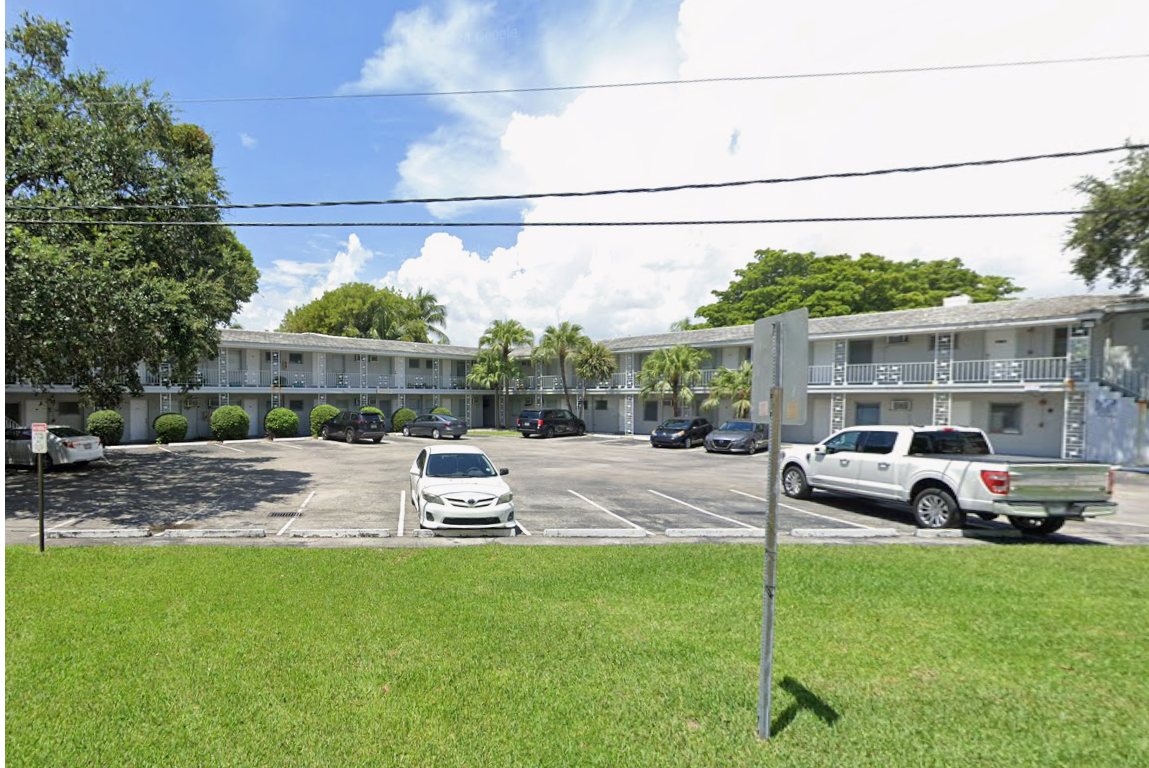
By Coral Gables Gazette staff
CORRECTED 4.6.26
A property on Caballero Boulevard where a developer has proposed two residential towers is at the center of Tuesday’s Sunshine Neighborhood Meeting on the University Station Rapid Transit Overlay District — and signals how Coral Gables’ effort to retain planning control near the University Metrorail Station is entering a new phase.
The City of Coral Gables will host the meeting on Tuesday, April 7, from 6 to 8 p.m. at the new Firehouse 4, 1345 Sunset Drive. The proposed amendments include adding 6100 Caballero Boulevard to the overlay district and revising multi-family development regulations within the station area to promote more consistent standards. The five South Dixie Highway properties already within the overlay — 1150, 1190, 1250, 1320, and 1350 South Dixie Highway — are not new to the discussion. The Caballero parcel, across the street from the city’s Jaycee Park, is.
A new parcel at the center of the debate
A proposed project for 6100 Caballero Boulevard — known informally as “The Gables Waterway” — envisions two mid-rise residential towers, nine and 13 stories, with 251 condominium units and approximately 515,000 square feet of development, including ground-floor retail and a public waterfront park. The project was first proposed in 2023 and has been the subject of ongoing discussions among the developer, county officials, and city planners.
Why the Caballero site matters
The Caballero parcel sits at the edge of Miami-Dade County’s quarter-mile radius from the University Metrorail Station entrance — the boundary that determines jurisdiction under the county’s Rapid Transit Zone framework. Planning and Zoning Board discussions in December 2025 confirmed that the radius reaches Caballero Boulevard but does not extend across the canal into adjacent single-family neighborhoods.
Including 6100 Caballero Boulevard in the city’s overlay district would place the proposed development under Coral Gables’ review process rather than the county’s, allowing the city to apply its own standards for design, height, setbacks and fees.
The addition also extends the overlay’s footprint. The original district forms a linear strip along South Dixie Highway. Caballero Boulevard runs perpendicular to U.S. 1, bringing the framework closer to established residential areas.
How the overlay came to be
The University Station Rapid Transit Overlay District did not emerge after the county acted. It developed in parallel with — and in anticipation of — Miami-Dade County’s move to extend its Rapid Transit Zone program to the University Metrorail Station corridor.
The RTZ framework gives the county authority over development within a quarter-mile of Metrorail stations, allowing projects to proceed under county rules and bypassing local zoning. Permit and impact fee revenues flow to the county rather than the municipality. The implications of that framework were already visible in Coral Gables’ backyard: a 38-story residential tower had risen near the Douglas Road Metrorail Station in 2023 without the city’s involvement — the tallest building outside of Brickell and visible from the Biltmore Golf Course.
With the county signaling its intention to create a University Station sub-zone, Coral Gables moved first. On July 2, 2025, the city’s Planning and Zoning Board voted 5–1 to recommend the University Station Rapid Transit District Overlay — a local framework designed to give developers an alternative approval path through the city rather than the county. Two months later, on September 3, the Miami-Dade County Commission formally approved the Coral Gables/University Station Sub-Zone of the RTZ program, confirming the county’s jurisdiction over the corridor and making the city’s overlay more urgent.
“Our goal is to support smart growth near transit while safeguarding the character and quality of life that make Coral Gables unique,” City Manager Peter Iglesias said when the overlay was first proposed.
City response to county control
The overlay represents Coral Gables’ negotiated alternative to the county framework rather than a direct challenge to it. The city has limited legal authority to block the RTZ outright. Its approach instead creates conditions that make local approval attractive to developers — and preserves the city’s ability to shape what gets built.
Projects reviewed under the city’s overlay remain subject to Mediterranean design standards, Board of Architects review and the city’s Transfer of Development Rights program, which links new development along the transit corridor to historic preservation incentives elsewhere in Coral Gables.
The City Commission approved the overlay on first reading in October 2025. In December, the Planning and Zoning Board advanced related Comprehensive Plan amendments establishing a maximum floor-area ratio of 3.5 and allowing building heights up to 120 feet — or 147 feet if a developer provides public open space. Commissioner Melissa Castro voted against the overlay ordinance, citing concerns about the pace of decision-making and the level of public input.
Divided public reaction
Public response to the overlay has reflected broader debates over growth and development in Coral Gables.
Supporters, including some Planning and Zoning Board members, have argued that maintaining some local control is preferable to ceding authority entirely to the county and to state laws such as the Live Local Act, which limits municipal ability to restrict certain housing developments.
Opponents have raised concerns about traffic, building height, and the pace of change along U.S. 1. Sue Kawalerski, the sole dissenting vote on the Planning and Zoning Board at the July 2 hearing, questioned both the overlay’s scale and whether the board had meaningful authority over the outcome. “Are we doing this to feel good, or are we doing this because we think we’re actually going to have input?” she asked. Kawalerski was subsequently removed from the board by a 3–1 commission vote on August 26, 2025 — a rare action that drew sharp criticism from residents and came weeks after a confrontation with Miami-Dade County Commissioner Raquel Regalado at the same July meeting over rapid-transit zoning.
What happens next
Tuesday’s Sunshine Neighborhood Meeting is a required public input step — but the timeline is more compressed than the standard amendment process might suggest. A public notice issued by the City Clerk since this article was first published shows the Coral Gables City Commission has scheduled a vote on the overlay amendments for its Regular Meeting on Tuesday, April 14 — one week after Tuesday’s Sunshine meeting. The April 14 agenda also includes site plan approval for The Mark, a 393-unit mixed-use development at 1250 South Dixie Highway that has been in the city’s review process since 2023, and zoning reclassifications for multiple parcels in the Singer Subdivision and Riviera Waterways Section that go beyond the Caballero addition.
Residents who plan to comment on the proposed amendments should do so Tuesday night at Firehouse 4 or in writing before the April 14 commission meeting.
Attendance is limited, and residents are asked to RSVP by emailing planning@coralgables.com. The meeting will also be available via Zoom and by phone at 305-461-6769 (Meeting ID: 305 446 6800).

This Post Has 2 Comments
You have got to be kidding me. More construction? Have you driven US1? It is a parking lot. Our roads cannot handle more congestion and people. The incorrect thinking is that people will take the Metrorail. It does not go to the Beach, West Miami, around town. This is total lunacy to think we can handle more people. God forbid we should have to evacuate Miami. It will not be accomplished. It is build, build, build with no roads or infrastructure increase. We are losing our quality of life. NO MORE BUILDING.
Just like Orlando Capote, no one’s safe in the city not-so-beautiful-after-all.
Don’t get in their way…they’ll bury you.
“I like to hold it as tight as I can.
I like to think of Coral Gables as an oasis in the desert, because we don’t allow a lot of things in the ‘Gables that are allowed in the county.”
“People save for years to be able to afford and buy a house in the Gables.
They want to live here for the quality of life.
~Margaret Pass
“The residents here have a very special quality of life that they enjoy.
That quality of life needs to be preserved, protected and nurtured.”
~Pat Salerno
“Coral Gables must remain the standard to which other communities aspire.
We don’t have a lot of flaring, glaring neons in the Gables.
When you drive into Coral Gables, there’s a physical ambience that you notice immediately, and that’s the result of…good code enforcement.”
~Paul Furman
“As part of an ongoing effort to enhance the health, safety and welfare of the citizens of Coral Gables.
Coral Gables is able to maintain it’s title “the city beautiful” with the help of it’s residents.
We appreciate your…cooperation.”
What a dumpster-load.