
By Coral Gables Gazette staff
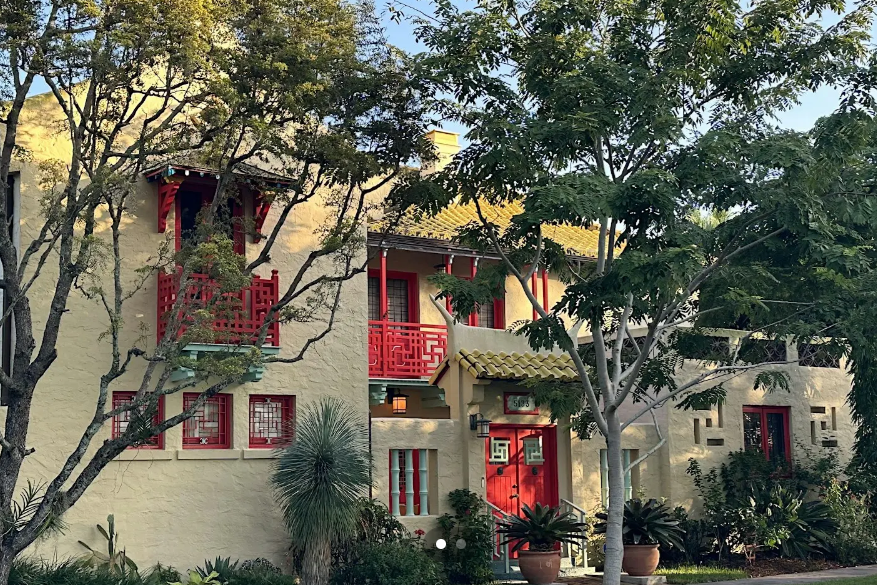
If you have driven along Riviera Drive slowly enough to notice, you have seen them: curved ceramic roof tiles, latticed balconies, moon-shaped doorways, and the unmistakable up-curving rooflines of classical Chinese architecture, tucked behind a low stucco wall in one of Coral Gables’ quietest streets. They are among the most photographed houses in the city. Most people who pass them have no idea what they are or how they came to be there.
This is the Chinese Village — eight homes built between 1926 and 1927 as a unified compound, commissioned by George Merrick and designed by Yale architect Henry Killam Murphy. It turns 100 this year. On Sunday, May 3, from 3 to 5 p.m., a private residence within the compound opens its doors for one afternoon — and the scholar who has spent years producing the definitive scholarly account of the village will be there to explain what you are looking at.
The Historic Preservation Association of Coral Gables will host its annual Champagne Soirée fundraiser at the private home, located at 5133 Riviera Drive, celebrating both the village’s centennial and the organization’s own 35th anniversary. Tickets are limited to 20 guests. Smart casual attire.
The architect and the moment
Henry Killam Murphy was not an obvious choice to design a Chinese compound in Florida. He was a Yale-trained New Haven architect who had spent the previous decade and a half in China, designing educational campuses and institutional buildings for universities, missionary colleges, and eventually the government of the Republic of China itself. By 1928 he was appointed architectural advisor to the National Government of the Republic of China, and by 1929 he was architect for city planning of Nanjing.
That China work was the point. During his years in China, Murphy developed what he termed Adaptive Architecture — a harmony of traditional Chinese style with modern architectural methods, materials, and building use. He had spent years studying the formal principles of classical Chinese design — the proportions, the rooflines, the spatial logic of the compound — and developing a method for translating those principles into contemporary construction. When George Merrick was assembling the themed international villages that would distinguish Coral Gables from every other Florida development of the 1920s, Murphy was the only American architect who had actually lived in China and built there at scale.
The result along Riviera Drive is, by any measure, remarkable. The complex features moon-doorways, lattice features, faux bamboo inserts, and up-curving roof lines, with a common wall connecting the homes creating a sense of communal living. The eight homes are joined by shared walls in the arrangement of a traditional Chinese compound — a spatial organization that has no parallel anywhere else in South Florida and almost none in the continental United States. Only eight of the originally planned homes were completed before the real-estate collapse and hurricanes of the 1920s ended the building boom. That they have survived intact for a century, in a city that has not always been gentle with its architectural heritage, is something close to a civic miracle.
The scholar
Leading the afternoon’s tour and lecture will be Boyuan Zhang, AIA, a Senior Associate at Robert A. M. Stern Architects in New York. Zhang holds a Master of Architecture from Yale — Murphy’s own alma mater — and a Bachelor of Architecture from Tsinghua University, one of the Chinese institutions whose historic buildings Murphy designed in the early 1920s. He is a Henry Killam Murphy Scholar, and his published research and presentations on Murphy’s adaptive architecture — with particular focus on the Coral Gables Chinese Village — represent the most authoritative scholarly account of the subject currently available.
The combination of Zhang’s credentials is almost implausibly precise for this occasion: a scholar trained at two of the institutions Murphy shaped, whose published work on Murphy’s method is considered definitive, leading a tour of the building Murphy designed a century ago in a city Murphy probably never expected to become the setting for his most unusual American commission.
The afternoon and its optional extension
The Champagne Soirée includes a reception, specialty bites by Atchana of Coconut Grove, and an exclusive tour of the home’s main floor, followed by Zhang’s lecture. The occasion marks two anniversaries simultaneously: the Chinese Village’s centennial and the 35th anniversary of HPACG, which was founded in 1991 to promote the understanding and preservation of Coral Gables’ historic resources.
For guests who want more, an optional VIP experience is available for an additional $150 per person: a private whole-house tour, from 1:30 to 2:30 p.m. before the main event, of the owner’s Contemporary American Drawings collection, guided by a Whitney Museum of American Art acquisitions co-chair.
The organization behind the event
The Historic Preservation Association of Coral Gables has been the city’s primary institutional advocate for its architectural legacy since 1991. Founded three years after the real estate developer boom of the late 1980s began putting pressure on some of Coral Gables’ historic neighborhoods, HPACG has spent 35 years documenting, advocating for, and educating residents about the irreplaceable built environment that George Merrick and his architects created in the 1920s. The Chinese Village — one of seven international themed villages Merrick commissioned — is among the most architecturally distinctive elements of that legacy.
The centennial of a building that the architect’s own nation could not have anticipated he would design, in a Florida city that no longer exists in the form Merrick imagined, guided by a scholar who studied at the institutions Murphy built — that is the kind of occasion the public will not find again in another hundred years.

Author: Coral Gables Gazette News Staff
Originally established in 1996 and relaunched as a digital publication in February 2025, the Coral Gables Gazette is an independent local news organization dedicated to factual, objective and accountable community journalism. Our newsroom reports on the people, policies, institutions and events shaping Coral Gables, Florida, providing residents with timely, informative coverage of the issues affecting their community. Our reporting includes City Hall, local government, municipal elections, public spending, real estate development, business, education, arts and culture, and neighborhood affairs throughout the City Beautiful. We follow City Commission decisions, examine public records and report on the businesses, organizations and individuals contributing to Coral Gables. We believe informed residents are essential to a healthy, engaged community. Stories published under the Coral Gables Gazette News Staff byline are prepared or compiled by the publication's editorial team. We strive for accuracy, fairness, transparency and clear distinctions between news reporting, opinion and advertising. Readers are encouraged to submit news tips, corrections, editorial inquiries and story suggestions through our Contact page and learn more about our standards through our Editorial Policy.








Just adding to this story: I designed a stand-alone 1 1/2 story art studio to 5133 Riviera Drive back in 2009 when the home belonged to Dr. Hutson who had meticulously restored the original home. In designing the studio, I applied variations of Murphy’s design details to create a structure that seamlessly fit within the village; to-date, I believe this is the only new structure ever added at this historic village.
March 25, 1966. On my way to my first day of school at Ponce de Leon Jr. High School (at the time) just two days after I came from Cuba, I was able to admire this wonder when the school bus turned at the corner of Le Jeune and Dixie approaching Riviera Drive, a specter among the trees. My first thought was that this must be “El barrio chino” (Chinatown) of Miami, since I knew there was one in Havana and also one in San Francisco. When I asked about it at school, people looked at me like I was crazy and I got the same reaction at home (“there’s no Chinatown in Miami). The image lingered on my mind, an unanswered question, until I learned its history many years later. I just read the Gables Gazette article and I am sorry to have missed this great opportunity today.
As they say in Spanish: Moraleja (moral of the story), I should pay more attention to the Gazette.