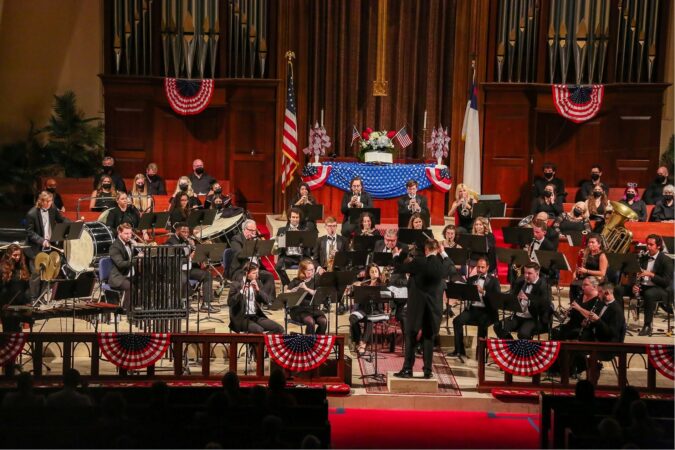
The Miami Sousa Band plans to give its audience barely a few seconds between selections when it returns to Coral Gables on Friday, Nov. 13, for a free Veterans Day concert. The rapid pace is a tribute to John Philip Sousa, whose touring band made marches, classical music and instrumental showpieces a popular form of American entertainment more than a century ago.
“Marches of Honor: A Veterans Day Celebration” begins at 7:30 p.m. at First United Methodist Church of Coral Gables, 536 Coral Way. Admission is free and open to the public.
The concert comes two days after the city’s inaugural Salute to Veterans ceremony, scheduled for Wednesday, Nov. 11, on Giralda Plaza, where hundreds of American flags hang overhead as part of Coral Gables’ commemoration of the nation’s 250th anniversary.
A concert that rarely pauses
The program is built around a performance practice Sousa popularized during the late 19th and early 20th centuries: a continuous procession of contrasting works, with little time between them.
The church’s concert announcement promises patriotic favorites, classical selections, featured instrumental soloists, light classics and musical novelties. The selections will follow one another with only seconds between performances.
The format serves a musical purpose. A stirring march can give way almost immediately to a lyrical solo, a familiar classical melody or an unexpected novelty. The changing pace and character of the pieces provide the variety that lengthy spoken introductions might otherwise interrupt.
Sousa understood the appeal of that kind of programming. After directing the United States Marine Band from 1880 to 1892, he organized his own ensemble and spent the next four decades bringing concert band music to audiences across the United States and abroad.
His performances combined musical discipline with a showman’s instinct for variety. Marches shared the program with orchestral transcriptions, popular works and solo performances designed to showcase individual musicians.
Touring bands occupied an important place in American musical life during an era when audiences could not summon performances through radio, recordings or streaming services. The bandstand and concert hall brought audiences into direct contact with music that might otherwise have been difficult to hear.
Sousa’s signature march returns
The evening’s best-known selection will be The Stars and Stripes Forever, the march Sousa composed in 1896 that became his most enduring contribution to American patriotic music.
Congress designated it the official national march of the United States in 1987, nearly a century after its composition.
The work’s sweeping brass passages, energetic rhythms and celebrated piccolo solo have made it a familiar feature of Independence Day celebrations, military ceremonies and band concerts.
The United States Marine Band identifies the composition as Sousa’s most famous march, a distinction reinforced by its continuing place in American public ceremonies.
Its inclusion gives Friday’s program a musical centerpiece. The surrounding selections, however, will demonstrate the broader range of concert band music that Sousa championed.
A local ensemble with a continuing tradition
The Miami Sousa Band is a professional-level concert ensemble founded and conducted by Dr. Seth M. Carlson, who also directs bands at Westminster Christian School in Palmetto Bay.
Carlson serves as organist and music outreach director at First United Methodist Church, where the Miami Sousa Band performs as an ensemble in residence.
The band’s mission is to preserve and present concert band literature through historically informed performances modeled on Sousa’s approach.
Its annual Veterans Day program has become part of the church’s November calendar.
Last year’s Salute to Veterans concert was held Sunday, Nov. 16, as an afternoon matinee. This year’s edition moves to a Friday evening.
The ensemble also collaborated with pianist Thomas Pandolfi in January on performances of Edvard Grieg’s Piano Concerto in A minor and Pyotr Ilyich Tchaikovsky’s Piano Concerto No. 1, a program the Gazette previously covered.
The range of those performances reflects the band’s interest in music beyond traditional military marches, including major works of the classical repertoire.
A concert series named for a Coral Gables educator
Friday’s performance belongs to the Lamar Louise Curry Concert Series, which First United Methodist Church presents as a free musical outreach program for the South Florida community.
Curry, remembered by generations of students as “Miss Curry,” taught social studies at Miami Senior High School for 32 years. Her students included future Florida Gov. Bob Graham, former Florida Attorney General Robert Shevin and former Coral Gables Mayor Don Slesnick.
In a 2023 remembrance, Slesnick recalled Curry’s influence as a teacher and her affection for the city where she lived.
Curry died in December 2012, shortly before her 106th birthday. Among her contributions to Coral Gables was a $200,000 bequest to the Coral Gables Garden Club for a public beautification project.
The gift helped create Lamar Louise Curry Park, a flowering green space beside Venetian Pool on De Soto Boulevard. The city named the park for her in 2018, and the Garden Club celebrated its completion in 2022.
Her name also lives on through the church’s concert series, which makes live music available without an admission charge.
If you go…
“Marches of Honor: A Veterans Day Celebration” begins at 7:30 p.m. Friday, Nov. 13, at First United Methodist Church of Coral Gables, 536 Coral Way.
Admission is free and open to the public. The sanctuary entrance is on Hernando Street, between Coral Way and Biltmore Way. The church has parking lots at Coral Way and Hernando Street and at Biltmore Way and Hernando Street.
For information, visit the Lamar Louise Curry Concert Series website or call the church office at 305-445-2578.
The evening offers an opportunity to hear a distinctive part of America’s musical heritage in a setting where the sound of a live concert band can fill the sanctuary, from the quietest instrumental solo to the final notes of Sousa’s most famous march.

Author: Coral Gables Gazette News Staff
Originally established in 1996 and relaunched as a digital publication in February 2025, the Coral Gables Gazette is an independent local news organization dedicated to factual, objective and accountable community journalism. Our newsroom reports on the people, policies, institutions and events shaping Coral Gables, Florida, providing residents with timely, informative coverage of the issues affecting their community. Our reporting includes City Hall, local government, municipal elections, public spending, real estate development, business, education, arts and culture, and neighborhood affairs throughout the City Beautiful. We follow City Commission decisions, examine public records and report on the businesses, organizations and individuals contributing to Coral Gables. We believe informed residents are essential to a healthy, engaged community. Stories published under the Coral Gables Gazette News Staff byline are prepared or compiled by the publication's editorial team. We strive for accuracy, fairness, transparency and clear distinctions between news reporting, opinion and advertising. Readers are encouraged to submit news tips, corrections, editorial inquiries and story suggestions through our Contact page and learn more about our standards through our Editorial Policy.