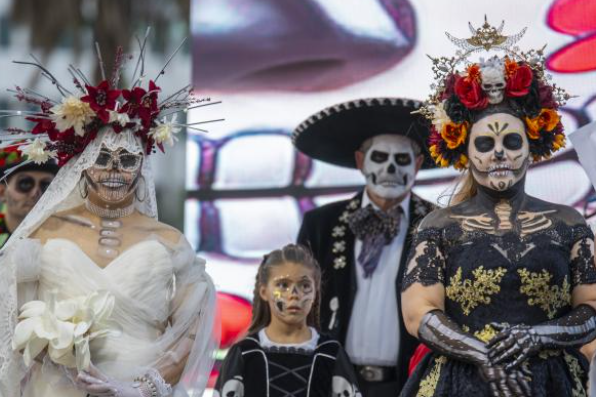
Coral Gables will mark Día de Muertos on Saturday, Oct. 31, with two free celebrations that approach Mexico’s tradition of remembrance from different directions: a literary tribute to Nobel Prize-winning poet Octavio Paz at the Coral Gables Museum and an evening festival featuring monumental Catrinas, music, dance and a communal altar at Ponce Circle Park.
The museum program runs from 10:30 a.m. to 2 p.m. at 285 Aragon Ave. The festival, organized by the Consulate General of Mexico in Miami, follows from 4 to 9 p.m. at 2810 Ponce de Leon Blvd.
The events coincide with Halloween, but Día de Muertos is a distinct observance rooted in Indigenous Mexican traditions and Catholic commemorations of the dead. Traditionally centered on Nov. 1 and 2, it honors deceased relatives through offerings of food, flowers, candles and personal objects. UNESCO recognizes the tradition as part of humanity’s intangible cultural heritage.
A poet’s altar opens at the Coral Gables Museum
For the first time, the Coral Gables Museum is presenting a traditional Día de Muertos altar, or ofrenda, in collaboration with the Mexican Cultural Institute in Miami.
The installation, titled “Una ofrenda a la memoria de Octavio Paz” (“An offering to the memory of Octavio Paz”), was created by Mexican artists Karla Kantorovich and Mónica Czukerberg. It brings together poetry, handmade objects and traditional offerings to explore how the living remember those who have died.
The choice of Paz gives the installation a literary dimension. The Mexican poet and essayist, who received the Nobel Prize in Literature in 1990, wrote extensively about identity, history, time and death.
The altar draws its principal inspiration from “Piedra de Sol” (“Sunstone”), Paz’s celebrated 1957 poem. Its 584 lines correspond to the approximately 584-day cycle of Venus as seen from Earth. Written as a single, flowing sentence, the poem concludes by repeating its opening lines, giving it a circular structure.
The poem takes its title and organizing imagery from the Aztec calendar stone. Its recurring language reflects a vision of time in which endings return to beginnings. New Directions, the poem’s English-language publisher, describes that structure as central to Paz’s exploration of memory, history and human experience.
Paz also examined the Mexican relationship with mortality in his 1950 book, “The Labyrinth of Solitude,” which includes a chapter titled “The Day of the Dead.” The museum’s tribute thus honors a writer who examined the same relationship between death, celebration and remembrance that the holiday expresses.
Handmade materials connect poetry with remembrance
The museum’s description of the installation combines traditional elements of Día de Muertos — marigolds, candles, copal incense, papel picado, photographs and symbolic offerings — with handcrafted clay objects, naturally dyed textiles, altered books and suspended pages bearing fragments of poetry.
Marigolds traditionally guide returning spirits through their color and fragrance. Candles illuminate the way, while photographs and personal offerings commemorate particular lives.
The handcrafted materials give the altar a contemporary artistic character while preserving its purpose as a place of remembrance.
The morning program begins with a presentation by Kantorovich and Czukerberg, who will introduce the installation and explain its symbolism. A family celebration in the museum courtyard follows, with Mexican food and pan de muerto tastings, live guitar music and a workshop in which visitors can decorate calaveras, or skulls, inspired by Día de Muertos imagery.
The museum also acknowledges Natacha Casafus for her collaboration and Nilo Verano for the musical composition.
Eight monumental Catrinas await visitors at Ponce Circle Park
The evening celebration shifts from the museum’s contemplative setting to a larger public festival.
Presented by the Consulate General of Mexico in Miami, “Mictlán: Día de Muertos 2026 — Un umbral entre mundos” (“A threshold between worlds”) will transform Ponce Circle Park into a gathering place for Mexican art, food, music and traditional observances.
According to the Greater Miami tourism bureau’s event listing, the park will feature eight monumental Catrina figures, marigold arches, animated digital installations and a central 360-degree altar intended as a communal space for remembrance.
Visitors will also encounter a Market of Memory offering food, drinks and crafts, along with a main stage for music, dance and storytelling.
The announced program includes a Catrina presentation, an altar visit and offering ritual, live performances, a runway presentation and a closing musical gathering called Fiesta de los Muertos.
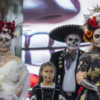
The Catrina, a skeleton figure typically portrayed in elaborate dress and a decorative hat, has become one of the most recognizable symbols of Mexico’s Day of the Dead celebrations. Its festive appearance reflects the holiday’s combination of humor, beauty and reflection on mortality.
The festival is organized by the Mexican Consulate in collaboration with REED Global Experience and JOY Group, with support from the City of Coral Gables. The Consulate describes the celebration as an effort to preserve Mexican cultural traditions and share them with the wider South Florida community.
Two celebrations, one tradition
Although the two events differ in presentation, both center on the idea that remembrance sustains a connection between the living and the dead.
At the museum, that connection takes shape through the words of Octavio Paz and an altar assembled from art and symbolic offerings. At Ponce Circle Park, it becomes a public celebration of music, ritual, food and shared cultural identity.
Both events are free and open to the public. Visitors can find museum information and RSVP through the Coral Gables Museum and festival details through the City of Coral Gables.
The city says its trolley service will operate from 10 a.m. to 10 p.m. Saturday, with Freebee transportation also available.
Author: Coral Gables Gazette News Staff
Originally established in 1996 and relaunched as a digital publication in February 2025, the Coral Gables Gazette is an independent local news organization dedicated to factual, objective and accountable community journalism. Our newsroom reports on the people, policies, institutions and events shaping Coral Gables, Florida, providing residents with timely, informative coverage of the issues affecting their community. Our reporting includes City Hall, local government, municipal elections, public spending, real estate development, business, education, arts and culture, and neighborhood affairs throughout the City Beautiful. We follow City Commission decisions, examine public records and report on the businesses, organizations and individuals contributing to Coral Gables. We believe informed residents are essential to a healthy, engaged community. Stories published under the Coral Gables Gazette News Staff byline are prepared or compiled by the publication's editorial team. We strive for accuracy, fairness, transparency and clear distinctions between news reporting, opinion and advertising. Readers are encouraged to submit news tips, corrections, editorial inquiries and story suggestions through our Contact page and learn more about our standards through our Editorial Policy.