
By Coral Gables Gazette staff
When Disneyland in California opened in 1955, it did more than introduce America to Sleeping Beauty Castle, riverboats, jungle cruises and a new kind of family entertainment. It also offered the public a softer, more enchanting encounter with a force many Americans feared: automation.
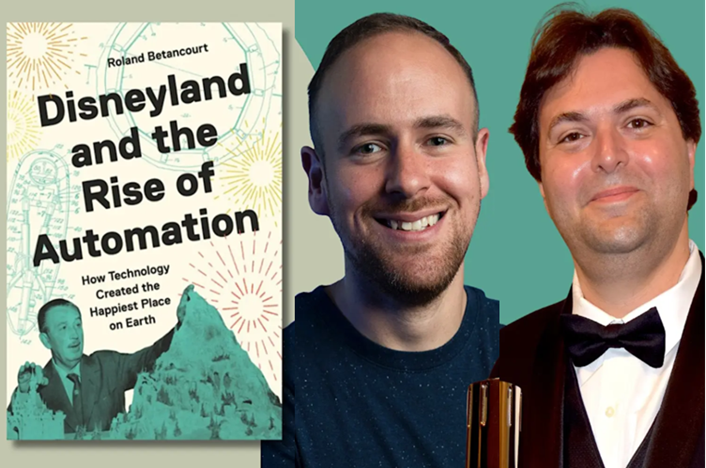
That is the argument at the center of Roland Betancourt’s new book, Disneyland and the Rise of Automation: How Technology Created the Happiest Place on Earth, which he will discuss Wednesday, June 17, at Books & Books in Coral Gables in conversation with Disney historian Didier Ghez.
The book, published by Princeton University Press, looks beneath the fantasy architecture and carefully staged charm of Disneyland’s first three decades to find something more industrial: the technologies of factories, assembly lines and military testing remade as rides, shows and attractions.
The result is not merely a history of Disneyland. It is a history of how Americans learned to experience automation as pleasure.
The machine inside the magic
Betancourt’s premise is both simple and startling: Disneyland made automation feel intimate, delightful and safe.
The park opened at a moment when automation was already a national anxiety. In postwar America, machines promised efficiency and abundance, but also raised fears of job displacement and dehumanized labor. Disneyland translated those anxieties into controlled motion, cheerful spectacle and repeatable wonder.
In Betancourt’s telling, the technologies behind the attractions mattered as much as the stories they told. Magnetic tape used to test ballistic missiles was repurposed to animate the talking macaws in the Enchanted Tiki Room. Programmable Logic Controllers, used in automotive assembly lines, helped make possible the mechanical precision of attractions such as the Matterhorn Bobsleds and Space Mountain.
What had belonged to factories and military laboratories became part of the choreography of a theme park.
That transformation is the book’s central insight. Disneyland did not hide automation by removing it. It made automation lovable by surrounding it with music, architecture, humor, characters and carefully managed sensory experience. Visitors did not encounter the assembly line as labor discipline; they encountered its logic as fantasy.
A park built like a factory
Betancourt, Chancellor’s Professor in the Department of Art History at the University of California, Irvine, approaches Disneyland with the eye of a scholar trained to study art, architecture, performance and ritual. That background matters. His earlier work focused on Byzantine visual and religious culture, including how images, spaces, sound and movement shape experience.
Disneyland might seem a long way from Byzantine art. Betancourt’s point is that it is not. Both require attention to built environments, choreographed bodies, sensory cues and the ways people are guided through space.
Seen that way, Disneyland becomes less an escape from modern industrial life than one of its most influential designs. Its product is not a car, a refrigerator or a weapon. Its product is experience: timed, repeated, engineered and consumed.
That idea gives the book a contemporary charge. The questions that surrounded automation in 1955 have returned in another form in the age of artificial intelligence. Will machines liberate workers or replace them? Will automation make life easier or more impersonal? Why do technologies that frighten us in the workplace become easier to accept when they arrive through entertainment, convenience or play?
Disneyland, Betancourt suggests, helps explain that pattern.
From Fordism to AI
The book places Disneyland in a broader history that runs from the Fordist factory to artificial intelligence. That sweep is part of what makes the subject larger than Disney fandom.
The early theme park was built in the shadow of industrial America. Walt Disney’s interest in automation and operational control intersected with the era’s fascination with factories, highways, mass production and systems engineering. The park then converted that logic into environments where crowds moved, vehicles cycled, figures spoke and shows repeated with mechanical reliability.
The rides were not only rides. They were demonstrations of a new social order: humans surrounded by responsive machines, entertained by systems they did not fully see.
For theme-park lovers, the book promises a new way to look at familiar attractions. For readers interested in technology, it offers a popular-culture history of automation’s emotional life. For anyone thinking about artificial intelligence, it provides a reminder that the public’s relationship with new technology is rarely shaped by white papers alone. It is shaped by where the technology appears, who introduces it and whether it arrives as threat, convenience or enchantment.
A conversation with a Disney historian
Betancourt will be joined by Didier Ghez, president of the Hyperion Historical Alliance and a prolific Disney historian whose work has focused on the studio’s artists, animation history and international networks.
Ghez is the author of Disneyland Paris: From Sketch to Reality, Disney’s Grand Tour, The Origins of Walt Disney’s True-Life Adventures and the multivolume They Drew as They Pleased series, among other books. He also edits the Walt’s People series and has long been associated with scholarship on Disney’s artists and archival history.
That makes the pairing especially well suited to the subject. Betancourt brings the broader history of technology, art and automation; Ghez brings deep knowledge of the Disney creative world that turned engineering into popular culture.
A Coral Gables audience may come for nostalgia — the Tiki Room, the Matterhorn, Space Mountain, the machinery behind childhood memory. But the evening’s deeper question is more contemporary: how does technology become acceptable when it is wrapped in pleasure?
Disneyland and the Rise of Automation invites readers to see the Happiest Place on Earth not as an escape from modernity, but as one of the places where modernity learned to smile.
An Evening with Roland Betancourt in conversation with Didier Ghez begins at 7 p.m. Wednesday, June 17, at Books & Books, 265 Aragon Ave., Coral Gables. The event is free and open to the public. Books will be available for purchase. RSVP grants general entry but does not guarantee seating.

Author: Coral Gables Gazette News Staff
Originally established in 1996 and relaunched as a digital publication in February 2025, the Coral Gables Gazette is an independent local news organization dedicated to factual, objective and accountable community journalism. Our newsroom reports on the people, policies, institutions and events shaping Coral Gables, Florida, providing residents with timely, informative coverage of the issues affecting their community. Our reporting includes City Hall, local government, municipal elections, public spending, real estate development, business, education, arts and culture, and neighborhood affairs throughout the City Beautiful. We follow City Commission decisions, examine public records and report on the businesses, organizations and individuals contributing to Coral Gables. We believe informed residents are essential to a healthy, engaged community. Stories published under the Coral Gables Gazette News Staff byline are prepared or compiled by the publication's editorial team. We strive for accuracy, fairness, transparency and clear distinctions between news reporting, opinion and advertising. Readers are encouraged to submit news tips, corrections, editorial inquiries and story suggestions through our Contact page and learn more about our standards through our Editorial Policy.












Really impressed with the customer support here. They answered my questions in minutes and the betting options are very competitive. I highly recommend krbet16 for a solid gaming session.
Finally found a place where the bonuses actually feel fair. I had a great run last night and the withdrawal process was surprisingly quick. Highly recommend boboslotlogin to everyone.
Really impressed with the interface here. Everything is very intuitive and the games load quickly without any lag. If you are looking for a reliable spot then idbata123 is the way to go.