By Coral Gables Gazette staff
Before the lights went down on “Man with a Movie Camera” in 1929, the audience received a warning. A title card announced that what followed would be an experiment: a film without intertitles, without a scenario, without actors or sets — an attempt to build an international language of cinema separated from theater and literature.
It was a manifesto disguised as a feature, and nearly a century later it remains one of the most radical things ever committed to celluloid.
On Wednesday, June 17, the Coral Gables Branch Library screens it in a form far closer to cinema’s physical origins than streaming — projected from a 16mm print — as part of its “Masters of Montage: series.
A cinema that wanted to break from theater
The film was the work of Dziga Vertov, born David Kaufman in 1896 in Bialystok, then part of the Russian Empire, into a Jewish family. As a young man he renamed himself with a pseudonym suggesting spin, movement and velocity — an apt name for a filmmaker who wanted cinema to break free of the stillness of theater.
Vertov believed the new Soviet republic demanded an entirely new kind of cinema, one purged of the borrowed conventions of the stage and the novel. He rejected staged drama and the inherited forms of literary storytelling, arguing instead for a cinema built from unstaged life: the kino-eye, the camera as a mechanical eye capturing life as it is rather than life as it is performed.
The film delivers exactly that.
Across a constructed single day, from a city waking at dawn to its machinery and crowds in full motion, “Man with a Movie Camera” moves through real Soviet cities with no conventional plot to follow and no character to identify with — except the cameraman himself, glimpsed climbing, crouching and balancing to get his shots.
It was assembled not in a day but over years of filming, then edited into a rapid, dizzying montage by Vertov and his wife and collaborator, Elizaveta Svilova, with cinematography by his brother Mikhail Kaufman. The three worked as a self-styled “Council of Three,” and all three have a genuine claim to authorship.
A family at the crossroads of world cinema
There is a remarkable footnote to that authorship.
Mikhail Kaufman, who shot the film and appears in it as the titular man hauling his tripod through traffic, was one of two filmmaking brothers. The other, Boris Kaufman, left for Paris and eventually Hollywood, where he became an Academy Award-winning cinematographer — the eye behind Elia Kazan’s On the Waterfront and Sidney Lumet’s 12 Angry Men.
One family thus stands at the root of both the most radical anti-narrative experiment of the silent era and two pillars of mid-century American storytelling, the very tradition Vertov set out to demolish.
The techniques that still feel modern
What astonishes contemporary viewers is not the theory but the sheer inventory of technique.
In a single film, Vertov deploys split screens, slow motion, freeze frames, stop-motion animation, extreme close-ups, jump cuts and vertiginous angles — a catalog of nearly every device the medium would spend the next century refining. He makes especially liberal use of double exposure to produce impossible images: the cameraman looming giant-sized over the crowd he is filming, or rising, tripod and all, from the bottom of a mug of beer.
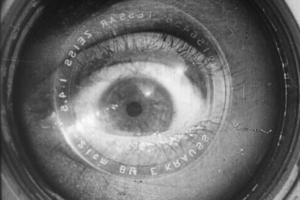
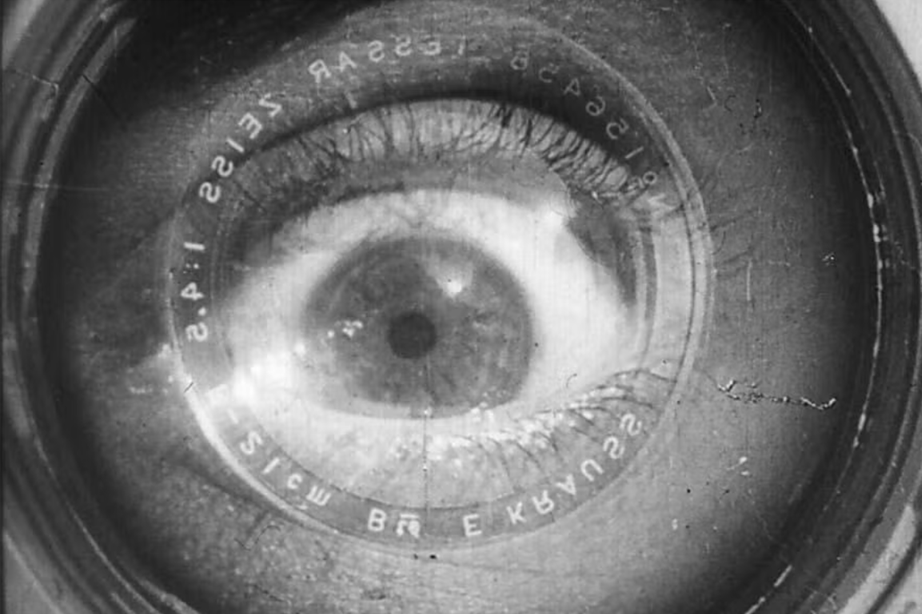
The film’s final shot layers a single human eye directly over a camera lens — the kino-eye made literal.
What gives the film its lasting charge is that it constantly reveals its own making. The film shows an image, then shows what the cameraman did to capture it, then what the editor did to assemble it. A family rides through the city in an open car; the film cuts to the cameraman perched in another car alongside, filming them. Children watch a street magician; the film cuts to Svilova at her bench, splicing those very frames.
It is a movie about how movies are made — and about the strange new relationship between human beings and the machines reshaping their lives.
That self-awareness is why the film aged so well while many of its contemporaries calcified. Largely dormant after the mid-1930s and revived in the 1960s, when documentary and experimental filmmakers rediscovered it, Man with a Movie Camera has since been ranked No. 1 in Sight & Sound’s critics’ poll of the greatest documentaries ever made — though “documentary” sits uneasily on a work this playful and constructed.
It is better understood as the purest demonstration of montage: the idea that meaning in cinema is created not within a single shot but in the collision between two.
The Revolutionary, the Scientist and the Poet
The screening is the centerpiece of Masters of Montage, a three-part series subtitled “The Revolutionary, the Scientist, and the Poet,” which examines how political upheaval, economic pressure and cultural ambition shaped the birth of montage in early 20th-century Russia.
The series pairs three filmmakers with three temperaments: Sergei Eisenstein, the Revolutionary, with Battleship Potemkin; Vertov, the Scientist, with Man with a Movie Camera; and Alexander Dovzhenko, the Poet, with Earth. Each screening opens with a multimedia presentation and exhibit on how Soviet ideology both ignited and constrained artistic innovation. Attendees are invited to stay for an open discussion after the film.
A film collection worth knowing about
There is a particular rightness to seeing this film at a library, and on 16mm.
The print comes from the Miami-Dade Public Library System’s own holdings, a rare surviving circulating 16mm film collection. Begun in 1956 as a teaching collection for public programming, it holds acclaimed features including Rashomon and The Passion of Joan of Arc, alongside experimental and educational shorts and Florida-specific titles that exist almost nowhere else.
Cardholders may still check out films for two weeks, though the library lends no projectors; patrons supply their own or arrange an on-site research visit.
For a generation raised on streaming, a public collection of physical film, projected in a public room, is its own small act of preservation — fitting for a movie that was, from its first frame, an argument about what cinema could be.
“Man with a Movie Camera” is silent and runs approximately 68 minutes. The program is listed for ages 19 and up.
“Masters of Montage: Man with a Movie Camera” screens Wednesday, June 17, from 5 to 7:30 p.m. at the Coral Gables Branch Library, 3443 Segovia St. Admission is free. For more information, call 305-442-8706 or email capleybr@mdpls.org.