By Coral Gables Gazette staff
If 2025 was a year centered around the City of Coral Gables’ Centennial Celebrations, then 2026 is poised to make history in a different way with several potentially game changing proposals and projects set to alter the future physical and political landscape of the City Beautiful.
The potential for seismic change will be tested early on as the city moves forward on its first ever mail-only ballot referendum in April, which will pose seven questions to voters. The exact ballot language for the questions has not yet been approved but the city attorney’s office said the language could go before commissioners for ultimate ratification in the next months, ahead of the election.
Potential election move to November tops list
The highest profile of the questions to be answered and the original reason why the referendum was set in the first place involves a potential move of the city’s elections from April to November.
For the city’s first century, elections had always been held in spring, but proponents of a change say that low-voter turnout and expensive elections make a strong argument for moving the elections to the fall to be part of a general election. Opponents of the move counter by saying that the local elections will likely get lost in the context of a larger election and that the move will favor candidates will larger campaign contributions as it will be costly to run elections.
Adding to the intrigue of the election vote in the Gables is that if it measure to change to November is adopted, candidates up for reelection in 2027, including Mayor Vince Lago and Commissioners Melissa Castro and Ariel Fernandez would face an election later in 2026 – five months before they would have faced election. The city’s first ever commission elections in November would take place with three of five commission seats, including the mayor’s, in play.
The other questions on the ballot include:
1. Adding a charter provision prohibiting further changes to the election date via ordinance. In 2025, a majority of Gables commissioners initially voted to chang city elections to November by ordinance, but the city reversed course on that decision when the courts overturned a similar decision in the City of Miami.
2. Requiring a vote of the electors prior to changes to the fund balance and reserve policy and/or use of the city’s reserves, except during certain emergencies. Soon after the April elections, the commission passed an ordinance requiring a supermajority to use the city’s reserves. This proposed move goes further requiring a vote of electors to make changes to fund balance policies.
3. Requiring a vote of the electors prior to any changes to the compensation of elected officials beyond the annual CPI adjustment. Much has been made of the previous commission’s decision to increase salaries in the budget and the issue was discussed at length during the elections. The change would require another vote of electors to adjust the compensation of commissioners.
4. Amending the charter to require a charter review committee every ten years beginning in 2035, and setting the composition of that committee. In the past, the charter review committee typically convened every 10 years, but the city broke from that pattern by convening it in 2023 – when the previous committee was formed in 2015. This change would establish a specific timeline and composition requirements.
5. Amending the charter to authorize Inspector General services, as needed. The Mayor has advocated for an inspector general for several years, especially, he says, to increase transparency and accountability in the face of claims made by others for corruption.
6. Amending the charter to allow the appointing commissioner or appointed official to remove a board member prior the end of their term. Currently, a vote of the entire commission is required to appoint and remove board members. This change would allow the commissioner who appoints board members to unilaterally remove them.
Mobility Hub to break ground
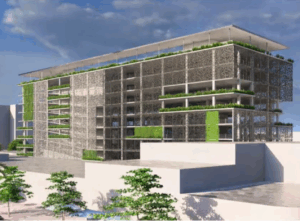
If the proposed charter amendments the April ballot referendum are likely to transform the political landscape the city, then the construction of Mobility Hub just off Miracle Mile in the 200 block Andalusia Avenue represents what could be one of largest physical developments in the city’s Central Business District.
Mothballed during the pandemic and then under a previous commission that was against the scope and price tag of the replacement parking garage, the Mobility Hub came to life again after election power shift on the commission. The mayor with Vice Mayor Rhonda Anderson and Commissioner Richard Lara breathed new life into the project last year and City Manager Peter Iglesias predicted the project would break ground this year.
The city still has to approve the final design of the project – which could see it wind its way through several city boards – before it reaches the construction phase.
In 2026, the city is also likely to move forward with plans to explore a public-private partnership for the redevelopment of Garage 4 (in the 300 block of Andalusia Avenue) once the Mobility Hub is underway. That project will be a mixed-use development as well and is also likely to sky above the Mile.
Proposal for new business improvement district to go to Commission in February
After holding a series of in-person and virtual meetings with residents, property and business owners, restauranteurs and others near the end of 2025, consultants hired by the city will be going to the city commission in February with a proposal or several on how, and if, to move forward with a new business improvement district (BID).
For a quarter of a century until 2023, the leaned on a taxed BID to take care of the heart of its commercial business center. Now, the city is considering reinstituting a different BID – the details of which are still being finalize – before making a final decision.
New development challenges with Live Local and Rapid Transit Zones
Development remains one of the biggest issues in Coral Gables with the city constantly walking a tightrope between attracting new projects and commercial interests while protecting the standard of living for residents who enjoy the city’s small-town and neighborhood charm. That challenge became harder in 2025 with the first projects in the city going through the Live Local Act and Rapid Transit Zone (RTZ) processes.
While the Live Local Act was enacted by the state and the RTZ is a county government creation, both preempt the city’s zoning standards and threaten to take away control as well as millions of dollars in permit and impact fees, while resulting in larger and more dense projects in certain parts of the city.
Cora Gables has already approved an overlay district to try and regain control of RTZ projects in the pipeline but the upcoming year will likely see other projects seek to take advantage of Live Local and RTZ and how the city’s handles these projects will effect that future skyline.
Youth Center legal fight to start the year off with a bang
Even before publication of this article, the city laid the groundwork for its first legal fight of 2026 when it set a January 2 deadline for lawyers representing the War Memorial Youth Center Association to provide documents the city says it should be privy to. Association representatives had previously informed the city that no additional documents would be provided.
Eleventh-hour meetings and correspondence in December could not bring the two sides together, and this looks like it will be headed to court. At the heart of the issues, is a reverter clause that was part of the original deed given to the city when it was gifted land to build the youth center many decades ago.
Lago, Anderson and Lara gave permission for the city to take the fight to court last year, as they view the reverter clause and uncertainties over the association and its financial operations as a “cloud on title.” Castro and Fernandez believe the that the whole issue against the youth center is a politically motivated pursuit of association president, former commissioner and mayoral candidate Kirk Menendez.
The city previously sued the association in the 1960s to try and get the reverter clause overturned but lost that case.
Other issues to come up during 2026
It’s impossible to tell what unforeseen issues will pop up in Coral Gables over the course of the next twelve months, but it is sure to be a combination of national, state, local and neighborhood as it always is.
The state’s upcoming battle between the governor and legislature to eliminate or reduce property taxes has the potential to dwarf any other issues over the next year, as it could mean the city’s budget total budget would be gutted if some of the more extreme measure being discussed are adopted.
Every neighborhood in Coral Gables will also face its share of challenges, whether the city decides to continue planning for a large-scale move to sewer system versus septic tanks or new dog parks are proposed without nearby residents’ knowledge.
Taken together, the ballot questions, major construction projects, legal battles and development pressures lining up for 2026 suggest a year that could redefine Coral Gables far beyond its centennial glow. Decisions made by voters, commissioners and the courts in the months ahead will shape not only how the city governs itself, but how it grows, moves and protects its identity amid powerful external forces. By this time next year, the City Beautiful may look much the same on the surface but the foundations beneath its political and physical landscape could be permanently altered.