
By the Coral Gables Gazette editorial board
The University of Miami is arguably Coral Gables’ most important civic and economic partner. It has been for over a century, and it remains so today — a research university, a cultural anchor and an employer of consequence whose relationship with this city is woven into the fabric of what Coral Gables is.
That relationship deserves a serious, durable framework. The university’s proposal for a 30-year amended development agreement with the city is, in that sense, a reasonable ambition. Long-term planning between an institution and its host city is preferable to the alternative: a series of episodic negotiations, each one reactive, none of them coherent. We support the principle of a renewed campus agreement.
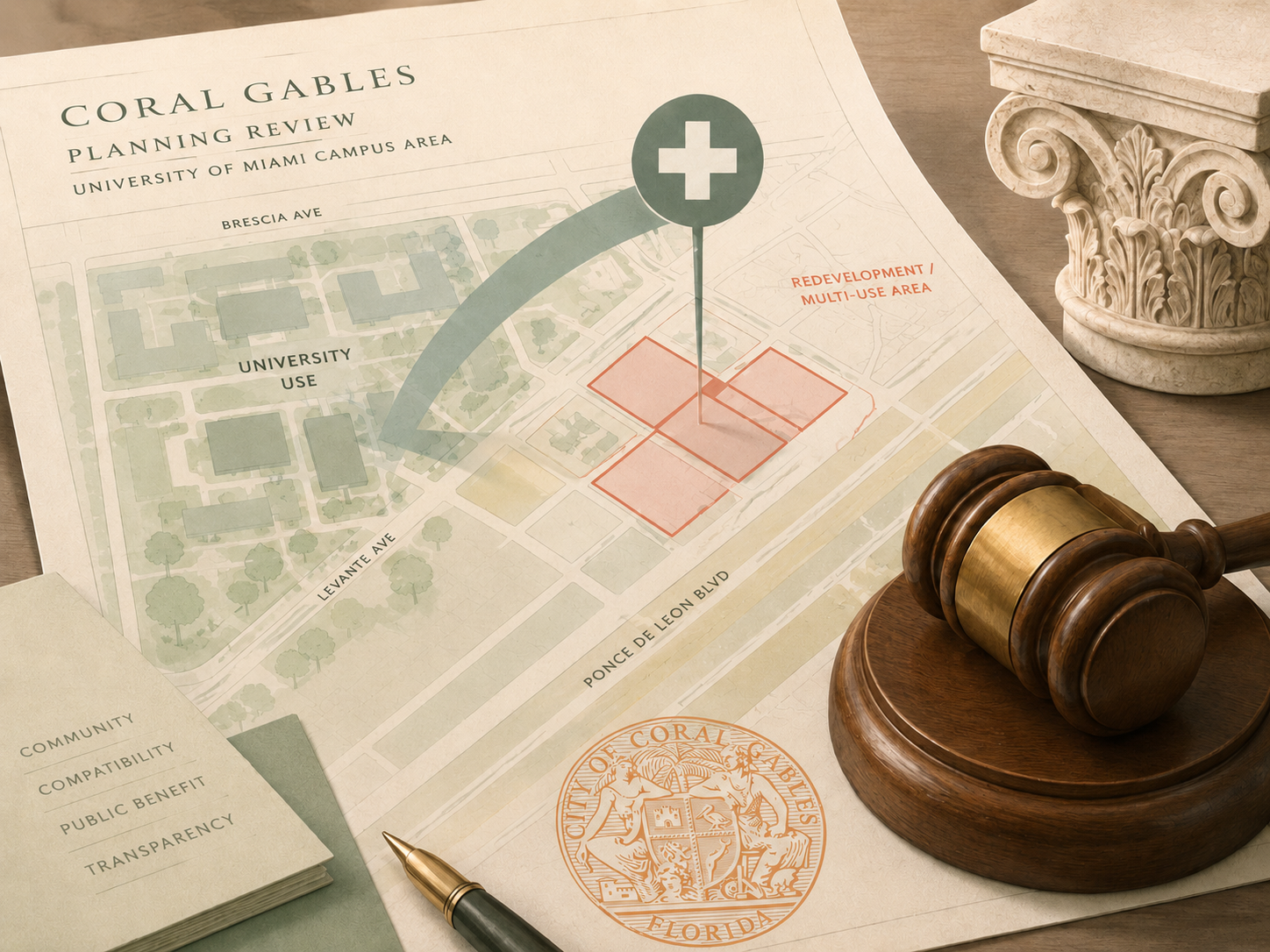
But one element of what the university has filed requires separate treatment before it moves through the approval process. Contained within a 217-page amendment package — now before the Development Review Committee — is a request to add hospital use as a permitted use in the Campus Multi-Use Area along Ponce de Leon Boulevard. The filing defines that use expansively: inpatient and outpatient care, surgical services, emergency care, radiation therapy, chemotherapy, and diagnostics, serving not only the university community but the general public.
That is not a campus amenity. That is a hospital.
The DRC is an administrative and technical body. It does not vote on approvals, and its review, however careful, is not a substitute for the full public accounting that a use of this scale and consequence demands. A hospital serving the general public — with emergency services, surgical suites, and inpatient beds — changes traffic patterns, infrastructure demands, neighborhood expectations, and the fundamental character of the corridor in ways that no technical consistency review can fully assess.
The city’s Planning and Zoning Board and City Commission should require, before any 30-year entitlement is recommended then approved, that the hospital-use question receive its own separate and complete public review. That review should address at minimum five questions.
First: What is the demonstrated public need? The University of Miami’s Miller School of Medicine already counts Jackson Memorial Hospital — a 1,550-bed public teaching hospital in Miami’s Civic Center and one of the largest in the nation — as its primary teaching facility, operating under a formal academic partnership. UHealth, the university’s own health system, operates 700 beds across 40 locations in South Florida and logged 1.7 million patient visits in fiscal year 2025. Baptist Health’s Doctors Hospital sits adjacent to the proposed Multi-Use Area, and South Miami Hospital is nearby. Before permitting another general-public hospital use on this corridor, the city should require a clear explanation of what gap in access or capacity a Coral Gables campus hospital would fill that these existing relationships and facilities do not — and who would be served.
Second: What are the traffic, parking and emergency-access implications? A hospital generates continuous vehicle traffic at all hours, requires emergency vehicle access, and creates parking demand that the current corridor may not easily accommodate. Independent or city-verified analysis should answer these questions before the city commits to permitting the use.
Third: How would a hospital affect the neighborhoods adjacent to the Multi-Use Area? The university’s filing states explicitly that the proposed boundary expansion would not encroach on residential areas along San Amaro and Campo Sano, and we take that representation at face value. But proximity is not the only concern. Noise, light, traffic, and the cumulative intensity of a hospital-scale facility deserve honest evaluation against the residential character this city has always worked to protect.
Fourth: What is the full public-benefit value of the Lee Lincoln Site conveyance? The university’s offer to transfer the 5.52-acre Lee Lincoln parcel for a new Centennial Park is meaningful and welcome. But the university would retain a perpetual recreational easement over portions of that land. The city should require a clear, independent valuation of what it is receiving — and a clear accounting of what it is giving in return — before embedding that exchange in an agreement that runs 30 years.
Fifth: What does a 30-year entitlement actually authorize, and what public process remains? The city should require a specific written explanation of what approvals would still be required before any hospital could be built. If hospital use is allowed in the agreement, any actual hospital proposal should still return for a full, public, discretionary review in which scale, access, operations, and neighborhood impact are examined. A 30-year campus agreement should not become a blank check for a future hospital whose consequences are not yet known.
Coral Gables was built on the premise that planning matters. Its beauty was not accidental. Its neighborhoods were not meant to be afterthoughts. Its streets and civic institutions reflect a belief that growth should be deliberate, not improvised.
That principle has been tested repeatedly in recent years as the city has weighed institutional expansion, public infrastructure, and private development pressure. Each time, the question is the same: will Coral Gables apply its own standards before granting long-term rights?
The university is an institution of great importance. Its agreement with this city deserves to be renewed. But a hospital is not a routine campus use, and it should not be treated as one. The Planning and Zoning Board and the City Commission should sever the hospital-use question from the balance of the agreement, or condition any hospital entitlement on a full, independent and public review of need, traffic, infrastructure and neighborhood impact.
The DRC meeting on Friday is the beginning of this process, not the end. Residents should understand that, and commissioners should remember it.
A great university can ask ambitious things of its host city. A great city can answer with discipline.
Coral Gables should do so here.












this is Supreme NIMBYism. i guess you privileged journalists have never had to wait 6 months for an appointment, or a procedure. if UHealth can build a full hospital on the care & excellence level of a Lennar (5555 Ponce), please by all means let them! with CG’s aging population, there is no lack of Demand. Doctors is nice, but tiny. traffic is a problem until it’s you, you Mom or your kid laying on a gurney. then you’ll want that hospital that’s now 12 miles away to be next door.
The have the old Cedars hospital for UM and is not doing great financially. We need more? NO
The problem with Cedars may be, precisely, that it is in the very inner city (as in, Camillus House is a neighbor). No one wants to go there, in spite of its superior level of care, because of its unappealing and downright dangerous location.
My wife and I receive first rate oncological care at Lennar, a Godsend, considering we are “frequent flyers “.
A measured expansion of the facility would be a boon to us and all Gables residents, young and old.
And, by the way, there’s already a proliferation of surgical centers throughout the Gables, poorly supervised by authorities — witness the one on the Trail where two patients have died during cosmetic surgery.
Pretty nice post. I just stumbled upon your weblog and wanted to say that I’ve really enjoyed browsing your blog posts. After all I will be subscribing to your rss feed and I hope you write again very soon!
Thanks for sharing excellent informations. Your web site is very cool. I am impressed by the details that you have on this site. It reveals how nicely you understand this subject. Bookmarked this web page, will come back for more articles. You, my friend, ROCK! I found simply the info I already searched all over the place and simply couldn’t come across. What an ideal website.