

By Coral Gables Gazette staff
Long before Million Dollar Mermaid became a Hollywood spectacle, its central figure was already part of Coral Gables’ origin story. In 1925, city founder George Merrick enlisted Annette Kellerman—then one of the most recognized performers on the planet—to help market his ambitious new city. Kellerman’s image, athletic modernity, and aquatic glamour became entwined with the early identity of Coral Gables, lending international attention to a place still inventing itself. That history returns to the foreground on Sunday, January 4, when the Coral Gables Art Cinema screens the 1952 Technicolor musical that mythologized her life.
The 2 p.m. screening takes place at the cinema on Aragon Avenue and is presented in partnership with an unusually broad coalition of local and international institutions, including the Australian Consulate in Miami, Books & Books, HistoryMiami Museum, the Merrick House Governing Board, and multiple City of Coral Gables departments. The program will be introduced by Australian Honorary Consul and Mayor Don Slesnick, followed by a reception on the plaza, underscoring the event’s civic as well as cinematic dimension.
Released at the height of MGM’s golden era, Million Dollar Mermaid stars Esther Williams as Kellerman, tracing her rise from a physically fragile childhood in Australia to global fame as a swimmer, performer and silent-film star. Directed by Mervyn LeRoy, the film runs 115 minutes and frames Kellerman as a figure who challenged social convention through athleticism, spectacle, and self-invention.
A Hollywood musical with local ties
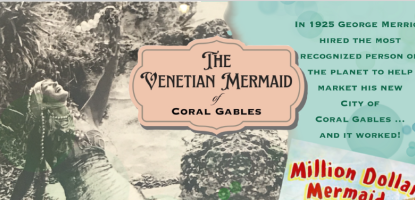
For local audiences, the film’s resonance lies less in studio-era romance than in place. Kellerman’s association with the city helped define the image Merrick sought to project: cosmopolitan, modern, and visually unforgettable. Her performances at what would become the Venetian Pool linked athletic performance to architecture and urban branding, a strategy that proved remarkably effective in attracting national attention to the fledgling city.
Seen through that lens, Million Dollar Mermaid becomes a cinematic afterimage of a marketing campaign that worked. The film does not merely recount Kellerman’s life; it amplifies the mythology that Coral Gables helped create, reflecting how spectacle and civic ambition intertwined during the city’s formative years.
Water, color and spectacle
Much of the film’s enduring appeal rests on its aquatic choreography. Legendary Hollywood choreographer Busby Berkeley staged the elaborate water ballets, transforming pools into geometric canvases of synchronized movement and saturated color. Berkeley’s sequences abandon realism in favor of abstraction, allowing motion and design to carry meaning. Critics have long cited the film as one of the most visually striking productions of the 1950s, notable for its willingness to indulge imagination at full scale.
Williams’ athletic precision anchors those sequences, but the choreography itself becomes the star, turning water into architecture and bodies into pattern. The result aligns uncannily with Coral Gables’ own aesthetic aspirations of the 1920s, when Mediterranean Revival architecture and theatrical public spaces were meant to signal refinement and possibility.
Civic memory on screen
The Art Cinema’s presentation frames Million Dollar Mermaid not simply as a classic musical but as a chapter of local history rendered in Technicolor. By pairing the screening with an introduction from the Australian Honorary Consul and a post-film reception, the event emphasizes conversation and civic memory rather than nostalgia alone.
That approach reflects the Art Cinema’s broader commitment to repertory programming that connects film history to place. For residents, the screening offers an opportunity to reconsider a familiar title through a distinctly Coral Gables lens—one that recognizes how Hollywood mythmaking and city-building once reinforced each other.
A city reflected back to itself
More than seventy years after its release, Million Dollar Mermaid remains a vivid artifact of mid-century spectacle. For Coral Gables, it also functions as a mirror, reflecting a moment when the city leveraged culture, celebrity, and water-bound fantasy to announce itself to the world. Revisiting the film today invites audiences to see how those early ambitions continue to ripple through the city’s identity.

Author: Coral Gables Gazette News Staff
Originally established in 1996 and relaunched as a digital publication in February 2025, the Coral Gables Gazette is an independent local news organization dedicated to factual, objective and accountable community journalism. Our newsroom reports on the people, policies, institutions and events shaping Coral Gables, Florida, providing residents with timely, informative coverage of the issues affecting their community. Our reporting includes City Hall, local government, municipal elections, public spending, real estate development, business, education, arts and culture, and neighborhood affairs throughout the City Beautiful. We follow City Commission decisions, examine public records and report on the businesses, organizations and individuals contributing to Coral Gables. We believe informed residents are essential to a healthy, engaged community. Stories published under the Coral Gables Gazette News Staff byline are prepared or compiled by the publication's editorial team. We strive for accuracy, fairness, transparency and clear distinctions between news reporting, opinion and advertising. Readers are encouraged to submit news tips, corrections, editorial inquiries and story suggestions through our Contact page and learn more about our standards through our Editorial Policy.











Wonderful review!!! It’s going to be a great event!!!
Beautifully written! Hope to fill every seat! It’s going to be a wonderful afternoon.