
By Coral Gables Gazette staff
Only weeks away from the city sending out its first mail ballots in its first ever completely mail ballot Special Referendum, Mayor Vince Lago is hosting a “Town Hall with Mayor Lago” meeting on Monday, March 9, that will deal with the eight issues on the ballot and the mail-in ballot process.
The meeting will take place at 5:30 p.m. in the Public Safety Building, 2151 Salzedo Street. Among those in attendance will be Alina Garcia, the county’s Supervisor of Elections, who will help explain the voting process.
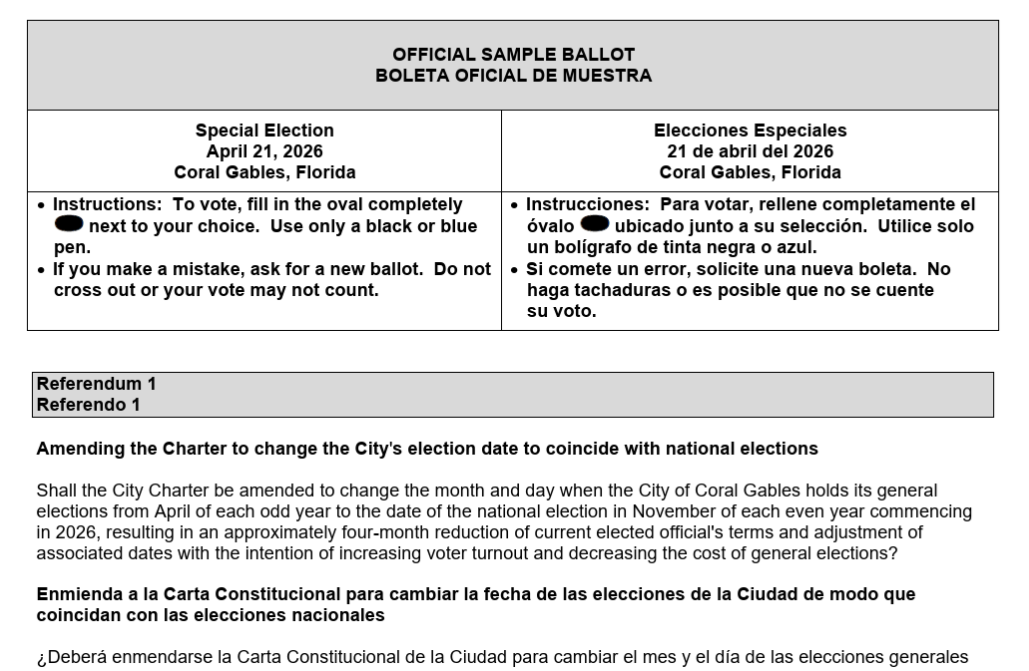
The town hall comes as Coral Gables prepares for a special mail-only election with mail ballots due on April 21, after being mailed out late this month. Some of the ballot issues could be transformative, fundamentally changing city processes that have been in place for more than a century, while others deal with mundane and granular issues involving city boards and committees.
Proposal to move city elections to November
The most prominent question on the ballot asks voters whether the city should move its municipal elections from April of odd-numbered years to November of even-numbered years, aligning them with state and federal election cycles.
Coral Gables has held its municipal elections in April for more than 100 years, dating back to the city’s founding.
Mayor Lago and a majority of the City Commission have argued that the move would increase voter turnout and reduce costs, estimating the city could save roughly $200,000 per election by holding the vote alongside county, state and federal contests.
Opponents counter that local races could become overshadowed on lengthy November ballots dominated by higher-profile contests. They also warn that campaigns could become more expensive as candidates compete for visibility during larger election cycles, potentially increasing the role of major donors in municipal races.
The issue reached the ballot after the commission previously attempted to move the election date by ordinance last year. Following a court ruling that struck down a similar effort in the City of Miami, Coral Gables commissioners ultimately opted to place the decision before voters.
Other ballot issues
A second ballot question is tied directly to the election-date debate. It would prohibit future changes to municipal election timing through commission ordinance if those changes conflict with state law.
Instead, any such changes would need to be approved by voters through a referendum.
Another proposal would place the city’s reserve and fund balance policies directly into the charter. Under the measure, changes to those policies or the use of reserve funds outside of certain emergencies would require both voter approval and a four-fifths vote of the City Commission. Supporters say the change would strengthen fiscal safeguards and protect the city’s long-term financial stability.
Voters will also consider whether to amend the charter to authorize the city to contract for inspector general services when needed. City officials have said the provision would enhance oversight and allow the city to bring in outside investigative resources to examine potential cases of fraud, waste or abuse.
A contentious proposed amendment spurred by a recent pay raise the previous city commission granted itself, would require voter approval for any increases in compensation for elected officials beyond routine annual adjustments tied to the Consumer Price Index.
Supporters say the measure would reinforce public trust by ensuring residents have the final say on significant salary increases for city commissioners and the mayor.
Another question would require the city to convene a Charter Review Committee every ten years beginning in 2035. The committee would be responsible for reviewing the city’s governing document and recommending potential updates, while the amendment also establishes guidelines for how the committee would be structured.
Voters will also decide whether commissioners should be allowed to remove members they appoint to city boards and committees before the end of their terms. Currently, most appointed members serve fixed terms once selected.
The final ballot question would eliminate runoff elections in mayoral and commission races.
If approved, candidates would be elected by plurality vote, meaning the candidate receiving the most votes would win even without a majority.
Runoff elections have occurred at least once during each of the past five municipal election cycles, and city officials say the additional elections can cost well into six figures.
Mail ballots arriving soon
Ballots for the April 21 special election will be mailed to all registered Coral Gables voters at the end of March. The election will be conducted entirely by mail, with no postage required to return completed ballots.
Ballots must be received by the Miami-Dade County Supervisor of Elections by April 21, and postmarks will not count. Residents must be registered to vote by March 23 to participate.
City officials say Monday’s town hall is intended to ensure residents understand both the ballot questions and the mechanics of the mail-only election as the city heads into an unusual spring voting season.

Author: Coral Gables Gazette News Staff
Originally established in 1996 and relaunched as a digital publication in February 2025, the Coral Gables Gazette is an independent local news organization dedicated to factual, objective and accountable community journalism. Our newsroom reports on the people, policies, institutions and events shaping Coral Gables, Florida, providing residents with timely, informative coverage of the issues affecting their community. Our reporting includes City Hall, local government, municipal elections, public spending, real estate development, business, education, arts and culture, and neighborhood affairs throughout the City Beautiful. We follow City Commission decisions, examine public records and report on the businesses, organizations and individuals contributing to Coral Gables. We believe informed residents are essential to a healthy, engaged community. Stories published under the Coral Gables Gazette News Staff byline are prepared or compiled by the publication's editorial team. We strive for accuracy, fairness, transparency and clear distinctions between news reporting, opinion and advertising. Readers are encouraged to submit news tips, corrections, editorial inquiries and story suggestions through our Contact page and learn more about our standards through our Editorial Policy.










I am hoping that the town hall is an honest and transparent discussion for residents to make an informed decision as to the referendums. To assist, the general election cost in April is $125,000 and in November is $20,000 (see CG Ord. No. 2025-08). Runoff elections will cost the same whether in April or November. The savings is $105,000 every 2 years ($52,500 per year) – not $200,000. Next, the referendum approved by Lago’s majority only prohibits an ordinance changing a November election date – it does not prohibit changing an April election date via ordinance (although that is illegal per Florida law). Finally, if increasing turnout and lowering cost are goals, why does Lago’s majority have us voting on the referendums only by mail in April (which will cost $150,000 with a lower turnout) rather than in November with in-person early and election day voting, ballot drop-off at the library and vote by mail (which will only cost $20,000 with a higher turnout)? In 2016 during his first term as a Commissioner, Lago voted for the referendum to be held in November (and against a restricted vote-by-mail as we are now doing) to save money and make voting easier. 22,937 residents voted on the prior referendums in 2016 – including 69% voting for runoff elections. Lago’s majority can change the referendum vote-by-mail to normal November voting if their stated goals for voting in November are honest.