
By the Coral Gables Gazette editorial board
Coral Gables has spent a century cultivating an identity rooted in civic quality, architectural beauty, and institutional seriousness. That identity depends not only on what the city builds and preserves, but on how its elected officials conduct the public’s business.
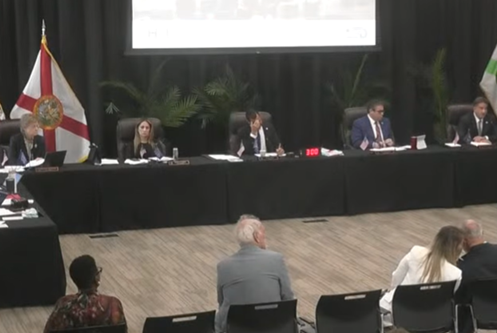
What occurred at the May 19 City Commission meeting was evidence of a governing body that has allowed personal conflict to displace institutional function as the dominant language of public life.
In the course of debating a single board reappointment, commissioners directed at one another accusations of sexual harassment, election misconduct, political retaliation, personal intimidation and past violations of Florida’s open-meetings law. These were not policy disagreements. They were not disputes about taxation, development, or the allocation of public resources. They were personal accusations, made from the dais, by elected officials, about one another.
That distinction matters.
Cities can absorb policy disagreement. Disagreement over budgets, land use, development density, and public safety priorities is not only inevitable — it is the legitimate work of democratic governance. Elected officials are supposed to represent different constituencies and different visions. Conflict over substance is healthy. It produces compromise, accountability and better outcomes.
What cities cannot absorb indefinitely is the replacement of policy disagreement with personal warfare. When every vote becomes retaliation, when every appointment becomes a political weapon, when every meeting becomes an occasion to relitigate grievances that have accumulated over years of factional mistrust — governance itself begins to fail.
Not dramatically. Not all at once. But steadily, and in ways that are difficult to reverse.
The Gazette has documented this trajectory across multiple meetings, disputes and governance conflicts — selective rule enforcement, escalating retaliation claims, and the progressive personalization of disagreements that began as policy differences. May 19 did not represent a sudden collapse. It represented the logical continuation of a trajectory that has been building for months.
That trajectory should concern every resident who depends on this commission to make consequential decisions about infrastructure, public safety, development, fiscal stewardship and the long-term character of the city.
The danger is that the commission has become a body in which disagreement increasingly cannot be separated from personal animosity, factional loyalty and the accumulated weight of political grievances that predate any specific item on any specific agenda.
When that happens, residents lose something essential: the reasonable confidence that their government is operating in good faith.
Public trust in institutions is the foundation on which everything else rests. Residents who believe their commission is engaged in permanent political warfare — rather than genuine deliberation about the public interest — eventually stop believing that outcomes reflect merit, that processes are fair, or that their participation matters.
That erosion is quiet. It does not announce itself. But it is real, and it is cumulative, and it is difficult to rebuild once it has taken hold.
It would be easy to dismiss what is happening in Coral Gables as simply a local reflection of a national condition. Permanent factional warfare, the personalization of political disagreement, the treatment of opponents as enemies rather than colleagues — these are not Coral Gables inventions. They have become the defining features of American political life at every level of government.
But that observation, while accurate, is not a defense. It is a diagnosis.
And it is precisely at the municipal level — where government is closest to the people it serves, where decisions are most immediate, and where consequences are most personal — that the cost of permanent political warfare is most directly felt. Residents of Coral Gables do not experience congressional gridlock in their daily lives. They experience their commission. The sidewalk that needs repair, the permit that needs approval, the park that needs to be built, the business trying to open — these are immediate. They are local. They are personal.
When the body responsible for those decisions is consumed by personal warfare, the people who depend on those decisions don’t get governed. They get ignored.
This editorial board does not adjudicate the specific allegations made at the May 19 meeting. We do not know which claims are true, which are exaggerated, and which reflect genuine grievances that have never been properly addressed. Those are factual questions that may be resolved through appropriate processes.
What we do know is this: a commission meeting in which elected officials spend the better part of an hour accusing one another of harassment, misconduct and bad faith is a commission that is not governing. It is a commission that is fighting. And Coral Gables residents (and staff) deserve better than a front-row seat to a fight that shows no signs of ending.
Mayor Vince Lago, Commissioner Ariel Fernandez and Commissioner Melissa Castro all face voters in November. Some of the voices that have defined this period of conflict may no longer be present. That is how democratic accountability is supposed to work, and the Gazette does not diminish its importance.
But electoral outcomes do not automatically restore institutional trust. A commission that has governed through ingrained conflict does not become a healthy institution simply because the conflict ends. The habits of governance that have taken hold — the retaliation framing, the personalization of every dispute, the erosion of procedural norms — will outlast any particular majority unless they are actively and deliberately addressed.
History offers ample evidence of this. Institutions that resolve factional warfare through consolidation rather than reform tend to trade one set of problems for another. The minority becomes silent. The majority becomes unaccountable. And the residents who once watched their commissioners fight one another begin to wonder whether anyone is fighting for them.
That is not the Coral Gables this community has worked to build.
The path forward requires more than a favorable election outcome. It requires commissioners across all factions to recognize that their individual political interests and the institutional health of the commission are not the same thing — and that when they treat them as identical, the institution suffers regardless of who holds the majority.
Commissioners who hold genuine policy disagreements should pursue them through legitimate means — motions, votes, public debate, and the accountability that comes with transparent decision-making. Commissioners who believe rules have been violated should pursue those concerns through appropriate institutional channels rather than from the dais during unrelated agenda items. And every commissioner, of each faction, should recognize that the residents watching these meetings are not partisans awaiting a winner. They are constituents trying to determine whether their government is worthy of their trust.
November will come. The faces may change. But the question of what kind of governing institution Coral Gables wants to be gets resolved in the daily conduct of the people the ballot box puts in office.
The City Beautiful cannot be governed through permanent political warfare.
That was true before this commission. It will remain true after it.












Anyone who watches the Commission Meetings whether in person or otherwise will see that any time questions are asked, or comments are expressed that do not agree with the Mayor he goes on long tirades that most of the time have nothing to do with the topic discussed. His reaction, and his replies turn into personal attacks! He continues to bring up the narratives that he wants people to believe irregardless of their relevance or for that matter their veracity. That is how he avoids dealing with the issues at hand. It is obviously very clear that as long as he is the chair he can get away with not following any established rules. He enforces time limits for some speakers, reminds residents to speak to the whole Commission and yet allows his usual supporters to attack directly and disrespectfully the two Commissioners that do not support him on be fed knee. He talks about the “blogs” even those that are written by known people but yet uses as a source the nasty, crude, anonymous one that supports everything he does. And of course, let’s not forget that he consistently says that families must be off the conversation while he consistently attacks the others’. Something has to give; rules must be enforced for everyone; respect should be a two way street, civility and decorum (two of his favorites terms) must be displayed on and off the dais!
100% agree with Mrs. Cruz. It’s time for the Mayor to grow up. He’s fostered a toxic atmosphere in our local government. It needs to stop
We know what we have to do come November elections.
The root problem is Lago’s (developer-funded Commissioners’) DISHONESTY.
(Typo correction)
The root problem is Lago’s (and developer-funded Commissioners’) DISHONESTY.
I am posting this to alert you to something wholly improper that is going on in Coral Gables:
There are dozens of boards and committees in Coral Gables filled with 400 political insiders whose loyalty to the Commissioners who put them there is purchased by giving them free golf at the Biltmore and Granada worth thousands of dollars. This political patronage must stop.
If you want to know more call me at 305-588-3005.
Jack Thompson
The rising level of toxicity at each successive commission meeting is appalling. It’s embarrassing.
And it’s in direct opposition to the campaign promises made during the last election cycle. Words are easy, but putting those promises into practice has proven to be impossible for Lago.
Lago’s response to any “inconvenient” statement made by Commissioners Castro and Fernandez is to accuse them of insanity. He used the word insane, in every possible form, at least 20 times during the last commission meeting. Maybe some introspection on his part is needed.
We all know the right thing to do, the hard part is doing it.