
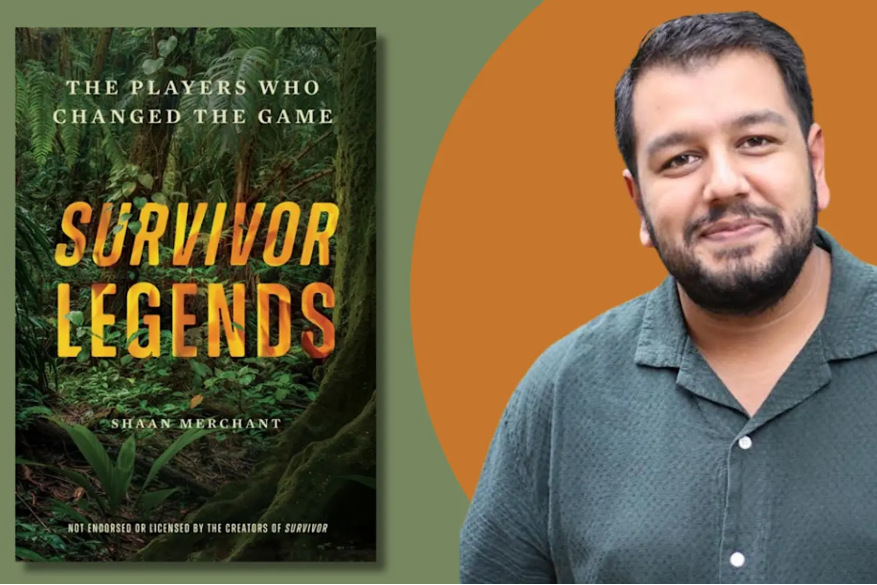
By Coral Gables Gazette staff
For 25 years, Americans have watched strangers lie, manipulate, betray allies, reinvent themselves, and compete for survival on a tropical island before a national television audience. Shaan Merchant argues that, in the process, Survivor accidentally became one of the most revealing cultural archives of modern America.
Merchant will discuss his new book, Survivor Legends: The Players Who Changed the Game, at Books & Books on Tuesday, May 26, at 7 p.m. The event is free and open to the public. Books will be available for purchase, though seating is not guaranteed and early arrival is recommended.
What initially sounds like an unlikely premise — using a reality television competition to examine American culture — becomes, in Merchant’s hands, a surprisingly expansive meditation on how the country has changed since the turn of the millennium. The book is nominally about Survivor. More fundamentally, it is about the audience that kept watching it.
A television show that became a cultural record
Merchant, whose journalism has appeared in publications including the New York Times, Slate, and the Philadelphia Inquirer, approaches Survivor not simply as entertainment, but as a long-running public record of evolving American ideas about morality, ambition, authenticity, race, gender, power, and social performance.
That perspective reframes the series entirely. What many viewers experienced as escapist television becomes, over time, a living archive of social values in transition.
The book examines contestants who reshaped the series across its first 25 seasons, from early strategic disruptors like Richard Hatch and Cirie Fields to later-era players whose influence extended well beyond the island itself. Merchant traces how contestants once condemned for manipulation later became celebrated tacticians, and how the public’s understanding of “heroes” and “villains” evolved alongside broader cultural debates happening across the country.
The timing matters. Survivor premiered in 2000, at the edge of a new century and before social media transformed public life. Over the next quarter century, the series unfolded alongside wars, economic upheaval, political polarization, changing conversations around race and gender, and the collapse of shared media culture into fragmented digital audiences. Through all of it, Survivor continued placing strangers into compressed social systems where alliances, loyalty, performance, and deception determined survival.
Merchant argues that the show often reflected the culture more accurately than audiences realized at the time.
Who gets remembered — and why
One of the book’s most compelling ideas is that Survivor became a kind of public laboratory for testing American attitudes toward power and morality.
Reality television is often dismissed as disposable entertainment — emotionally loud, culturally fleeting, designed more for reaction than reflection. Merchant sees Survivor differently. Each season, he suggests, captured a particular American moment: shifting attitudes toward leadership, competition, manipulation, identity, and belonging. Contestants frequently became symbols of broader cultural anxieties they did not necessarily intend to represent.
The book explores not only who won the game, but why certain players were celebrated, rejected, rehabilitated, or remembered differently as the culture itself evolved around them.
Richard Hatch, vilified by many viewers after the show’s first season for his unapologetic strategic manipulation, now appears almost foundational to modern reality competition television. Later players refined those same tactics into increasingly sophisticated forms of social gameplay. Meanwhile, contestants once dismissed by audiences were reevaluated years later through changing conversations surrounding race, gender dynamics, authenticity, and public identity.
Merchant also examines how production itself shapes collective memory. Editing decisions determine who becomes a protagonist, who becomes comic relief, who becomes a villain, and who disappears almost entirely. In that sense, Survivor became not only a game about power, but a show about storytelling itself — who controls narratives, how audiences internalize them, and why certain archetypes endure.
Beyond reality television
What gives Survivor Legends unusual reach is that Merchant’s argument extends far beyond reality television fandom.
He contends that the show’s influence now permeates mainstream storytelling and contemporary culture in ways that are rarely acknowledged directly. The social dynamics that define Survivor — strategic alliances, moral ambiguity, performative identity, shifting loyalty, public judgment — increasingly appear throughout prestige television and modern entertainment.
Former contestant Mike White, creator of HBO’s The White Lotus, serves as one of the clearest examples of how the boundaries between reality television and prestige storytelling have blurred. Merchant argues that the emotional and structural DNA of Survivor migrated into the broader culture long ago, even as critics continued dismissing reality television as unserious.
That observation also helps explain why the series has endured while many other reality programs faded. Survivor continuously adapts because the culture around it continuously changes. The rules of the game remain recognizable, but the moral expectations surrounding the players evolve with each generation of viewers.
The result, Merchant suggests, is a long-running cultural mirror that reveals as much about the audience as it does about the contestants themselves.
The Coral Gables event
The evening at Books & Books is likely to appeal not only to longtime Survivor fans, but also to readers interested in media criticism, contemporary culture, and the ways entertainment shapes public consciousness.
Merchant is originally from Nashville, Tennessee, and now lives in New York City. In addition to his print journalism, he has contributed research and production work for programs including Full Frontal with Samantha Bee, The Daily Show with Trevor Noah, and WNYC’s On the Media.
The event takes place Tuesday, May 26, at 7 p.m. Admission is free, though seating is limited and early arrival is recommended. Additional information is available through Books & Books.

Author: Coral Gables Gazette News Staff
Originally established in 1996 and relaunched as a digital publication in February 2025, the Coral Gables Gazette is an independent local news organization dedicated to factual, objective and accountable community journalism. Our newsroom reports on the people, policies, institutions and events shaping Coral Gables, Florida, providing residents with timely, informative coverage of the issues affecting their community. Our reporting includes City Hall, local government, municipal elections, public spending, real estate development, business, education, arts and culture, and neighborhood affairs throughout the City Beautiful. We follow City Commission decisions, examine public records and report on the businesses, organizations and individuals contributing to Coral Gables. We believe informed residents are essential to a healthy, engaged community. Stories published under the Coral Gables Gazette News Staff byline are prepared or compiled by the publication's editorial team. We strive for accuracy, fairness, transparency and clear distinctions between news reporting, opinion and advertising. Readers are encouraged to submit news tips, corrections, editorial inquiries and story suggestions through our Contact page and learn more about our standards through our Editorial Policy.











This show was never a really good view of “American Culture” … at least the culture most of would like to live by