
By the Coral Gables Gazette editorial board
A budget is an act of confidence. Every line item that projects revenue and authorizes spending reflects a judgment that the conditions behind it will hold. Governments make these judgments every year, and they are usually right enough. The question worth asking is what happens when they are not.
The City of Coral Gables released its midyear financial report at a moment that, on the surface, looks stable. Revenues are substantial. Core services are funded. The city is operating within a larger budget than last year. And yet the numbers point in a different direction.
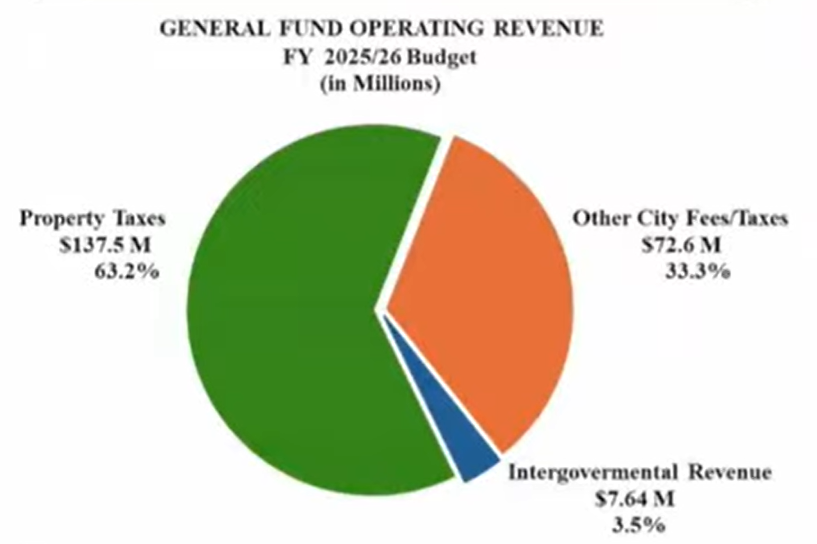
Through the first half of fiscal year 2026, the city has collected slightly less, as a share of its budget, than it had at the same point a year earlier — even as that budget has grown by more than $16 million. The difference is modest in percentage terms. It is more consequential in what it suggests: that the assumptions underlying the city’s financial plan are beginning to drift from the conditions that support them.
The report does not show broad weakness. It shows something more specific. The categories most closely tied to development activity — construction permits and Planning and Zoning fees — are running well behind last year’s pace, against a budget that assumed they would grow. At the same time, design review activity through the Board of Architects has nearly doubled year over year. The result is an uneven pattern: Parts of the development pipeline appear active while others lag.
Budgets are often treated as statements of fact. They are, in reality, statements of expectation. They reflect assumptions about growth, behavior, and conditions that cannot be fully controlled. When those assumptions begin to shift, the most important question is not whether the numbers still add up but whether the assumptions still hold.
The midyear report suggests that some of them may not.
That possibility is sharpened by what is happening elsewhere in the city’s finances. The Coral Gables Country Club fund required a $1.4 million transfer from the General Fund at midyear — nearly triple last year’s transfer of $507,400. The Transportation and Trolley fund posted a wider operating loss than the prior year, reflecting the addition of the Southern Loop pilot. These are policy choices. The city is deciding, in real time, what to maintain, what to expand, and what to subsidize. Those decisions become consequential when made against a revenue picture less certain than the budget assumes.
Property taxes, the city’s largest source of revenue, provide a reliable base — but they are largely front-loaded, arriving early in the fiscal year and offering limited ability to offset softness elsewhere once collected. That role falls to more dynamic sources: permits, fees, and activity-driven revenue. It is precisely those sources that are showing strain.
The framework also carries risk beyond the city’s control. Discussions at the state level about changes to property tax structures remain unresolved. The outcome of those debates is unclear. What is clear is that Coral Gables, like many municipalities, relies heavily on revenue sources that could be affected by decisions made elsewhere. The current report does not measure that risk. It does illustrate why it matters: a budget that depends on growth-sensitive revenue is less insulated from change. If one part of the system softens while another remains fixed, the pressure does not disappear. It shifts.
That is what the midyear numbers show —a redistribution of pressure within the system.
The city’s financial position remains stable. Revenues are substantial. Core services are funded. The question is how closely the city’s financial model aligns with the conditions that will shape tomorrow.
We believe this moment calls for that kind of deliberate examination.
Construction activity may accelerate in the second half. Fee collections may recover. The Venetian Pool, recently reopened after a $6 million restoration, is expected to generate stronger revenue after a partial-year closure. There are pathways to alignment.
But none of them are guaranteed.
The sooner the gap between expectation and performance is acknowledged, the more options the city will have. Coral Gables is not facing a fiscal imbalance. It is facing a moment of recalibration. The budget assumes momentum. The midyear data shows hesitation.
The task now is to understand that gap—and decide how to respond.











Great layout of the dynamics fluctuations involving the “iffy” categories of cyclical revenue sources. Thank you
As an Economist by education these very factors were a constant challenge to any type of similar budgets relating to fixated and variable options almost like gazing into a crystal ball and crossing your fingers
Sure, there’s plenty of new ideas that may come into play and save the inevitable and unwelcome move to raise property taxes yet one crucial area that is in dire need of analysis is the expense-side of our budget and now we have approved an inspector general to take a deep dive into our ledgers and make some timely recommendations to address this in a beneficial fiscally responsible analysis
Again, thank you for your analysis