
By Coral Gables Gazette staff
You can start at the Biltmore, take a trolley across town, pass the Venetian Pool, and end up in a City Commission meeting that never seems to end. Along the way you might land on a hotel, a college, a landmark fountain, or a local business whose name is as familiar as the street it sits on. The money bears the face of George Merrick. The tokens include a trolley, a clock, and a rubber duck. You do not pass Go. You sit through a commission meeting.
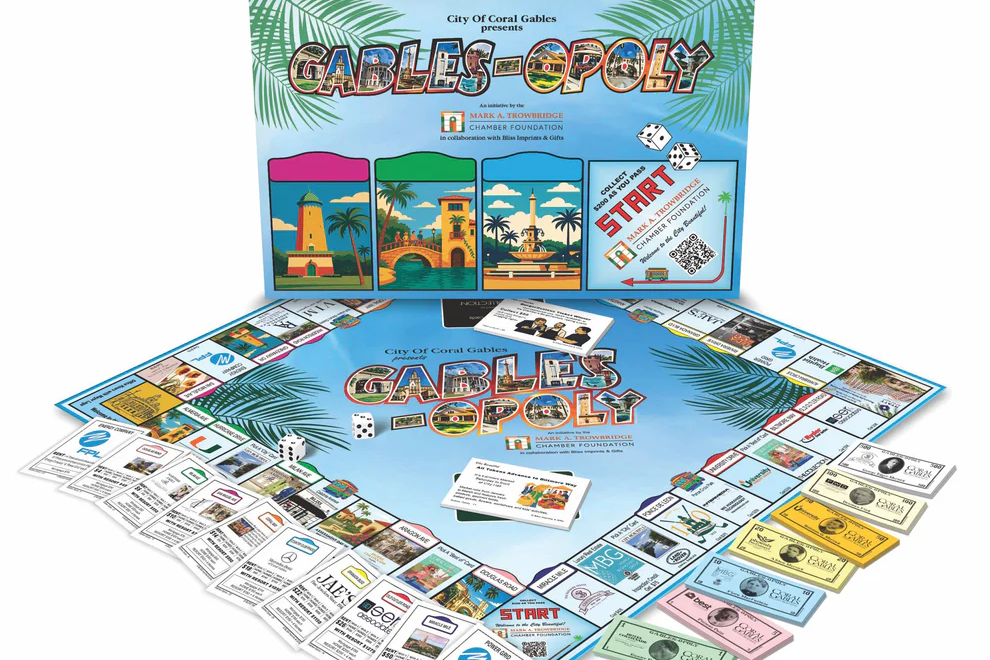
This is Gables-Opoly, a limited-edition board game presented by the City of Coral Gables in partnership with the Mark A. Trowbridge Chamber Foundation — and it is more than a novelty. It is a curated portrait of the city, one square at a time. The game made its public debut earlier this month, where a larger-than-life version of the board took over Giralda Plaza and invited passersby to step inside the game. It is now available for $29.95 at select local retailers and online, with the initiative expected to generate more than $150,000 for the Foundation’s work in business development, education, and workforce programs.
What’s on the board
The game was created by Eddy Martinez, co-owner of Bliss Imprints and Gifts on Miracle Mile, in collaboration with the Coral Gables Chamber of Commerce. The design substitutes Coral Gables equivalents for every element of the classic Monopoly layout. The railroads are gone, replaced by the Coral Gables Trolley. The utilities include Florida Power and Light. The currency bears the face of George Merrick, the city’s founder. The properties include the Biltmore Hotel, the Venetian Pool, the University of Miami, the Hotel Colonnade, and the Hyatt Regency Coral Gables, along with more than 40 local events, departments, and community organizations represented across the board.
The playing tokens are where the game’s personality lives most vividly. Players can move through the board as a lighthouse, a heart sculpture, a trolley, a classic car, a parking meter, or a rubber duck. The rubber duck is not arbitrary. It is a tribute to the late Mark Trowbridge, the longtime president and CEO of the Coral Gables Chamber of Commerce, who was known across the city as Mr. Coral Gables and was famous for carrying a rubber duck as a kind of personal signature. The foundation bearing his name is the game’s primary beneficiary. “Gables-Opoly was created to capture the spirit and small details that define Coral Gables and shape its unique identity,” Martinez said in published reports.
How the board got built
The board is not a strict map. It does not attempt to replicate geography or hierarchy. Instead, it reflects participation — a blend of historic landmarks, civic institutions, and the more than 30 local businesses that helped fund the project and earned a place on the board. That mix is the point.
The game serves as a fundraiser. Participation helps finance the initiative. Inclusion on the board follows. What emerges is a civic artifact shaped both by history and by the present-day network of businesses and institutions that chose to take part. A city’s identity is not handed down from above; it is assembled from the people and places that show up, invest, and engage. Gables-Opoly is, in that sense, an accurate record of contemporary Coral Gables.
Thirty percent of every sale goes directly to the Mark A. Trowbridge Chamber Foundation. The initiative is projected to generate more than $150,000 in long-term support for the Foundation’s programs in education, workforce development, and inclusive hiring. The game is presented by the City of Coral Gables in partnership with the Foundation, and created in collaboration with Bliss Imprints and Gifts.
A city representing itself
The board does not claim to define Coral Gables. It reveals how the city sees itself — through its landmarks, its institutions, and the businesses and organizations that chose to be part of the picture. Every city eventually produces an artifact that tries to capture what the city is. Gables-Opoly is Coral Gables’ version, and it is more interesting than most because it asks residents to do something with it. You do not look at Gables-Opoly. You play it. You own Miracle Mile or you do not. You get stuck at the commission meeting or you do not. The game makes the city into a system with rules and luck and winners and losers.
The game also arrives at a specific historical moment. It was developed as the city wrapped up a yearlong celebration of its centennial — 100 years since George Merrick incorporated Coral Gables in 1925. The Merrick currency is not decorative in that context. It is a statement about continuity: the city that Merrick designed with a particular idea of beauty and civic ambition is still here, still debating its identity, still producing artifacts that try to explain what it means to live here.
The rubber duck
Of all the design choices in Gables-Opoly, the rubber duck token is the one that will mean the most to people who knew Mark Trowbridge and nothing at all to people who did not. That asymmetry is intentional and appropriate. Local memory works that way. The people who were there understand the reference. The people who were not are invited to ask about it, which is how a city passes its stories from one generation to the next.
Trowbridge spent decades building the institutional infrastructure that made Coral Gables’ business community function — the relationships, the programs, the civic rituals that turn a collection of storefronts into something resembling a community. He was known as Mr. Coral Gables not because he was the most powerful person in the room but because he was the most present. The foundation bearing his name continues that work. The rubber duck on the game board is a small, specific and entirely Coral Gables way of saying so.






YES. WE OWN A PIECE OF CORAL GABLES!
Our organization is supporting the Mark A. Trowbridge Legacy Initiative commemorating the City of Coral Gables Centennial Foundation with the sponsorship of a Property Space!
Sau khi tham gia 66b nguyễn sỹ sách , tôi thấy phần đăng ký và đăng nhập được thiết kế rất đơn giản và tiện lợi. TONY05-22