

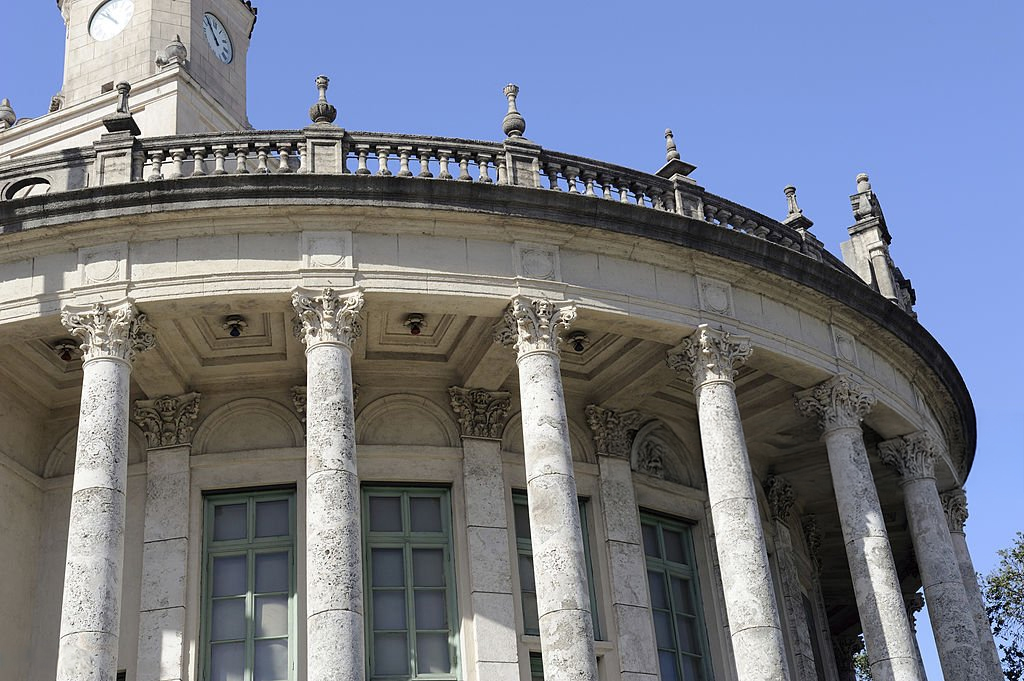
What began as a routine presentation on updated floor plans for the historic Coral Gables City Hall renovation quickly evolved into a broader debate at the January 27 commission meeting over how far the city should go in hardening the century-old building against modern security threats, with commissioners pressing for physical barriers and controlled access while architects initially emphasized solutions designed to preserve the building’s open historic layout.
Architects outline updated floor plans while preserving historic layout
Richard Heinsenbottle, president of R.J. Heisenbottle Architects, walked commissioners through revised plans showing the organization of departments across multiple floors, maintaining much of the building’s historic configuration while introducing modern amenities.

“The city manager’s office is in the same place it is in today,” Heinsenbottle said. “Wherever possible, we have tried to maintain consistency with what was historically there with just a handful of adjustments.”
He described new restrooms and break rooms on each floor, flexible spaces on the ground level, and a large conference room and gallery space. The second floor, he noted, would remain the elected officials’ floor, with the mayor’s administrative area centered along the building’s historic axis.
“All of the mayor’s administrative area is right on the center line of the building lining up with the mayor’s balcony,” Heinsenbottle said.
Access to commissioners’ offices, he explained, would be controlled through a central reception desk, with individual offices secured by locking systems.
“Each one of your offices has a locking device and you’re only going to be able to get in if you’re authorized,” he said.
Mayor presses for physical barriers to control access and noise
But Mayor Vince Lago repeatedly raised concerns that the open corridor outside the offices left both officials and staff vulnerable, pointing to noise disruptions, privacy issues, and prior incidents involving members of the public.
“I walked into my office and there was somebody using my bathroom,” Lago said. “That’s a problem.”
He argued that the corridor needed a physical break, similar to a partition wall already installed outside his current office.
“There has to be some sort of partition wall,” Lago said. “There has to be something there which breaks the corridor both on the left and the right side. I think it provides the necessary security and the break where you don’t have people congregating in those hallways.”
Lago emphasized that the change was not about aesthetics or personal preference.
“This is for future elected officials,” he said. “I’m not going to be here when this is being completed.”
Vice mayor and architect discuss noise and reception controls
Vice Mayor Rhonda Anderson echoed concerns about both noise and uncontrolled access, recalling issues with glass partitions and visitors entering offices unexpectedly.
“When you were having meetings, I might as well just be in the room with you because there was a piece of glass in between,” Anderson said. “The other problem that we have is because people don’t know which door to enter. They just come in and you’re in the middle of another meeting.”
She suggested a buzzer or controlled entry system tied to the reception area.
Architects initially pointed toward soundproofing and procedural controls rather than structural barriers.
“That corridor is in fact a waiting room for everyone on the floor whenever they have office hours,” Heinsenbottle said. “There’s no other place large enough for them to wait.”
He added that acoustic measures would be incorporated.
“We can sound isolate every one of those walls so that they’re sound insulated with an SDC rating of over 50,” he said. “We’ll use acoustical plaster on the ceilings.”
City manager details building-wide security upgrades
City Manager Peter Iglesias reinforced that security was already being built into the overall design, particularly at the building’s main entrance.
“We are using the courtyard entrance as the main entrance,” Iglesias said. “There is a screen at that first floor. The two other doors are just used for fire. You can get out but you can’t come in.”
He explained that all visitors would pass through magnetometers, with security personnel and cameras monitoring the building.
“Everybody will come through that security area,” Iglesias said.
Commissioners raise safety concerns
Commissioner Richard Lara focused on the safety of frontline staff.
“Currently a member of the public could come through the main doors on the first floor up the stairs, come in through the double door where our liaison is working and they have no idea who’s coming through,” Lara said. “Many times it is not inconceivable that you can have somebody come in and they may be irritated about something.”
Commissioner Ariel Fernandez broadened the discussion to modern security realities, describing a violent incident he witnessed in a congressional office that lacked a protected reception area.
“There should be a level of protection,” Fernandez said. “You just don’t know. That’s the reality that we’re living in today.”
Fernandez also questioned whether the first floor of City Hall was sufficiently hardened, noting that a heavily used conference room sat outside the protected zone.
“I don’t think we’ve hardened the building enough in these plans,” he said.
Commission votes to add partition wall and door
While architects continued to emphasize screening and controlled access at the building’s main entrance, commissioners returned repeatedly to the need for a physical barrier on the second floor to create a protected zone outside elected officials’ offices.
“I’m going to make a motion to do exactly what I have there now for the future commissioners,” Lago said, calling for a control wall and door at the reception area.
Anderson seconded the motion.
After a brief procedural clarification from City Attorney Cristina Suárez, the commission voted unanimously to add the partition wall and door to the renovation plans.
Architects and city staff agreed to incorporate the change, along with enhanced soundproofing and the broader security upgrades already planned.
Renovation moves forward with security shaping design
Iglesias indicated the city was ready to move forward with construction documents once commissioners expressed general satisfaction with the layout.
“We will have a very robust security system,” he said.
As the presentation concluded, Heinsenbottle summarized additional design elements, including concealed HVAC systems above the mezzanine floor to improve the building’s historic appearance and new office layouts for the city attorney and other departments.
Despite the initial focus on floor plans and architectural features, the extended discussion underscored a central challenge facing the renovation: balancing preservation of the historic City Hall’s traditional openness with the demands of modern security and privacy.
In the end, commissioners made clear that contemporary safety concerns would shape the final design, even if it required altering the building’s original flow.

Author: Coral Gables Gazette News Staff
Originally established in 1996 and relaunched as a digital publication in February 2025, the Coral Gables Gazette is an independent local news organization dedicated to factual, objective and accountable community journalism. Our newsroom reports on the people, policies, institutions and events shaping Coral Gables, Florida, providing residents with timely, informative coverage of the issues affecting their community. Our reporting includes City Hall, local government, municipal elections, public spending, real estate development, business, education, arts and culture, and neighborhood affairs throughout the City Beautiful. We follow City Commission decisions, examine public records and report on the businesses, organizations and individuals contributing to Coral Gables. We believe informed residents are essential to a healthy, engaged community. Stories published under the Coral Gables Gazette News Staff byline are prepared or compiled by the publication's editorial team. We strive for accuracy, fairness, transparency and clear distinctions between news reporting, opinion and advertising. Readers are encouraged to submit news tips, corrections, editorial inquiries and story suggestions through our Contact page and learn more about our standards through our Editorial Policy.










Excellent coverage of important issues at city hall not found in other media outlets. Kudos to the Gazette team for precision and depth of detail on these important matters.