By Coral Gables Gazette staff
Nearly a century after Soviet authorities pulled Earth from release after just nine days, the 1930 Ukrainian silent classic will screen next week at the Coral Gables Branch Library on 16mm, drawn from one of the country’s rare circulating public-library film collections.
The Miami-Dade Public Library System’s AV Club presents Earth, directed by Alexander Dovzhenko, on Wednesday, July 15, from 5 to 7:30 p.m. The screening is the third and final installment of Masters of Montage: The Revolutionary, the Scientist, and the Poet, a series exploring how political upheaval and artistic ambition collided in early Soviet cinema. The program is restricted to attendees 19 and older.
A poet among revolutionaries
The series pairs three landmark Soviet directors under contrasting labels: Sergei Eisenstein, “The Revolutionary,” represented by Battleship Potemkin; Dziga Vertov, “The Scientist,” represented by Man with a Movie Camera; and Dovzhenko, “The Poet,” whose Earth closes out the series.
Where Eisenstein’s films argue through montage and Vertov’s celebrate the camera’s mechanical eye, Dovzhenko’s is often described as the most lyrical of the three, built around the rhythms of harvest, birth and death in a Ukrainian farming village rather than direct political argument.
That distinction did not spare it from controversy.
Why Earth unsettled Soviet censors
Earth is set during the forced collectivization of Ukrainian farmland under Stalin’s first Five-Year Plan, a campaign that pitted the Soviet state against landowning peasants known as kulaks and that Dovzhenko, a Ukrainian filmmaker, treated less as propaganda than as a meditation on land, machinery, death and renewal.
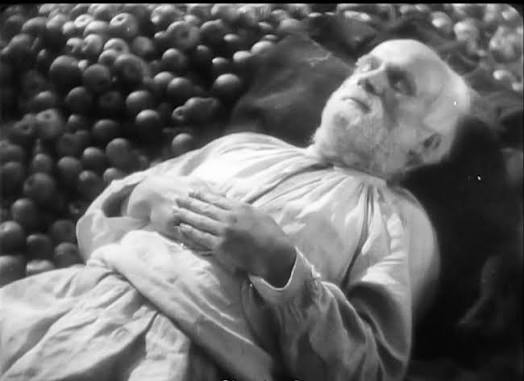
The film follows a young man’s death at the hands of a kulak opposed to collectivization, building to an extended funeral sequence widely regarded as one of the era’s most powerful uses of montage.
Soviet officials, who had praised Dovzhenko’s earlier work, found Earth ideologically unclear rather than persuasive. Critics attacked what they saw as its focus on nature and the body over doctrine, and the film was pulled from release just nine days after it opened in April 1930.
Specific scenes were cut before and after release, including a scene of a grieving woman appearing nude and another depicting peasants relieving themselves into a tractor radiator. At least six edited versions of the film have circulated in the decades since. Dovzhenko’s own father was reportedly expelled from his farming collective in the fallout.
Despite, or because of, that history, Earth is now widely regarded as one of the defining works of Soviet-era cinema and a high point of the montage technique the library series is built around.
Each screening in the series opens with a multimedia presentation on how Soviet ideology both fueled and constrained its filmmakers, followed by an open discussion after the film.
A living 16mm archive
The screening also highlights the library system’s 16mm film collection, which dates to 1956 and was built as a teaching collection for public programming.
Miami-Dade Public Library describes it as one of the last remaining circulating 16mm film collections in the nation. Alongside acclaimed features such as Rashomon, The Passion of Joan of Arc and Alphaville, the collection includes short films by artists including Len Lye, Luis Buñuel and Eisenstein himself, as well as Florida-specific titles documenting the state’s history.
Library cardholders can check out films from the collection for two weeks, though the library does not lend projection equipment.
What to know
Earth screens Wednesday, July 15, from 5 to 7:30 p.m. at the Coral Gables Branch Library, 3443 Segovia St. The program is open to attendees 19 and older.
For more information or accessibility accommodations, contact 305-442-8706 or capleybr@mdpls.org.

Author: Coral Gables Gazette News Staff
Originally established in 1996 and relaunched as a digital publication in February 2025, the Coral Gables Gazette is an independent local news organization dedicated to factual, objective and accountable community journalism. Our newsroom reports on the people, policies, institutions and events shaping Coral Gables, Florida, providing residents with timely, informative coverage of the issues affecting their community. Our reporting includes City Hall, local government, municipal elections, public spending, real estate development, business, education, arts and culture, and neighborhood affairs throughout the City Beautiful. We follow City Commission decisions, examine public records and report on the businesses, organizations and individuals contributing to Coral Gables. We believe informed residents are essential to a healthy, engaged community. Stories published under the Coral Gables Gazette News Staff byline are prepared or compiled by the publication's editorial team. We strive for accuracy, fairness, transparency and clear distinctions between news reporting, opinion and advertising. Readers are encouraged to submit news tips, corrections, editorial inquiries and story suggestions through our Contact page and learn more about our standards through our Editorial Policy.