
By the Coral Gables Gazette editorial board
For months, Coral Gables First raised almost nothing.
Then, in a four-day window immediately after the candidate-qualifying period closed, the Lago-linked political committee collected $134,500.
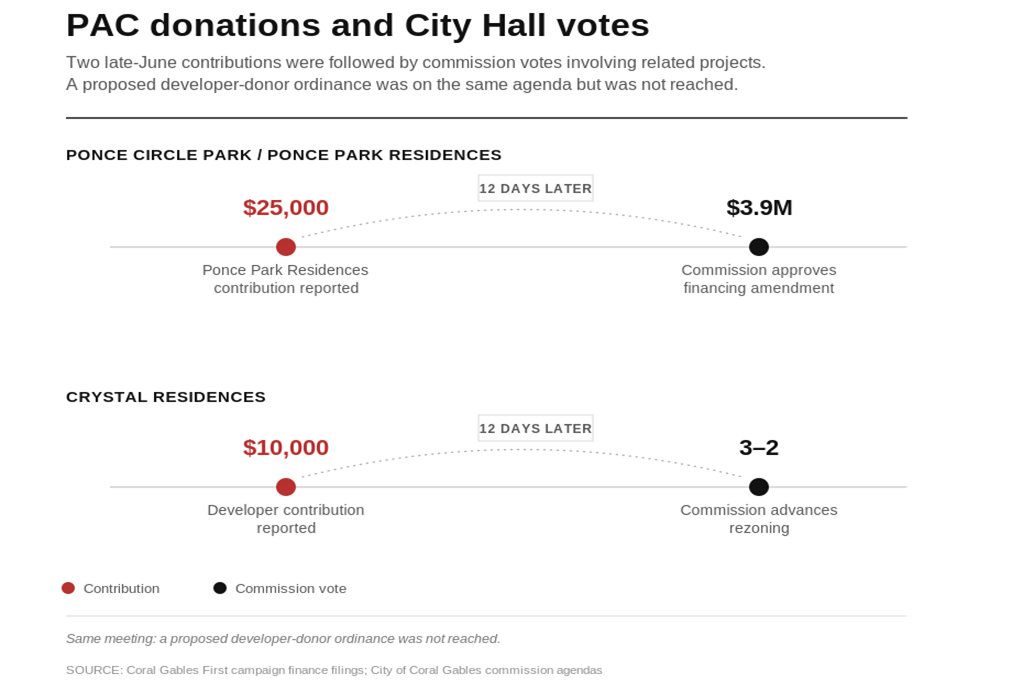
Two of those contributions sat close to commission votes involving projects tied to the donors. A $25,000 contribution from a developer entity came less than two weeks before commissioners approved a $3.9 million financing amendment for the Ponce Circle Park redesign beside that developer’s project. A $10,000 personal contribution from another developer came before a contested rezoning vote on Crystal Residences, his project.
Nothing in the public record shows either vote was decided by the contribution that came before it. Nothing in Florida law required either donor to wait.
That last point is worth sitting with, because it is the actual subject of this editorial.
Florida law allows political committees to accept money that candidate campaigns cannot, including larger checks from corporations and from people or entities with business before local governments. Florida’s campaign-finance laws regulate candidates, political committees and electioneering communications organizations, among others, but they do not by themselves resolve the local ethics question Coral Gables now faces.
What remains a local choice is whether Coral Gables wants its own ethics code to say more.
The public record identified in this reporting does not show a city rule requiring a commissioner to disclose, step back from or publicly acknowledge a vote involving a recent donor to a political committee tied to, supportive of or politically associated with that commissioner. Residents are left to reconstruct the calendar themselves: contribution by contribution, donor by donor, agenda item by agenda item.
That is too much to ask of the public and too little to ask of City Hall.
Coral Gables has already begun to confront the issue. Then it stopped.
An ordinance sponsored by Commissioner Melissa Castro, which would create a new Section 2-309 of the city code prohibiting campaign contributions from real estate developers, appeared on the July 7 commission agenda. The meeting ran long. The item was never reached.
It was not voted down. It was not debated. It was not formally set aside after a public airing.
It simply remains unfinished.
That matters because the ordinance is not framed merely as an election-law measure. It would sit in Chapter 2, Article V of the city code: “Conflict of Interest and Code of Ethics.” That is the right frame.
This is not only a question about campaign mechanics. It is a question about public trust in land-use, zoning, development-agreement and procurement decisions. When people asking the city for valuable approvals also write large checks to committees politically associated with city officials, residents deserve rules that are clear before the vote, not explanations after it.
Coral Gables would not be inventing this concept from nothing. Miami Beach’s current rules restrict candidates for mayor and commission from directly or indirectly soliciting vendors, real estate developers or their lobbyists for contributions not only to campaigns, but also to political committees and electioneering organizations involved in city elections.
That precedent is worth studying. It is also worth qualifying.
A rule is only as strong as its definitions. If Coral Gables bans contributions only from a narrow category of “real estate developers,” it may miss much of the influence network that surrounds local government: architects, land-use lawyers, contractors, consultants, vendors, business entities, family affiliates and others with a direct stake in city decisions.
Castro’s ordinance may be the right starting point. It should not be treated as the final word.
The commission should ask the city attorney to explain, publicly and plainly, how far Coral Gables may go under state law. It should examine whether the ordinance reaches only pending development applications or also recent approvals, development agreements, procurement matters and related entities. It should consider whether disclosure, recusal or contribution restrictions are the right tools, and where state preemption limits local action.
But it should have that debate in public.
None of this requires assuming bad faith by any donor or elected official. Developers, contractors and other business interests have legitimate reasons to support candidates and committees whose views they share. Participation in civic life is not improper merely because a participant has business before the city.
But the standard for public confidence cannot be limited to whether a contribution is legal.
The better question is whether residents can see, clearly and in time, when money tied to city business is moving into city politics — without needing to cross-check campaign reports, corporate records, property files and commission agendas themselves to understand who is funding whom while votes are pending.
That is exactly what local ethics rules are for.
Coral Gables should not wait until the next fundraising report, the next rezoning fight or the next public-works contract to decide whether its standards are adequate. The ordinance has a sponsor. It has a subject. It has already appeared on an agenda.
Now it needs a hearing.
The City Commission should place Section 2-309 back on the calendar, debate it fully and decide in public whether Coral Gables is prepared to ask more of itself than Florida law already requires.
The law may allow political committees to collect large checks from interests with business before local government.
Coral Gables should decide whether that is good enough.













All large donations from big corporations to any candidate’s campaigns should just be stopped. This includes all levels of politics – local, state and federal. Donations should come from individuals and be limited in size. Perhaps this would level the playing field?
This will be a bigger problem in a November election with more uninformed voters. Political Cortadito ran an article in July that Commissioner Lara spent $753,000 to become a Commissioner:
. https://politicalcortadito.com/2025/07/16/coral-gables-developers-lobbyists-lead-giving-753k-to-elect-richard-lara/
He got 4,421 votes in the general election (13.8% of registered voters). The cost is almost $160 per vote! I got 3,921 votes in the general election (11.5% of registered voters) and contributed $19,400 to my campaign because candidates for local office should fund their own campaign for independence to residents and avoid being bought by developers. My cost was under $5 per vote. Money can purchase a result for developers with goals inconsistent with residents that increase density, traffic, safety, police, fire and infrastructure demands. Lago and Anderson did nothing to bring residents to polls, have a candidate townhall meeting or allow candidates to purchase a booth at the Farmers Market. They want to increase their incumbent advantage more than letting residents decide what is best for their City. Lago even campaigned for Lara and is still vindictive against Fritz & Franz because it had my signs in its window – just like Joe Carollo with Ball & Chain. Sadly, with incumbents more worried about getting re-elected than quality of life for residents, it is unlikely that Coral Gables will have any campaign reform. And that will diminish our quality of life.
Good luck with any reform unless a large amount of residents push it forward. You will get nothing as long as King Lago rules Coral Gables. He has all his sidekicks and puppets in his pocket. The reason being if they do not do what he wants he will punish them. Lago = Joe Carollo, a vindictive autocrat who is ruining this City by making it a concrete jungle for pay-offs. We have said over and over no more construction, but it continues at record speed. We did not know of your pocket money schemes. Your job was to recuse yourself on all voting items. If you did and if you disclosed your money tree, maybe we would not be sickened by your behavior. The fact that you have not disclosed your PAC pay-offs shows how despicable he is. I have no respect for him at all.
I can not accept the behavior of Lago, our underhanded Mayor and Lara our undistinguished commissioner. You should have made the residents of this City aware of the back door payouts by developers. and you absolutely should have recused yourselves from voting for these projects. When there was a contribution before or after the vote does not matter. You lined them up behind our backs and showed incredible dishonestly. I have been on the receiving end of Lago’s arrogance, and have been disgusted by his attitude.
Explore premium selections crafted for comfort, durability, and enjoyable performance. Whether you’re new or experienced, a sex toy can add excitement and variety to personal moments. Enjoy trusted quality, discreet packaging, and convenient online shopping with products designed to provide lasting satisfaction and dependable value for every purchase.
It is remarkable that the Crystal Residences developer and the commissioners that support them are able to get away with taking advantage of a bunch of autism parents in order to destroy a historic property. That should be the story. These parents are misled into being so desperate as to believe that the only possible place in the world that can help their children needs to be this school at this location ONLY if the old property is completely destroyed. I don’t know how these people can look at themselves in the mirror.
ogs7aw
Hi there! This post couldn’t be written any better! Reading through this post reminds me of my previous room mate! He always kept talking about this. I will forward this article to him. Pretty sure he will have a good read. Thank you for sharing!
Explore varied intimate accessories designed for adult personal enjoyment and flexible routines. Compare shapes, textures, sizes, and materials to find a comfortable option suited to your preferences. Smooth, body-safe construction can support easier cleaning and everyday care. The anal toys collection offers multiple designs for adults seeking variety, convenient online shopping, discreet packaging, and dependable product quality for adults today.