
By Coral Gables Gazette staff
The 2026 Academy Award winner for Best Documentary Feature arrives at the Coral Gables Art Cinema this week with a story that began inside a small Russian school and ended with footage smuggled out of the country.
Mr. Nobody Against Putin, directed by David Borenstein and co-directed by Pavel Talankin, screens Friday through Monday, May 22 through 25 and again May 28 at 2:45 p.m. and 7 p.m. Tickets are $8 for members and $12.75 for nonmembers.
What the film is
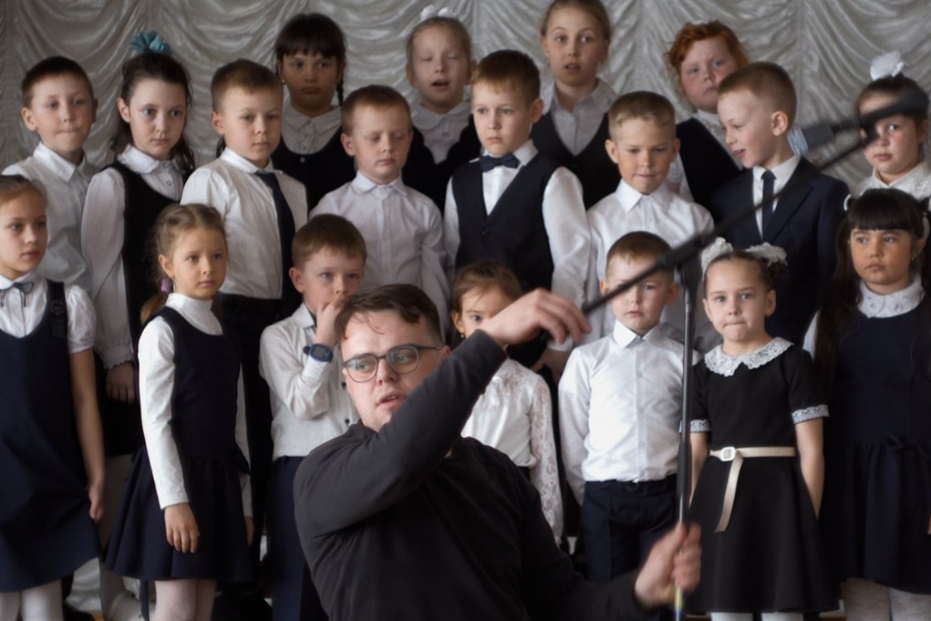
Talankin is an unlikely whistleblower — a beloved Russian school videographer and teacher known by students as a mentor and prankster who offered them refuge in his office. After Russia invaded Ukraine, his role inside the school changed dramatically as patriotic programming and state messaging began reshaping daily life in the classroom.
Then the Russian government issued a directive: schools were required to film and document their patriotic education programs as proof of compliance.
Talankin complied publicly. Quietly, he began preserving something else.
Instead of simply submitting footage to the Ministry of Education, Talankin secretly sent material to foreign filmmakers, documenting how propaganda, nationalism, and political conformity gradually transformed the school and the community around it.
Over two years, Talankin recorded assemblies, classroom messaging, student activities, and increasingly militarized civic rituals inside the industrial Russian city of Karabash. The footage was eventually smuggled out of Russia to Denmark, where co-director David Borenstein assembled the documentary in Copenhagen.
The result is a film that functions simultaneously as political reporting, personal testimony, and a portrait of moral conflict inside an authoritarian system.
What makes it distinctive
What separates Mr. Nobody Against Putin from many contemporary political documentaries is its scale. Rather than attempting to explain the entirety of modern Russia or the war in Ukraine, the film confines itself largely to one school, one town, and one increasingly conflicted man watching his environment change around him.
That narrow focus gives the documentary unusual power.
The transformation unfolds incrementally: patriotic assemblies become routine, military symbolism enters classrooms, students repeat official slogans, and ordinary educational rituals begin carrying political meaning. The film understands that systems of propaganda rarely arrive all at once. They emerge gradually through repetition, institutional pressure, and the normalization of language.
Talankin himself remains central to the film’s effectiveness because he does not initially appear to think of himself as an activist. He is frightened, conflicted, emotionally attached to his students, and visibly uncertain about the risks of what he is doing. The documentary’s emotional weight comes less from confrontation than from watching an ordinary person slowly realize neutrality may no longer be possible.
The New Yorker’s Richard Brody called it “remarkable — an exemplary work of cinematic modernism, a reflexive film that turns its genesis into its subject and its moral essence.” Kino Lorber describes it as “a cross between School of Rock and 1984, a surprisingly funny study of how authoritarian regimes break the spirit of all except the most unlikely” — a formulation that captures the film’s tonal range, which moves between warmth, dark comedy, and genuine alarm.
The awards context
The film won the 2026 Oscar for Best Documentary Feature. It also received the BAFTA for Best Documentary. It premiered at the Sundance Film Festival in January 2025, where it won a special jury award and sparked global attention. Talankin, who now lives in the Czech Republic after fleeing Russia, accepted the awards alongside Borenstein and producer Helle Faber.
Why it matters now
The documentary arrives at a moment when questions surrounding propaganda, nationalism, institutional loyalty, and information control resonate far beyond Russia itself. But the film’s strength lies in its refusal to become abstract. It grounds those themes in classrooms, school hallways, awkward ceremonies, and the daily routines through which governments shape civic identity.
That perspective makes the documentary unsettling precisely because so much of it initially appears ordinary.
For the Coral Gables Art Cinema, the screening continues the theater’s long-standing commitment to international and politically consequential filmmaking — programming that treats cinema not merely as entertainment but as a way of understanding how power and individual conscience intersect.
What to know
Mr. Nobody Against Putin screens May 22 through 25 and again May 28 at the Coral Gables Art Cinema, 260 Aragon Avenue, Coral Gables. Showtimes are 2:45 p.m. and 7 p.m. Tickets are $8 for members and $12.75 for nonmembers. Additional information and tickets are available through the Coral Gables Art Cinema website.

Author: Coral Gables Gazette News Staff
Originally established in 1996 and relaunched as a digital publication in February 2025, the Coral Gables Gazette is an independent local news organization dedicated to factual, objective and accountable community journalism. Our newsroom reports on the people, policies, institutions and events shaping Coral Gables, Florida, providing residents with timely, informative coverage of the issues affecting their community. Our reporting includes City Hall, local government, municipal elections, public spending, real estate development, business, education, arts and culture, and neighborhood affairs throughout the City Beautiful. We follow City Commission decisions, examine public records and report on the businesses, organizations and individuals contributing to Coral Gables. We believe informed residents are essential to a healthy, engaged community. Stories published under the Coral Gables Gazette News Staff byline are prepared or compiled by the publication's editorial team. We strive for accuracy, fairness, transparency and clear distinctions between news reporting, opinion and advertising. Readers are encouraged to submit news tips, corrections, editorial inquiries and story suggestions through our Contact page and learn more about our standards through our Editorial Policy.











Bài viết rất hữu ích cho công việc của tôi xn88. TONY07-20