
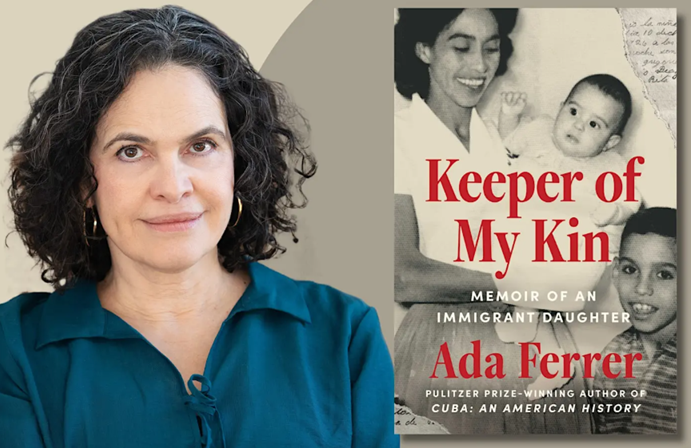
By Coral Gables Gazette staff
Ada Ferrer has spent three decades writing about Cuba — its revolutions, migrations, political ruptures, and complicated relationship with the United States. Her latest book turns that same historical lens on her own family.
The result is Keeper of My Kin: Memoir of an Immigrant Daughter, one of the most anticipated memoirs of the spring publishing season. Ferrer will appear in conversation with journalist and author Mirta Ojito on Thursday, May 21, at 7 p.m. at the Sanctuary of the Arts in Coral Gables. The evening is presented by Books & Books in partnership with the University of Miami’s Cuban Heritage Collection. Tickets are required and include a copy of the book.
The book
Published by Scribner, Keeper of My Kin combines memoir and history in a way that reflects Ferrer’s particular gifts as a writer — she is a Pulitzer Prize–winning historian who has never written anything purely academic, and a daughter and sister who has never written anything purely personal. This book is both at once.
The story begins in April 1963, four years after Fidel Castro came to power, when Ferrer’s mother made the agonizing decision to leave Cuba with her ten-month-old daughter Ada while leaving behind her nine-year-old son, Poly. That separation, which lasted nearly two decades, becomes the emotional spine of the memoir.
Moving across generations and across the Florida Straits, Ferrer reconstructs the lives of those who left and those who stayed behind: her parents, who rebuilt their lives in the United States; the grandmother who raised Poly after their departure, a Black woman born a year after the end of slavery in Cuba; Poly himself, whose life was shaped irrevocably by revolution and family rupture; and a once-secret brother named Juan José, whose existence Ferrer discovered only later.
Part of the book’s emotional and historical texture comes from a cache of letters exchanged across years of family separation, discovered after the deaths of Ferrer’s parents, alongside government records obtained through Freedom of Information Act requests. The combination of intimate correspondence and institutional archives gives the memoir unusual depth.
Ferrer the historian and Ferrer the daughter are the same person looking at the same evidence from two directions.
The reception
The memoir arrives with extraordinary critical attention. Publishers Weekly, in a starred review, praised Ferrer for how she “braids a clear-eyed account of recent Cuban history with an empathetic catalog of its effects on her family,” calling the book “a memorable and heartrending achievement.”
Javier Zamora, author of Solito, described it as “a brilliant testament to the power of storytelling — a devastatingly human portrayal of the effects of migration, family secrets, and the history that binds and moves us.”
Historian Martha S. Jones placed the memoir within a broader contemporary political context, describing it as “a gift to a nation striving to better understand the stakes of every stop, detention, and expulsion carried out today.”
The author and the conversation
Ferrer is the Dayton-Stockton Professor of History at Princeton University, where she moved after nearly three decades at New York University. Her previous book, Cuba: An American History, won the 2022 Pulitzer Prize in History and the Los Angeles Times Book Prize. Born in Cuba and raised in the United States, she has traveled regularly to the island and conducted research there since 1990.
Joining Ferrer in conversation will be Mirta Ojito, the Pulitzer Prize–winning journalist and author of Finding Mañana: A Memoir of a Cuban Exodus. Ojito has worked at the Miami Herald, El Nuevo Herald, and The New York Times, where she shared the 2001 Pulitzer Prize for national reporting for a landmark series on race in America.
The two writers share not only a Cuban heritage, but a long engagement with questions of migration, memory, exile, and belonging — themes that sit at the center of Keeper of My Kin. Their conversation promises to feel less like a standard author event than an exchange between two writers who have spent much of their careers examining how history reshapes families across generations.
Introductions will be delivered by Roberto Martínez, former U.S. Attorney for the Southern District of Florida.
What to know
The evening with Ada Ferrer takes place Thursday, May 21, at 7 p.m. at the Sanctuary of the Arts in Coral Gables. Tickets are required; each ticket admits two guests and includes one copy of Keeper of My Kin ($30 plus tax). Tickets are available through Books & Books. The event is co-presented with the University of Miami’s Cuban Heritage Collection.

Author: Coral Gables Gazette News Staff
Originally established in 1996 and relaunched as a digital publication in February 2025, the Coral Gables Gazette is an independent local news organization dedicated to factual, objective and accountable community journalism. Our newsroom reports on the people, policies, institutions and events shaping Coral Gables, Florida, providing residents with timely, informative coverage of the issues affecting their community. Our reporting includes City Hall, local government, municipal elections, public spending, real estate development, business, education, arts and culture, and neighborhood affairs throughout the City Beautiful. We follow City Commission decisions, examine public records and report on the businesses, organizations and individuals contributing to Coral Gables. We believe informed residents are essential to a healthy, engaged community. Stories published under the Coral Gables Gazette News Staff byline are prepared or compiled by the publication's editorial team. We strive for accuracy, fairness, transparency and clear distinctions between news reporting, opinion and advertising. Readers are encouraged to submit news tips, corrections, editorial inquiries and story suggestions through our Contact page and learn more about our standards through our Editorial Policy.












Điều mình thích là slot365 win không bị rối mắt như vài nơi khác mình từng thử. TONY06-29