By Coral Gables Gazette staff
Coral Gables’ proposed budget solves one problem and exposes another.
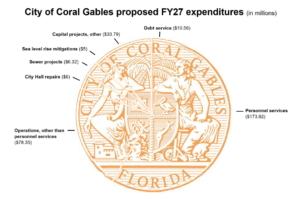
The $318.44 million plan City Manager Peter Iglesias sent to the City Commission on July 1 moves the city’s recurring capital program onto recurring revenue, answering a concern raised in prior Gazette budget analyses about relying too heavily on reserves and accumulated surplus. But it does so just as the city’s recurring revenue base faces two tests: softer development-related collections and a proposed statewide homestead-exemption expansion that the city says could reduce property-tax revenue within two years.
The result is a budget that is more durable and more exposed at once. It is more durable because it now funds a larger share of its capital program from recurring revenue, the money the city expects to collect every year. It is more exposed because that revenue is the very thing a possible homestead-exemption expansion and softer development-related fees could weaken.
The distinction between two kinds of money explains the shift. Recurring revenue arrives each year, chiefly property taxes and fees. One-time revenue comes from reserves and prior-year surpluses, which can be spent once and are then gone. For years, Coral Gables funded part of its capital program with one-time balances, a practice earlier Gazette analyses flagged as difficult to sustain without a replacement.
The fiscal 2027 budget builds that replacement. It funds 100 percent of the $12.58 million annual cost of its capital matrices, the recurring program that pays for infrastructure, with recurring revenue, where that cost once relied on prior-year surplus. The change moves a standing obligation off the reserve ledger and onto the operating base.
The city has not eliminated its use of reserves, but it has reduced it. Total transfers from reserve funds fall from $32.36 million in the current adopted budget to $19.21 million, including $7.82 million from the General Fund, $2.83 million from the Building Division reserve and $5.50 million from the General Capital Improvement Fund. Reserves still supply about $19.2 million, or roughly 6 percent, of the $318.44 million total. The city also projects outstanding principal debt of $92.5 million at the close of fiscal 2026, with debt service of $10.56 million, or 4 percent of its operating and debt-service budgets, below its 8 percent cap, and it entered the budget cycle with the general fund reserve fully funded at $64.08 million, at the commission’s 25 percent target. The restraint extends to capital itself: net of transfers, capital spending declines to $51.07 million from $53.02 million, a 3.69 percent reduction, even as the plan funds more of it from recurring revenue. By the measures the earlier analyses used, this is a more disciplined plan.
What the city now leans on more heavily is the question. Property taxes supply 49 percent of operating revenue, and much of the remainder comes from fees tied to development and city services. That is the base the capital shift now rests on.
Part of that base has been softening. The Gazette’s May midyear analysis found construction permit revenue running at 55.4 percent of budget through March and Planning and Zoning fees at $4,341, or 4.3 percent of a target the city had already cut by two-thirds. The fiscal 2027 budget does not retreat from those assumptions. It raises Planning and Zoning Board fees to $150,000 from $100,000 and sets total restricted permit-fee revenue at $15.70 million, up 3.1 percent from this year. Some development lines rest on firmer ground, including Board of Architects fees, which ran ahead of budget at midyear and are set at $1.2 million. But the pattern the midyear report identified, strong design-stage review paired with softer construction-stage revenue, remains built into the plan.
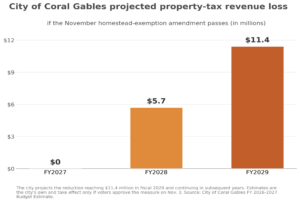
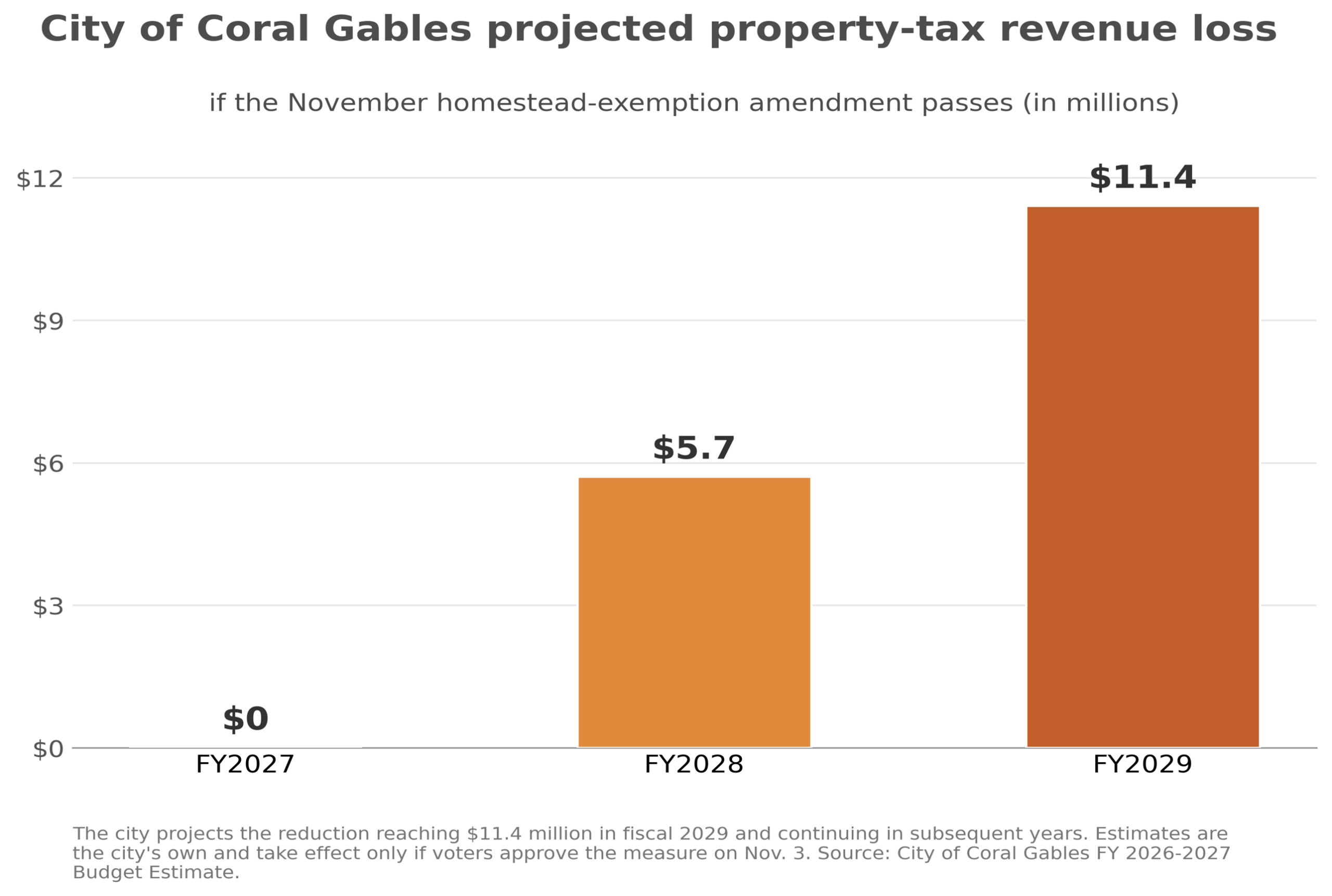
The larger test is no longer a projection. The proposed constitutional amendment on the November ballot would increase the current homestead exemption by $100,000 in 2027 and by $200,000 in 2028, reducing the taxable value of homesteaded properties. The city estimates the change would reduce Coral Gables property-tax revenue by $5.7 million in fiscal 2028 and $11.4 million in fiscal 2029 and beyond. Homesteaded properties generate roughly 48 percent of the city’s property-tax revenue, the largest single piece of the recurring base the budget now depends on.
The spending side leaves little room to absorb a shortfall. Personnel accounts for about 69 percent of operating expenditures, and it is rising. Health insurance and retiree benefit costs climb $3.64 million on premium increases the city puts above 20 percent, and overtime rises 23.7 percent. Two of the city’s three union contracts, with the Fraternal Order of Police and the firefighters, expire September 30, the day before the fiscal year the budget covers, and the plan assumes successful negotiations. The recurring costs the budget must meet are climbing and partly unsettled, even as the recurring revenue meant to cover them faces a possible cut.
Holding the millage flat does not sidestep those pressures. Because values rose 6.5 percent, the unchanged 5.559 rate collects about $8.9 million more than this year, and under Florida’s truth-in-millage rules a rate above the rolled-back rate, the rate that would raise the same revenue as the prior year, is advertised as a tax increase. The additional collections build some cushion. They do not resolve how the city will absorb the loss it has already measured for the years just ahead.
That leaves fiscal 2028 as the real test. The proposed budget makes the city’s capital program steadier by tying it to recurring revenue, and it reduces the reliance on reserves that earlier analyses questioned. It does so by shifting weight onto a revenue base that a softening development market and a November vote could narrow. The first $5.7 million of that narrowing would arrive the year after this budget takes effect. Whether the city can carry its new structure through that reduction, without returning to the reserves it has worked to preserve, is the question the fiscal 2027 budget leaves for the one that follows.