
By Coral Gables Gazette staff
Barry Jenkins and Tarell Alvin McCraney grew up a few blocks apart in the same Liberty City housing project, a low-slung public-housing complex that residents have long called the Pork and Beans. They never met as children. Years later, introduced through a mutual friend at a Miami arts collective, they discovered they had each carried the same neighborhood, the same hardships and — as both have spoken of openly — mothers who struggled with the same addiction.
Out of that shared geography came one of the most acclaimed American films of the century.
On Friday, June 19, the Coral Gables Art Cinema brings that film back to a Miami screen, marking the 10th anniversary of “Moonlight” with a single 9 p.m. screening in 4K.
A film set in Miami-Dade
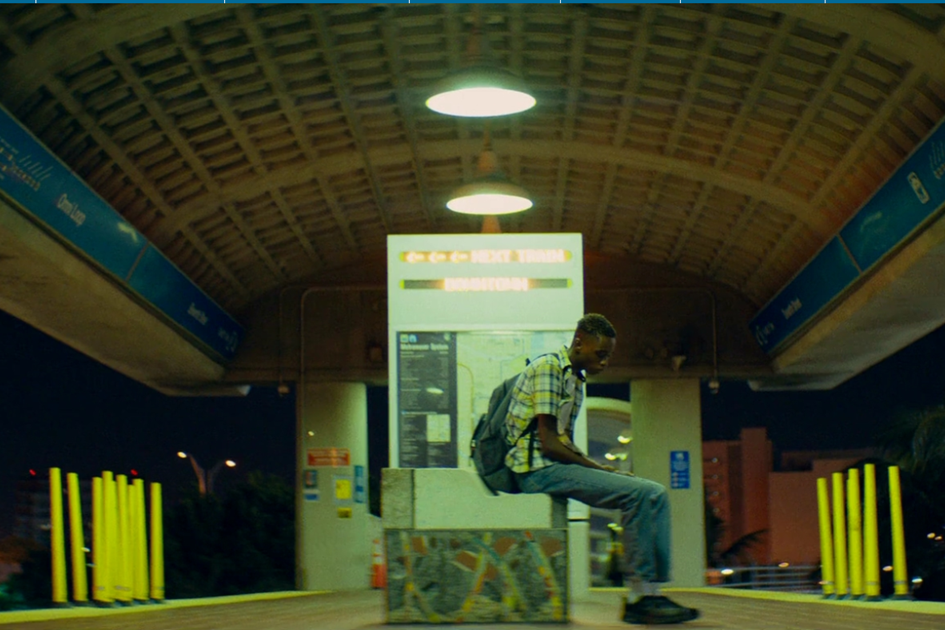
For an audience in Coral Gables, the film carries a proximity no streaming queue can replicate. “Moonlight” was shot on location only a few miles away, in the Liberty City neighborhood where its story unfolds — at Liberty Square, at neighborhood locations and at the historically Black Virginia Key Beach, where the drug dealer Juan teaches the silent boy Chiron to float in the open water.
The film insists on Miami as its residents actually live in it, far from the pastel glamour of Miami Beach that has stood in for the city in so many other productions.
Jenkins has spoken about the strangeness of returning to direct in the place he came from. During the shoot, he turned around at one point to find a cluster of neighborhood children gathered around the monitors, trying on the headphones, watching him work — and he recognized that he had once been one of those children, with no one who looked like him behind a camera to suggest that the work was even possible.
That recognition has since taken concrete form. With support from Jenkins and McCraney, a cinematic-arts program for young people was established at the African Heritage Cultural Arts Center in Liberty City, where McCraney himself once studied.
Three actors, one life
Adapted from McCraney’s unproduced, semi-autobiographical play In “Moonlight” Black Boys Look Blue, the film chronicles the life of Chiron, a young Black man in Miami, across three chapters — childhood, adolescence and adulthood — as he navigates poverty, his mother’s addiction and the slow, frightening discovery of who he is.
Jenkins structured the story as a triptych, casting three different actors as Chiron at each stage, a formal gamble that asks the audience to find a single soul across three faces.
The film draws extraordinary work from an ensemble that includes Mahershala Ali, Naomie Harris, Janelle Monáe, André Holland and Trevante Rhodes. It builds toward an ending of almost unbearable restraint — two grown men at a kitchen table, a lifetime of unspoken feeling held in the silence between them.
An ending that made Oscar history
When it premiered at the Telluride Film Festival in the fall of 2016 and opened that October, “Moonlight” arrived as something Miami cinema had rarely produced: a deeply local film that became a national and international event.
Distributed by A24 and produced on a modest budget, “Moonlight” went on to gross more than $65 million worldwide and win three Academy Awards — Best Supporting Actor for Ali, Best Adapted Screenplay for Jenkins and McCraney, and Best Picture.
That final prize was delivered in one of the most chaotic moments in the ceremony’s history, after the award was first announced, in error, for another film, then corrected live on stage — an ending as improbable as any the movie itself contains.
A record of a neighborhood in flux
A decade on, the film has acquired a second life as a record of a place in transition. Liberty City — and Liberty Square in particular, one of the oldest public-housing developments in the country — has since become the subject of a contested, large-scale redevelopment plan. “Moonlight” now stands, for many who screen it, as a document of a community in the years before that change.
The film’s emotional force was always inseparable from its geography. To watch it now, so close to where it was filmed, is to watch a neighborhood as it was, and to be reminded how rarely Miami’s interior life receives such careful attention on screen.
A fitting host
The screening is part of the Art Cinema’s Special Presentations series of limited and one-time engagements.
The cinema itself is a fitting host for a film about Miami made by Miamians: a nonprofit theater that opened in October 2010, operated by Coral Gables Cinematheque, Inc. in a city-owned building in the heart of downtown. It is precisely the kind of venue — independent, civic and devoted to films that multiplexes often overlook — where a movie like “Moonlight” belongs.
The film runs 111 minutes, is rated R and screens in 4K digital format, in English with closed captions available.
“Moonlight” screens Friday, June 19, at 9 p.m. at the Coral Gables Art Cinema, 260 Aragon Ave., as a 10th-anniversary Special Presentation. Tickets are $8 for members and $11.75 for nonmembers. For tickets and the full Special Presentations program, visit the Coral Gables Art Cinema website or call 786-472-2249.











bzo3zl
fakm5r