By Coral Gables Gazette staff
The Coral Gables City Commission has moved forward with plans to create a centralized downtown maintenance program funded by a mandatory assessment on commercial property owners, directing staff to prepare an item to hire a consultant to develop the funding model.
Mayor Vince Lago, who is sponsoring the initiative, directed the city clerk at the April 14 meeting to place an action item on the next commission agenda that would authorize hiring an outside consultant — the first formal expenditure in a process that city officials say will eventually be funded through a mandatory assessment on commercial property owners within the central business district.
The update, presented by Economic Development Director Belkys Perez and Deputy City Manager Joe Gómez, revealed a formalized scope of work and a revised timeline. Staff told the commission they expect to return in May with a finalized scope. A cost breakdown will take longer — developing the assessment methodology requires hiring a consultant first.
What the program would deliver
The proposed maintenance improvement district would provide services above and beyond what the city currently delivers — a distinction Perez was careful to draw. The scope as currently defined includes routine sidewalk and alley maintenance, scheduled pressure cleanings, enhanced trash and litter removal, installation and maintenance of drought-resistant landscaping, minor alley restorations, and aesthetic improvements.
The program would also include a dedicated supervisor responsible for overseeing work in the field and escalating issues — a broken sign, a malfunctioning light, a damaged sidewalk — to the appropriate city department for action.
“This is enhancing the services that are currently provided by the city,” Perez told the commission. “This is above and beyond the services the city provides.”
The program is designed to supplement, not replace, existing property owner obligations. Under current city code, commercial property owners are already responsible for maintaining the landscaping and sidewalks fronting their properties. The centralized program would layer professionally managed services on top of those existing responsibilities.
Lago cites inconsistent conditions downtown
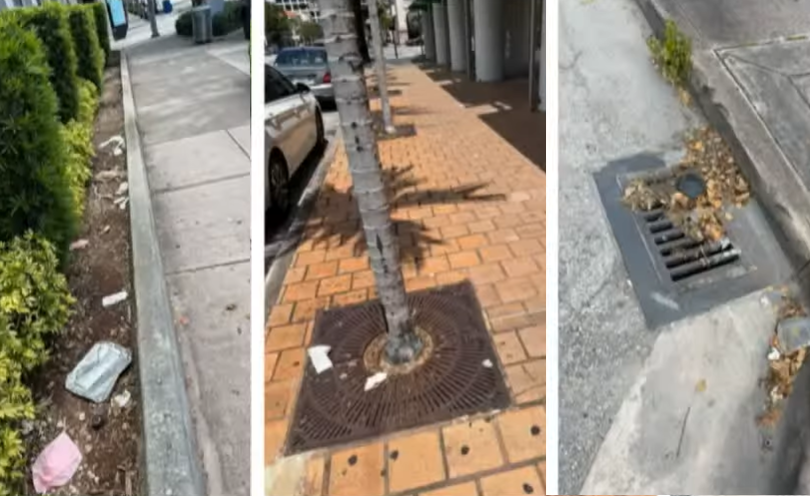
Lago opened Tuesday’s presentation with photographs he took himself over the weekend documenting current conditions in the downtown. He then showed the result after calling staff — a notably cleaner streetscape — using the contrast as a real-time argument for why a centralized, consistently managed program is necessary.
The current system relies on individual property owners to maintain their own frontages and on code enforcement to address violations, which city officials said produces inconsistent results. A block maintained by a diligent property owner sits next to one that has not been addressed in years. A dedicated supervisor overseeing a coordinated program would catch and escalate problems before they become visible failures.
“That’s the way our city should look every moment of the day,” Lago said of the cleaned streetscape. “It’s investing in our downtown and making sure we get things done.”
The timeline and the consultant
Staff told the commission that a finalized scope of work will be ready next month. A cost breakdown will require more time.
“That’s going to take a little more time, mayor, because we have to hire a consultant to come up with the revenue model,” Gómez told Lago.
Lago responded by directing the city clerk to place the consultant authorization on the next commission agenda as a formal action item. “I’d like it to be presented before the commission about this and have my colleagues work with you on this front so that we can hopefully take the next step to hire a consultant to then be able to address this issue,” he said.
The consultant’s work will include developing the methodology for apportioning the assessment among property owners — likely based on linear street frontage, meaning larger properties with more street exposure would pay more. Once that methodology is complete, the proposed district must return to the commission for a formal public hearing before any assessment can be imposed. The full process will take several months at minimum.
What the assessment means for property owners
The assessment is a mandatory charge on properties within the district. Property owners would be required to pay regardless of whether they would have chosen to participate. The amount is not yet known. The methodology has not yet been developed. The commission has directed staff to proceed with the next step in the process.
Commissioner Richard Lara framed the assessment in terms designed to reassure property owners at the March 10 meeting where the proposal was first formally presented. “We’re not looking to increase or burden businesses,” he said. “They have an existing obligation to maintain this. We’re looking to, if done correctly, maybe even reduce their expense.”
The economy of scale argument underpins that reassurance. City Manager Peter Iglesias has noted that pressure cleaning three consecutive blocks costs less per block than each property owner arranging individual service. Commissioner Ariel Fernandez cited a real-world example in which a group of property owners who collectively arranged pressure cleaning achieved a 25 to 30 percent cost reduction compared with what each had paid individually. The assessment, supporters argue, would formalize that logic city-wide.
Background and context
The maintenance improvement district concept was first formally presented to the commission at the March 10 meeting, where Lago unveiled a slideshow documenting conditions across the city’s commercial corridors — diseased shrubs unchanged for decades, broken sidewalks, blocked storm drains, abandoned parking meter poles, and alleys littered with garbage. The Coral Gables Chamber of Commerce, represented by president and CEO Jorge Arrizurieta, expressed broad support for the program at that meeting, describing a well-structured assessment as an important step toward maintaining the downtown’s standard of excellence.
The proposed district boundaries follow the central business district, with the program extending to corridors along Ponce de León Boulevard, Southwest Eighth Street, and Sunset Drive. The alleys behind Miracle Mile — a priority identified by Arrizurieta at the March meeting — are included. The front sidewalks of Miracle Mile and Giralda Plaza storefronts, which already have dedicated maintenance, are excluded from the front sidewalk component but not from alley services.
What comes next
The path from the April 14 update to an enforceable assessment likely runs through several additional steps: a finalized scope of work in May, a consultant hired to develop the revenue and apportionment model, a completed methodology returned to the commission for review, and a formal public hearing before any assessment can take effect.
For commercial property owners in the central business district, the practical implication of last week’s action is that the process is advancing. The remaining questions are how much property owners will be asked to pay, how that amount will be calculated, and when the assessment will take effect.