
By Coral Gables Gazette staff
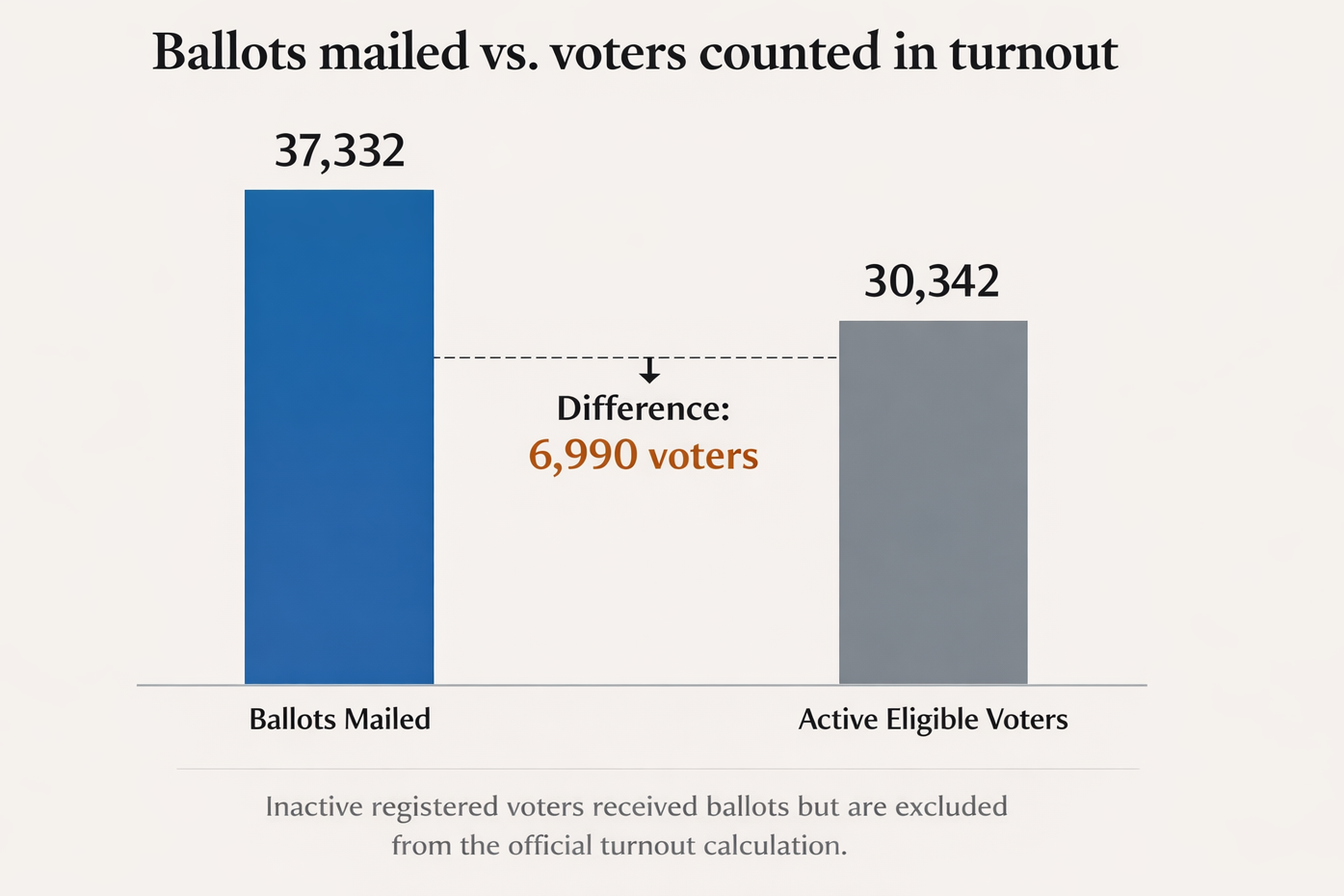
Coral Gables mailed 37,332 ballots for its April charter referendum. But the turnout rate will be calculated using a pool of 30,342 voters.
The difference of 6,990 voters reflects how turnout is defined.
Under Florida election law, voters who have not participated in recent elections and have not responded to address confirmation notices are classified as inactive. They remain eligible to vote and, in this case, received ballots. But they are not included in the active voter denominator used to calculate turnout. The result: participation in this referendum will be measured against a smaller electorate than the one invited to take part. any ballot returned by a registered voter — active or inactive — will be counted. The distinction affects only how turnout is calculated.
That distinction becomes more significant when the election’s stated purpose is considered. One of the eight charter questions on this ballot — Referendum 1 — would move city elections from April to November specifically to increase voter participation. The election meant to address low turnout is, at its midpoint, a low-turnout election. As of April 2, 3,930 ballots had been returned — approximately 13 percent of the active eligible pool, with less than three weeks remaining before the April 21 deadline.
The friction was foreseeable
The structural conditions shaping participation in this election were foreseeable. When the City Commission voted 3–2 in January to place the referendum on an April mail ballot, Commissioner Ariel Fernandez raised concerns about mail delivery problems within the city and the limits of a mail-only format for voters who prefer or depend on in-person voting. The 3–2 majority — Mayor Vince Lago, Vice Mayor Rhonda Anderson, and Commissioner Richard Lara — proceeded.
The early returns are the first documented evidence of how that decision is unfolding. Beyond the active and inactive voter gap, the election’s design introduces additional constraints on participation. Ballots must be received — not merely postmarked — by Election Day. There is no ballot curing for errors or missing signatures. In-person drop-off is limited to a single location: the Miami-Dade Supervisor of Elections office in Doral, miles outside Coral Gables.
Each condition, taken individually, is consistent with state law. Taken together, they define a participation landscape shaped by how easily voters can complete and return a ballot.
The precinct data makes those differences visible. Precinct 636 in the heart of the city, anchored by the Coral Gables Branch Library, leads all precincts with 540 returned ballots. Precinct 646, at the city’s southern edge, has returned 25. The gap between the most and least engaged precincts reflects differences in participation across neighborhoods, as well as the varying conditions under which residents are voting.
What the early returns show
The partisan composition of returned ballots adds texture to the picture. Republican voters account for 1,661 of the 3,930 ballots returned — 42.3 percent of the total, a share that exceeds their proportion of the active electorate. Democratic voters (1248) account for 31.8 percent. Voters with no party affiliation (949) account for 24.2 percent.
Whether that Republican return-rate advantage reflects the party’s share of the active electorate, organized outreach by referendum supporters, or broader patterns in mail-ballot participation is not yet clear from the available data. What is clear is that the composition of early returns skews toward Republican voters — and that composition will shape the result if the gap persists through April 21.
None of these features determines the outcome of the referendum. Together, they define the conditions under which participation occurs — and how it will be recorded.
The pace of returns has increased. Between March 30 and April 2, 838 additional ballots were returned — a three-day rate that, if sustained, would produce a substantially different final turnout than the early numbers suggested. Whether that acceleration reflects growing awareness of the referendum, organized outreach by interested parties, or simply the natural compression of returns as a deadline approaches is not yet clear. What it does suggest is that the structural conditions this election has exposed have not prevented participation from moving. The question is whether they have shaped who is participating — and whether that composition holds through April 21.
What permanence changes
The eight questions on this ballot are proposed amendments to the city’s charter — permanent structural changes to how Coral Gables elects its leaders, manages its reserves, and oversees its officials. Charter amendments do not expire. The turnout rate at which they pass becomes part of the context in which their mandate is understood.
The Supervisor’s official turnout figure will be calculated against 30,342 active eligible voters. The civic reality is that 37,332 households received ballots. Both numbers will exist when results are certified on April 21. Only one will appear in the official record.
Two electorates
Coral Gables has framed this referendum, in part, as a response to historically low turnout in local elections. The early returns illustrate how participation is already being filtered before it is measured.
The result is a system in which two electorates coexist: the broader group of registered voters who received ballots, and the narrower group of active voters against which turnout will be calculated. The election is taking place across both. The official turnout figure will reflect only one.
The issue is not just how many residents vote in the coming weeks. It is how participation is defined, measured and ultimately understood.
This Post Has 5 Comments
This is a complete misleading article. Every active and inactive legal registered voter in Coral Gables, voting in the election, will have the vote counted. Period. This is what matters.
Arguing about the technical definition of the turnround metric, is irrelevant to the outcome of the election.
Let’s focus the attention of the readers of the insightful topics, like the one you pretended to cover ( there are two segment of voters in CG: those who vote only in mayor elections, and those who follow the activists and vote in every election); instead of trying to imply that the vote of inactive voters will not be counted.
This is well said Alberto.
Vote NO on all, or should I say vote NO on everything Lago, Anderson and Lara want. We need to take back our City .from the autocratic leadership that has made a mess of our City or disrespected what we want or asked for. The Garden of the Lord and the dog park are 2 big examples, They do what they want.
Excellent comment. Now I know to vote yes on everything. Much appreciated
If we had a November referendum vote, Mayor Lago’s majority could have saved the City $130,000 and avoided all questions about low voter turnout and whether a representative democracy has decided these critical Charter amendments affecting how our government works. In 2016, the Commission (with Mayor Lago on it) rejected the vote-by-mail option. 22,937 (72% of all voters) voted on Charter referendums in November 2016 simultaneous with the Presidential election at a cost of only $20,000. In 2016, you were allowed to vote early at the library, vote in person on Election Day at your precinct, drop your ballot off at the library or vote by mail. In 2016, it was important to save money and get more votes on referendum questions. In 2026, Mayor Lago’s majority spends more money for less votes. WHY? It would not extend anybody’s term. I think Mayor Lago’s majority fears (a) the 15,885 voters who voted in 2016 to have runoff elections and (b) losing their Charter proposals with normal voting. So, his majority is forcing the City to pay more money for our first ever vote-by-mail to manufacture a result to change how we have voted for the past 100 years solely to increase his incumbency advantage and the power of his special interest groups. Mayor Lago’s personal retribution for his 2 candidates losing in 2023 is another factor. In 2016, the Commission listened to the Charter Review Committee. In 2026, Mayor Lago’s majority ignored the Charter Review Committee and residents who provided comments at 2 town hall meetings. There is no need to race to amend our Charter. VOTE NO to all proposals based on this shady process.