By Coral Gables Gazette staff
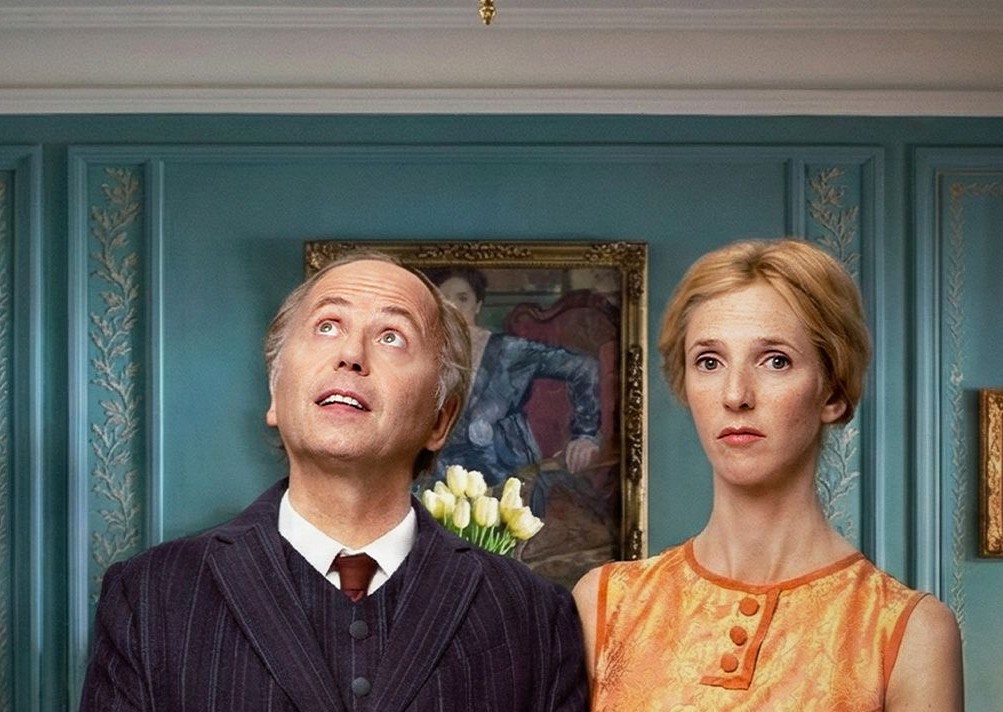
The apartment is large, elegant, and immaculate. The egg must be cooked exactly three and a half minutes. The wife moves through a world of milliners and card games. The stockbroker has never once thought to ask what happens above the fifth floor, where the building’s Spanish maids live six to a hallway, share a single cold water tap, and speak a language no one downstairs has any reason to learn.
That is the Paris of Philippe Le Guay’s “The Women on the 6th Floor,” and it is the world the University of Miami’s French Film Series brings to Coral Gables on Wednesday, March 25, at 4 p.m. in the Merrick Building, Room 210.02, at 5202 University Drive. Admission is free and open to all. A discussion follows the screening.
A comedy built on a genuine social divide
Set in Paris in 1962, “The Women on the 6th Floor” follows Jean-Louis Joubert, a conservative stockbroker played by Fabrice Luchini, whose ordered life begins to unravel when his longtime housekeeper quits and is replaced by María, a young Spanish immigrant played by Natalia Verbeke. When Jean-Louis follows María upstairs to see where she lives, he enters a world that exists four floors above his own and might as well be on another continent: a warm, crowded, communal space where a group of Spanish women have built something resembling a community despite unheated rooms, shared toilets, and wages that would not cover a single evening at the restaurants his wife frequents.
The film’s social history is not incidental. The Spanish women on the sixth floor are not simply servants in a French comedy. They are refugees from Francoist Spain — women who left a country governed by dictatorship, took the most invisible work available in Paris, and maintained their culture, their language, and their solidarity in rooms the building’s respectable tenants had never once thought to visit. Director Le Guay based the film on his own childhood memories: his father was a stockbroker, and the family had a Spanish maid. He has described the sixth floor as a place that seemed, to a child, impossibly alive compared to the floors below.
Luchini, Maura and a César win
Fabrice Luchini is one of French cinema’s most recognizable presences — a performer whose particular gift is making self-absorption both comic and sympathetic. As Jean-Louis, he plays a man whose rigidities are not malice but habit, whose class assumptions are so deep he has never had to examine them, and whose transformation is less a moral awakening than a gradual thaw. The performance earned widespread praise when the film screened out of competition at the Berlin International Film Festival in 2011.
Carmen Maura — a fixture of Pedro Almodóvar’s early films and one of Spanish cinema’s most celebrated actors — plays Concepción, the matriarch of the sixth floor community, with a combination of authority and warmth that anchors the film’s emotional core. Her performance won the César Award for Best Supporting Actress at the 2012 ceremony — the French equivalent of the Academy Award. The film received two additional César nominations, for costume design and production design.
Sandrine Kiberlain plays Suzanne, Jean-Louis’s wife, in a performance that resists the easy choice of making her merely unsympathetic. Lola Dueñas, another Almodóvar alumna, appears among the maids. The ensemble — all the Spanish actresses cast as themselves in a language several of them did not speak fluently on arrival — gives the film an authenticity that its more polished surroundings cannot replicate.
A film series built for conversation
“The Women on the 6th Floor” is part of the University of Miami’s French Film Series, which presents award-winning French and Francophone films from 2008 to 2022 on select Wednesday afternoons. The series is free, open to the public, and designed around discussion — each screening is followed by a conversation about the film’s themes, context, and craft. No prior knowledge of French cinema or French language is required.

Author: Coral Gables Gazette News Staff
Originally established in 1996 and relaunched as a digital publication in February 2025, the Coral Gables Gazette is an independent local news organization dedicated to factual, objective and accountable community journalism. Our newsroom reports on the people, policies, institutions and events shaping Coral Gables, Florida, providing residents with timely, informative coverage of the issues affecting their community. Our reporting includes City Hall, local government, municipal elections, public spending, real estate development, business, education, arts and culture, and neighborhood affairs throughout the City Beautiful. We follow City Commission decisions, examine public records and report on the businesses, organizations and individuals contributing to Coral Gables. We believe informed residents are essential to a healthy, engaged community. Stories published under the Coral Gables Gazette News Staff byline are prepared or compiled by the publication's editorial team. We strive for accuracy, fairness, transparency and clear distinctions between news reporting, opinion and advertising. Readers are encouraged to submit news tips, corrections, editorial inquiries and story suggestions through our Contact page and learn more about our standards through our Editorial Policy.