
By Coral Gables Gazette staff
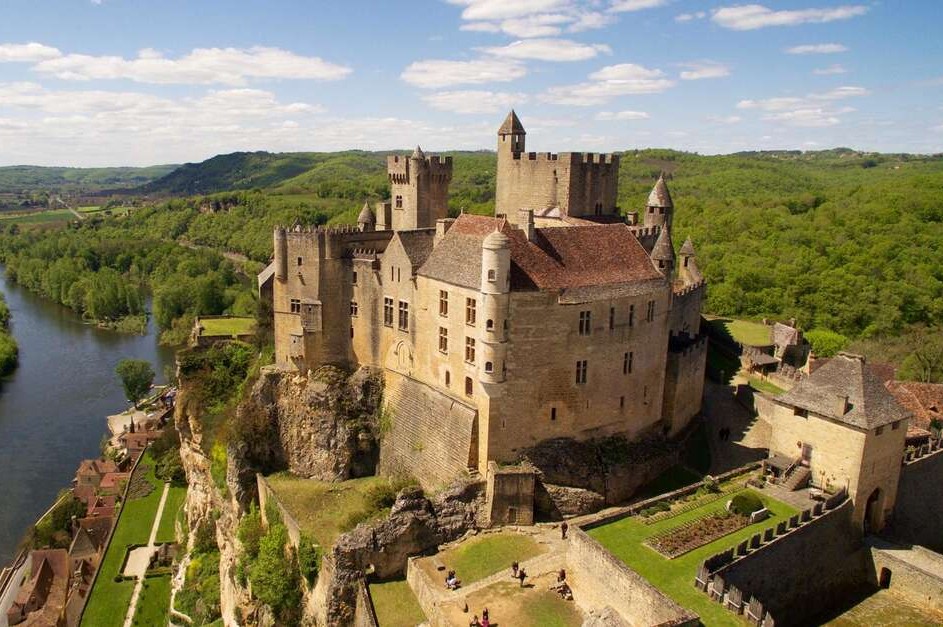
Imagine standing at the edge of a limestone cliff above the Dordogne River. Below, the valley spreads out in long green folds. Above, the walls of a fortress rise in dark medieval stone, unchanged in outline since the days when Richard the Lionheart sheltered here between campaigns. You have not moved. The Dordogne has not changed. Nine centuries have passed and the stone holds.
That is the experience at the center of Wednesday evening’s lecture at the Coral Gables Museum. “History through Architecture: Medieval and Renaissance Castles of Périgord, France” takes its audience on a journey through one of Europe’s most castle-dense regions, a corner of southwestern France that has been shaped, stone by stone, by a thousand years of conflict, faith, power, and artistic ambition. The lecture runs from 5:30 to 7:30 p.m. at the museum’s home at 285 Aragon Avenue.
A land built for war — and then for beauty
The Périgord, which corresponds roughly to France’s modern Dordogne department, earned its reputation for châteaux the hard way. For more than three centuries, the region sat at the front line of some of medieval Europe’s most sustained and brutal conflicts: the wars against the Cathars, the struggles between feudal lords, and above all the Hundred Years’ War, which made the Dordogne River a literal border between the French and English kingdoms. On the French bank, the fortress of Beynac. On the English bank, the fortress of Castelnaud. Each staring at the other across the water for more than a century.
War produced the first layer of architecture in the Périgord: thick walls, round towers, cliff-top positions chosen for visibility and defense. But war eventually ended, and the region’s builders turned to other ambitions. The same châteaux that had been designed to resist siege engines were gradually transformed into places of residence, of ceremony, and of beauty. The Renaissance arrived in the Périgord not as a sudden revolution but as a slow infiltration, evident in a carved window frame here, an elegant courtyard there, a formal garden where a moat had been.
The lecture traces that arc through seven specific monuments, each representing a different chapter in the region’s architectural history. The cliff-top fortress of Château de Beynac stands for the raw feudal period, its walls rising from rock so steep that the castle was considered nearly impregnable. The Romanesque abbey-church of the Abbaye de Saint-Amand-de-Coly represents the role of religious devotion in shaping the Périgord’s built landscape: its walls were fortified not for conquest but for survival, reaching heights that could shelter an entire village. Château de Puymartin, mysterious and largely intact since the 13th century, embodies the transition from fortress to residence. Château de Hautefort, transformed in the 17th century from a medieval stronghold into something approaching the châteaux of the Loire Valley, marks the full flowering of Renaissance ambition in the region.
The philosopher in the tower
The most intellectually charged stop on the lecture’s architectural tour is also its most intimate. Château de Montaigne, situated near the borders of the Périgord and the Bordelais, is not the most dramatic fortress in the region. What makes it exceptional is a single round tower that still stands from the original 16th-century structure, the rest having been destroyed by fire in 1885. In that tower, beginning in 1571, Michel de Montaigne retired from public life, surrounded himself with roughly a thousand books, and began writing the work that would change literature.
The Essays were born in that circular room. Montaigne had the ceiling beams painted with Greek and Latin inscriptions, 67 quotations drawn from the Bible and from classical authors, including Horace, Lucretius, and Sophocles. The room was both library and sanctuary, a place from which, as one historian has written, he could survey his own lands and, figuratively, survey human life. He spent years there asking the question that became the signature of the entire project: “Que sais-je?” What do I know?
The lecture’s inclusion of Château de Montaigne in a survey of medieval and Renaissance architecture is not incidental. It is a reminder that the buildings of the Périgord were not only military and aesthetic achievements. They were also the conditions under which some of the most consequential thinking in Western history occurred. Architecture as the container of ideas. Stone as the precondition for thought.
The castle that surprised Thomas Jefferson
The lecture closes with one of the Périgord’s most surprising monuments. Château de Rastignac, a classical mansion built in the late 18th century, breaks with the medieval and Renaissance structures that precede it in the evening’s survey. Its facade, with a central rotunda and flanking colonnaded wings, bears a striking resemblance to the White House in Washington. The connection is not coincidental: the design is widely believed to have been influenced by Thomas Jefferson, who served as American minister to France from 1784 to 1789 and was known for his deep engagement with French neoclassical architecture during his time in Paris. Whether Rastignac influenced the White House or drew from the same sources Jefferson had studied remains a matter of architectural debate. But the resemblance is unmistakable, and it places the Périgord in an unexpected transatlantic conversation.


This Post Has One Comment
Advise us time in advance. please!
Notification e-mail inside the CG Gazette arrived Today.
Several people would have liked to attend.
Thank You