
By the Coral Gables Gazette editorial board
At the March 10 City Commission meeting, Mayor Vince Lago did something that does not happen often enough in municipal government: he showed his work. He presented a slideshow — prepared by city staff, grounded in photographic evidence — documenting the gap between what Coral Gables’ commercial corridors are supposed to look like and what they actually look like. Diseased shrubs unchanged for three decades. Broken sidewalks patched with asphalt. Alley conditions that, as Vice Mayor Rhonda Anderson put it, nearly knock you off your feet. The images were the record.
What followed was a proposal that this board believes deserves full support: “a maintenance improvement district” that would fund centralized beautification services for commercial property owners across the city’s downtown corridors through a mandatory, proportional assessment. Pressure cleaning. Landscaping. Alley maintenance. Deficiency reporting. Done collectively, consistently, and at a scale that individual property owners acting alone have never been able to achieve.
The maintenance gap Lago documented has been around for a while. Commissioner Ariel Fernandez noted that he and the mayor have discussed versions of this idea for roughly 15 years. That timeline reflects how difficult it is to assemble the ingredients required for a policy change of this scale: clear evidence, a workable mechanism and the support of the people who will fund it.
For years, the missing variable was private sector buy-in. That variable is now present. Jorge Arrizurieta, president and CEO of the Coral Gables Chamber of Commerce, appeared before the commission as a partner who had already heard the proposal, discussed it with the chamber’s board, and arrived to express support. That is a large thing. It is the difference between a good idea and a viable one.
There is a lesson embedded in that timeline worth naming directly. Coral Gables has a legal framework that already requires commercial property owners to maintain the sidewalks and landscaping fronting their buildings. The city has had that authority for years. What it lacked was the collective will and the structural mechanism to act effectively. The maintenance improvement district resolves both problems at once. It creates a new system for fulfilling an existing one.
The analogy is familiar to anyone who has tried to maintain a shared space. One neighbor who keeps up their property and three who do not produces not a clean block and three messy ones — it produces four messy ones. The compliant neighbor loses the incentive to comply. The standard collapses not because no one cared but because the system rewarded neglect and punished effort. A maintenance improvement district replaces that system with one in which everyone contributes, everyone benefits and the standard holds.
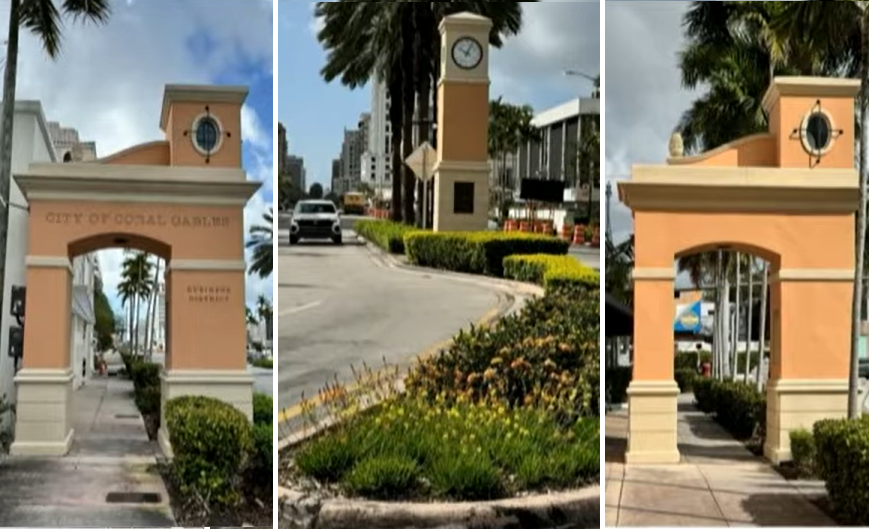
The City Beautiful was a civic standard written into the city’s founding DNA — into its architecture, its street design, its canopy corridors, its insistence that beauty is obligation. That standard has survived a century of development, economic cycles, and changing tastes. What it has not survived, in pockets, is benign neglect: the slow accumulation of overgrown hedges, dirty alleys, and sidewalks that no one in particular is responsible for because everyone in general is.
A city that calls itself Beautiful carries a responsibility that most municipalities do not. Visitors and residents do not distinguish between a storefront’s landscaping and the city’s. They see Coral Gables. When it falls short, the city absorbs the reputational cost even when the legal responsibility belongs to a property owner. Commissioner Fernandez made exactly this point at the dais. The maintenance improvement district is, among other things, an acknowledgment that the City Beautiful standard cannot be outsourced to voluntary compliance.
This board has one recommendation for the commission as this process moves forward: treat the timeline seriously. City Manager Peter Iglesias will return at the next meeting with a preliminary schedule. That schedule should be ambitious. The legal and financial framework will take months to develop — district boundaries must be defined, property owners cataloged, costs analyzed, a consultant engaged, and a public hearing held. None of that is quick. All of it is necessary. But the commission should resist the institutional tendency to let a complex process become an indefinite one.
The conditions that make this proposal viable — mayoral leadership, Chamber support, commission consensus — exist right now. Civic momentum requires follow-through. The city should set a target date for returning a draft plan to the commission, hold staff to it, and keep the business community engaged throughout the process. Fifteen years of conversation is long enough. The next 15 months should produce results. Mayor Lago said it plainly at the dais: if the city depends on people to maintain its standards voluntarily, it will fall short of what the City Beautiful requires. He is right. A standard enforced selectively is a preference. Coral Gables has always been something more than that — a city that built beauty into its obligations, not just its aspirations. The maintenance improvement district is an opportunity to make that true again, one corridor at a time.












If your city is so beautiful then why do you have high-rises right next to high-rises such as you built right against Belmont Village. It makes this whole city look disgusting. One disgusting fine-rise on top another.
A beautiful city can not be enjoyed when citizen’s safety is threatened by e bikes, bikes, scooters, robots and skateboards riding on the sidewalks.