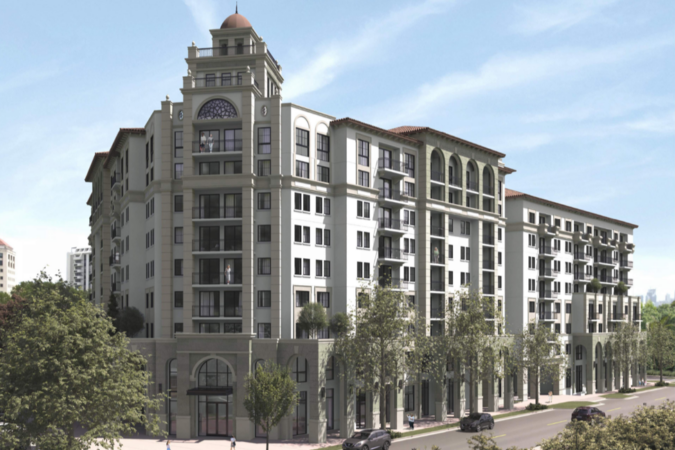
The developer of Crystal Residences has told a Miami-Dade court that disputes over whether some project supporters misstated where they live do not provide grounds to overturn the development’s city approvals.
In a 55-page response filed Nov. 13, FRC Realty, LLC, the project’s applicant of record, asked the Eleventh Judicial Circuit’s appellate division to deny resident Bonnie Bolton’s petition challenging three approvals the Coral Gables City Commission granted Aug. 25 for the nine-story project at 110 Phoenetia Ave.
The brief, filed by Greenberg Traurig, does not determine whether the challenged speakers gave accurate addresses. It argues instead that commissioners based their decisions on planning criteria and staff analysis, making “any dispute concerning individual speakers’ representations” legally immaterial to the approvals.
The filing is the developer’s first comprehensive answer to Bolton’s petition, which the Gazette reported in September. The court has not ruled.
Developer disputes testimony challenge
FRC argues that commissioners recognized that public opinion alone does not constitute competent substantial evidence, the legal standard governing the challenged land-use decisions.
The brief calls Bolton’s “discussion of speaker counts and challenged support letters” beside the point, arguing that commissioners relied on planning, zoning and development findings rather than the number of people supporting the project.
It also rejects Bolton’s due-process claim. The developer notes that Bolton and her attorney, David Winker, spoke at both commission hearings and raised the address allegations before the final vote.
Due process, the brief argues, “did not guarantee that the City Commission would accept her position or assign the disputed evidence the weight she preferred.”
Bolton contends that commissioners relied on testimony she alleges was false without giving her an adequate opportunity to challenge its credibility.
After the August hearing, Fifield Companies, the Chicago-based developer behind the project, said it “was surprised and disappointed by the alleged conduct,” did not condone misleading information and supported an investigation.
A 2022 traffic study the city relied on
FRC also disputes Bolton’s claim that traffic impacts were inadequately addressed.
The brief says the city conducted a traffic study in 2022. The underlying document, however, was submitted for an earlier applicant, Century Crystal Group, LLC, and accepted by the Coral Gables Public Works Department on Oct. 14, 2022.
The study, dated Oct. 11 and signed by engineer Dima Poe, analyzed a project with 184 residential units, 16 live/work units and a 60-student school.
The Public Works memorandum accepting the study described a different configuration: 193 residential units, a 60-student school and a 7,805-square-foot church.
The memorandum recommended a school drop-off and pickup plan to address vehicle queues and coordination with Miami-Dade County on traffic-signal timing.
“These items should be addressed before the project can move forward,” the memorandum stated.
The city’s June 17 staff report relied on the 2022 study and said its recommendations had been incorporated into conditions of approval.
Those conditions require a school operations plan and three years of annual traffic monitoring, beginning one year after the building receives its first temporary certificate of occupancy. The developer must pay for the monitoring and contribute up to $200,000 toward roadway improvements if the public works director determines they are necessary.
The 2026 approval caps school enrollment at 75 students, the same limit established by Ordinance No. 2962 in November 1991. The 2022 traffic study modeled a school serving 60 students. The 2026 approval therefore did not raise the longstanding enrollment cap.
The two appendix volumes reviewed by the Gazette do not include a newer traffic study or explain why the 2022 study and Public Works memorandum describe different development configurations.
Developer says timing objection was waived
Bolton’s petition also challenges the sequence of the city’s land-use approvals.
Ordinance 2026-26 changed the property’s future land-use designation but was subject to a delayed effective date. Bolton argues that the rezoning and related approvals could not lawfully take effect before that amendment did.
FRC responds that Florida law permits a city to adopt a comprehensive-plan amendment and related land-use approvals together. It also argues that Bolton waived her objection by failing to raise the sequencing issue at either commission hearing.
“Accordingly, any such objection is waived by Petitioner’s inaction during the City Commission hearings,” the brief states.
If the court accepts that argument, it could reject the timing objection without deciding whether Bolton’s interpretation of the approval sequence is correct.
The developer further argues that any timing concern “goes only to when the implementing approvals take effect, not to whether the City Commission validly adopted them.”
The comprehensive-plan amendment is subject to a 31-day waiting period after adoption, which can be extended by a timely administrative challenge. Bolton’s petition says a separate state administrative challenge is underway, but the Gazette has not independently confirmed that filing.
Police investigation is separate
The police investigation into the disputed testimony is separate from the court case.
Commissioners voted 4-0 at the Aug. 25 hearing to refer the allegations for investigation, an action formalized in Resolution 2026-218.
Police Chief Ed Hudak described the potential inquiry at the meeting as “a long drawn out investigation, not a very high priority.”
The developer’s court filing does not resolve whether any supporter testified falsely. It asks the court to uphold the city’s approvals regardless of the disputed testimony.

Author: Coral Gables Gazette News Staff
Originally established in 1996 and relaunched as a digital publication in February 2025, the Coral Gables Gazette is an independent local news organization dedicated to factual, objective and accountable community journalism. Our newsroom reports on the people, policies, institutions and events shaping Coral Gables, Florida, providing residents with timely, informative coverage of the issues affecting their community. Our reporting includes City Hall, local government, municipal elections, public spending, real estate development, business, education, arts and culture, and neighborhood affairs throughout the City Beautiful. We follow City Commission decisions, examine public records and report on the businesses, organizations and individuals contributing to Coral Gables. We believe informed residents are essential to a healthy, engaged community. Stories published under the Coral Gables Gazette News Staff byline are prepared or compiled by the publication's editorial team. We strive for accuracy, fairness, transparency and clear distinctions between news reporting, opinion and advertising. Readers are encouraged to submit news tips, corrections, editorial inquiries and story suggestions through our Contact page and learn more about our standards through our Editorial Policy.