
By Coral Gables Gazette staff
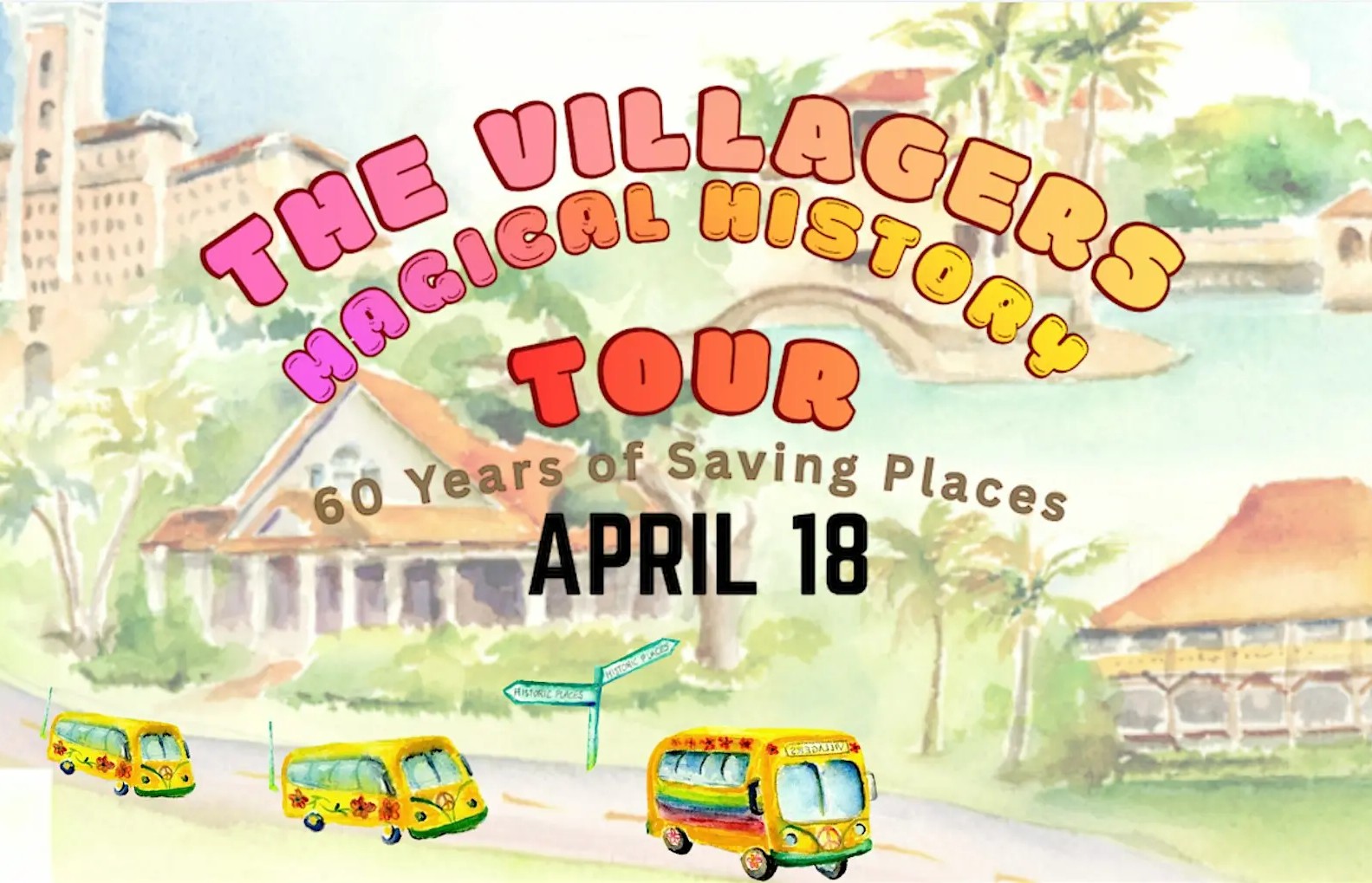
Every building the Villagers have helped save tells a story the wrecking ball would have ended. The Biltmore Hotel. Vizcaya. The Miracle Theatre. The Black Police Precinct and Courthouse Museum. The Merrick House. The Douglas Entrance — the very site that prompted a group of concerned citizens to form the organization in the first place, back in 1966, when demolition seemed inevitable and someone had to stop it. Sixty years later, the Villagers are still at it, and on Saturday, April 18, they are inviting the public to come along for the ride — literally.
The Villagers’ 60th Anniversary Magical History Tour and Party takes place April 18, beginning at Coral Gables Congregational Church, 3010 De Soto Boulevard. Bus tour check-in opens at 3:30 p.m. for a 2.5-hour journey through 34 historic sites across Miami-Dade that have benefited from Villagers grants. The evening’s 1960s-themed party runs from 6:30 to 8:30 p.m. at the same location, with live music, elevated retro food, and silent and live auctions. Tickets are $60 per portion, $120 for both. No tickets are sold the day of the event — advance purchase through April 17 is required.
Sixty years of stopping the clock
The Villagers did not set out to become Miami-Dade’s most consequential preservation organization. They set out to save one building. The association originated with the efforts of a group of citizens who came together in 1966 to work to save the Douglas Entrance, one of George Merrick’s original public projects in Coral Gables. That campaign succeeded, and the momentum it generated never dissipated.
Founded in 1966, the Villagers is Miami-Dade’s oldest historic preservation organization, dedicated to preserving the cultural and architectural heritage of the region. What began as a single-issue rescue effort evolved into a sustained institutional force. Since 1966 the Villagers have awarded more than 280 preservation grants to over 90 organizations in Miami-Dade County. The grant recipients read like a tour of the region’s most significant architectural and cultural landmarks: the Miracle Theatre, the Biltmore Hotel, the Merrick House, Vizcaya, the Barnacle, Gesu Church, the Scottish Rite Temple, Old Miami High, Pinewood Cemetery, the Miami River Inn, and the Dade County Courthouse, among many others.
The organization has also taken the long view on preservation’s future. Beyond financial support, the Villagers have been active in identifying and nominating properties for the National Register of Historic Places and advocating for preservation at threatened sites, with early hands-on restoration work at landmarks including Vizcaya and the Venetian Pool. Scholarships to Florida university students focused on historic preservation ensure that the expertise required to do this work will not disappear when the current generation steps back.
Co-chair Gina Guilford captured the spirit of the anniversary precisely: “We stopped the clock on our treasured sites being destroyed — starting in 1966. It’s time to take a breath and celebrate the history we’ve been able to help protect.”
The tour: 34 sites across Miami-Dade
The bus tour is the heart of the April 18 celebration and the more unusual of its two offerings. Member-led and carefully curated, it moves through 34 historic sites — each one a preservation success story, each one a building or landmark that might not exist today without a Villagers grant. The route begins in Coral Gables, moves into downtown Miami, continues south through the bayfront landmarks of Brickell and Coconut Grove, and ends in the township of Larkin, now the City of South Miami.
The tour includes a stop at the Black Police Precinct and Courthouse Museum in Overtown, where visitors will receive a guided tour of the preserved building and its exhibits on segregated Miami — a reminder that historic preservation is not only about architecture but about the full complexity of a community’s past. The stop includes a snack and bathroom break.
Bus seating is very limited and organizers are urging early purchase. The tour cannot accommodate wheelchairs or walkers, and tickets are strictly advance purchase only — no walk-ups.
The party: live music, auctions and flower power
For those whose preference runs more toward the festive than the documentary, the 1960s-themed party from 6:30 to 8:30 p.m. offers live music from the era, elevated retro food, and a silent and live auction with items that include an African safari, a Tuscan country home, and a Florida Keys vacation home. Sixties attire is welcomed and encouraged — flower power is explicitly on the program.
The evening’s co-chairs are Guilford, Kelley Schild, Sweet Pea Ellman, and Lilian Walby, leading a committee that has spent months shaping an event worthy of the milestone it marks.
Why the anniversary matters
The Villagers’ work has particular resonance in Coral Gables, where George Merrick’s original vision produced one of the most architecturally coherent planned communities in the country — and where the temptation to redevelop or neglect historic structures has always competed with the obligation to preserve them. The organization’s grant history in Coral Gables alone — the Congregational Church, the Biltmore, the Merrick House, the Douglas Entrance, the Miracle Theatre — represents a sustained intervention on behalf of the built environment that residents walk past every day without necessarily knowing how close some of it came to disappearing.
The Magical History Tour is an opportunity to understand that history not as a museum exercise but as a living civic argument — a demonstration that the buildings still standing are standing because people decided they should be.

Author: Coral Gables Gazette News Staff
Originally established in 1996 and relaunched as a digital publication in February 2025, the Coral Gables Gazette is an independent local news organization dedicated to factual, objective and accountable community journalism. Our newsroom reports on the people, policies, institutions and events shaping Coral Gables, Florida, providing residents with timely, informative coverage of the issues affecting their community. Our reporting includes City Hall, local government, municipal elections, public spending, real estate development, business, education, arts and culture, and neighborhood affairs throughout the City Beautiful. We follow City Commission decisions, examine public records and report on the businesses, organizations and individuals contributing to Coral Gables. We believe informed residents are essential to a healthy, engaged community. Stories published under the Coral Gables Gazette News Staff byline are prepared or compiled by the publication's editorial team. We strive for accuracy, fairness, transparency and clear distinctions between news reporting, opinion and advertising. Readers are encouraged to submit news tips, corrections, editorial inquiries and story suggestions through our Contact page and learn more about our standards through our Editorial Policy.










Just wanna comment on few general things, The website design and style is perfect, the content material is rattling great : D.