By Coral Gables Gazette staff
In July 2024, a Moscow court sentenced Mikhail Zygar to eight and a half years in prison for disseminating what Russia called “fake news” about its armed forces. Zygar was not in the courtroom. He was in New York, where he has lived in exile since leaving Russia after the full-scale invasion of Ukraine in 2022. The sentence will be served, if at all, only if Russia manages to extradite him — something it has not successfully accomplished with any prominent dissident since the invasion began.
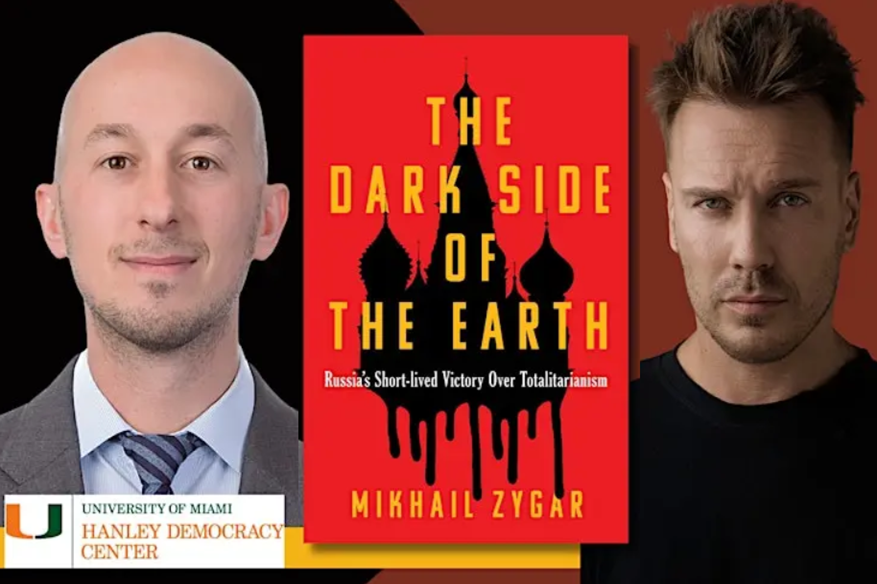
On Saturday, March 28, Zygar will be at Books & Books in Coral Gables to discuss his new book, “The Dark Side of the Earth,” in conversation with Aaron Rosen, in partnership with the University of Miami George P. Hanley Democracy Center. The event begins at 5 p.m. at 265 Aragon Avenue, is free and open to the public, and will be followed by a book signing. Books will be available for purchase. Seating is not guaranteed; the organizers recommend arriving early.
The man Russia sentenced in his absence
Zygar was born in Moscow in 1981, ten years before the Soviet Union he would spend a career documenting collapsed. He worked for Newsweek Russia and the business daily Kommersant before becoming, in 2010, the founding editor-in-chief of Dozhd — TV Rain — Russia’s only independent national television channel. Dozhd gave airtime to opposition voices, covered anti-government protests that state television dismissed or ignored, and asked the kinds of questions at presidential briefings that Russian journalists were not supposed to ask. Zygar received the Committee to Protect Journalists’ International Press Freedom Award in 2014.
The channel was eventually driven off Russian cable networks, its budget cut in half, its staff reduced. When Russia invaded Ukraine in February 2022, Dozhd broadcast coverage that contradicted the Kremlin’s account of the war. Within weeks, Russian authorities shut it down entirely. Zygar left Russia. A Moscow court designated him a “foreign agent” in October 2022. He was placed on an international wanted list in April 2024. Two months later came the in-absentia sentence.
He has kept writing. He contributes a weekly column on Russia and the war to Der Spiegel and writes for The New York Times, Time, Vanity Fair, and Foreign Affairs. He lectures at Columbia University. And he has completed his most ambitious book: a decade-long attempt to answer the question his earlier work circled without resolving — not who Vladimir Putin is, but how Russia got here.
The argument the book makes
“The Dark Side of the Earth” begins in April 1961 — the morning Yuri Gagarin became the first human in space — and moves through the following three decades to the dissolution of the Soviet Union, a moment Zygar watched as a ten-year-old child in Moscow. His argument is counterintuitive and, in the current moment, uncomfortable: what the West perceived as a triumph for freedom was not a clean break. The Soviet Union did not simply end. It transformed. The democratic opening of the late 1980s and early 1990s produced real change but also left intact the machinery of authoritarianism — the instincts, the institutions, the personnel — that Putin later reactivated.
To make that argument, Zygar conducted several hundred interviews over nearly a decade — with Mikhail Gorbachev, with the first presidents of the independent post-Soviet republics, with leaders of independence movements, and with the Western politicians and diplomats who witnessed and participated in those events. He examines the lives of figures like Andrei Sakharov, Alexander Solzhenitsyn, and the poet and songwriter Vladimir Vysotsky, whose resistance to totalitarianism he treats not as historical curiosity but as direct precedent for what is happening now.
The book was named a Best History Book of the Year by The Times of London. It has received starred reviews from Kirkus and Booklist, and praise from Fiona Hill, Anne Applebaum, Yulia Navalnaya, and Dmitry Muratov, the journalist who received the 2021 Nobel Peace Prize. Foreign Policy described it as “pointed, novel, and profoundly relevant.” The Cipher Brief called it “a call to vigilance in the face of resurgent authoritarianism.”
Why this conversation matters here
Books & Books has spent more than four decades bringing writers into conversation with South Florida readers at a moment when that conversation is most needed. The partnership with the University of Miami’s Democracy Center for Saturday’s event is deliberate: Zygar’s book is not only a history of Russia. It is an argument about democracy — about how free societies fail to consolidate their gains, how authoritarianism survives its apparent defeats, and how the Cold War that the world declared over in 1991 continued through different means until it produced the war in Ukraine.
Coral Gables is a city with a large population of Cuban Americans and Latin American immigrants who understand from direct personal experience what it means to live through the failure of a democratic opening — to watch a revolution’s promise dissolve into something recognizable and terrible. Zygar’s argument will not be abstract to many people in that room on Saturday afternoon.
On Saturday afternoon, a man who has been sentenced to nearly nine years in a Russian prison will sit in a bookstore on Aragon Avenue and answer questions about how the country that wants to imprison him got to be the way it is. He will have driven no distance to get there. The distance is already built into his life. The conversation will begin at 5 p.m.

Author: Coral Gables Gazette News Staff
Originally established in 1996 and relaunched as a digital publication in February 2025, the Coral Gables Gazette is an independent local news organization dedicated to factual, objective and accountable community journalism. Our newsroom reports on the people, policies, institutions and events shaping Coral Gables, Florida, providing residents with timely, informative coverage of the issues affecting their community. Our reporting includes City Hall, local government, municipal elections, public spending, real estate development, business, education, arts and culture, and neighborhood affairs throughout the City Beautiful. We follow City Commission decisions, examine public records and report on the businesses, organizations and individuals contributing to Coral Gables. We believe informed residents are essential to a healthy, engaged community. Stories published under the Coral Gables Gazette News Staff byline are prepared or compiled by the publication's editorial team. We strive for accuracy, fairness, transparency and clear distinctions between news reporting, opinion and advertising. Readers are encouraged to submit news tips, corrections, editorial inquiries and story suggestions through our Contact page and learn more about our standards through our Editorial Policy.