
By Coral Gables Gazette staff
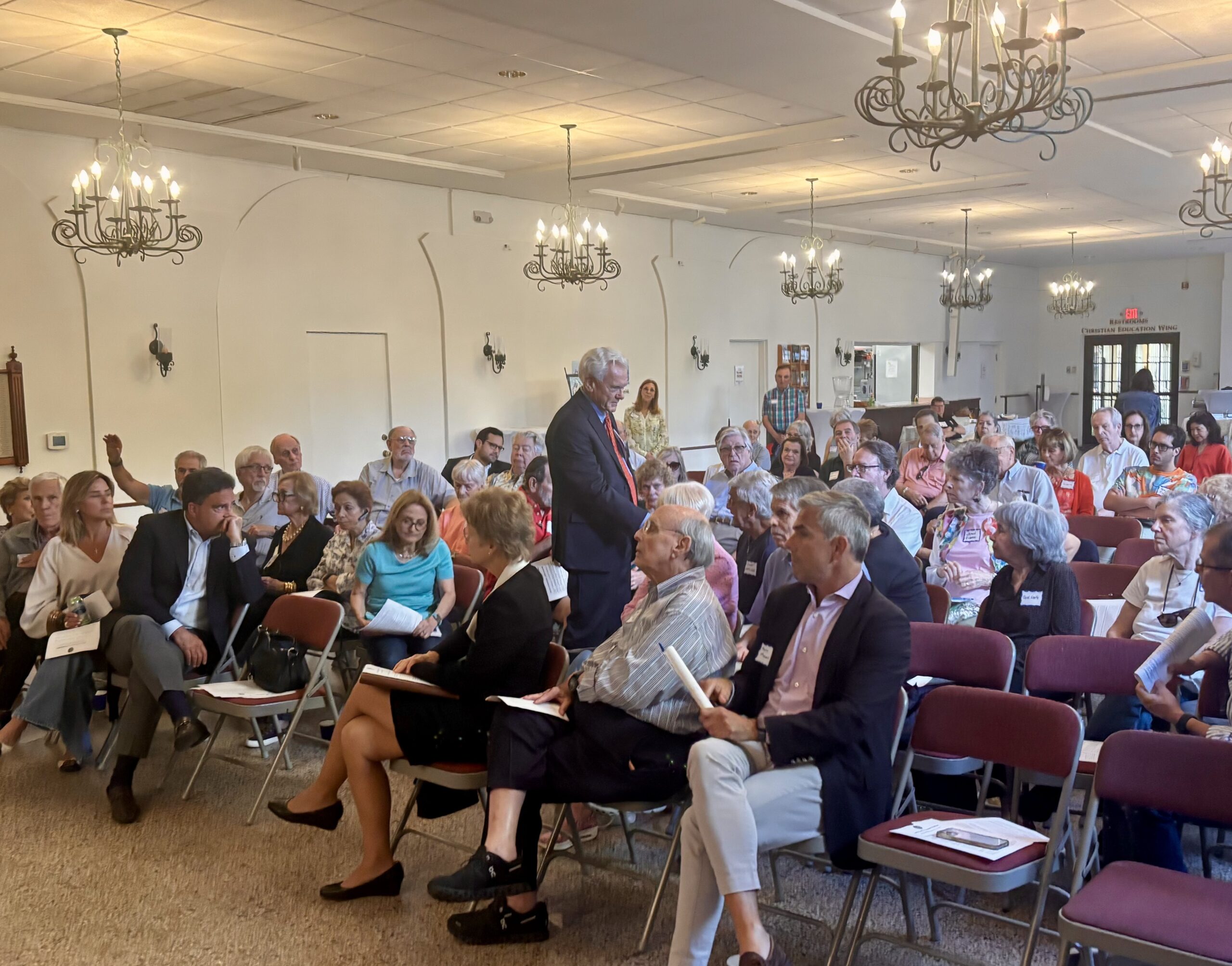
On the 84th anniversary of the death of Coral Gables founder George Merrick, the Gables Good Government Committee (GGG) convened a community forum to walk residents through a slate of eight ballot questions that will be decided by mail-in vote this spring.
Roughly 60 residents gathered at the Coral Gables Congregational Church to hear from former mayor and GGG founder Don Slesnick, who led a detailed presentation on the referendum items. Ballots are due April 21 with several proposals addressing issues rooted in the city’s charter and governance structure.
Slesnick, who also chaired the Charter Review Committee that evaluated the proposed changes, guided attendees through each of the eight questions. The format included statements from both supporters and opponents of the ballot questions.
The election timing debate
The most prominent issue of the evening – and the first item on the ballot – is a proposed shift in municipal election timing from April to November. The measure is widely seen as the driving force behind the broader referendum.
Providing background, Slesnick explained that the Charter Review Committee convened in 2023 had initially voted against placing the election date change on the ballot. However, a reconstituted version of the committee last year ultimately declined to take a formal position, concluding that it would be “inappropriate…to take a political position on the ballot language.”
The committee did, however, recommend removing language in the ballot question stating that the change was intended to increase voter turnout and reduce costs, arguing that such wording amounted to “electioneering.” That recommendation was not adopted by the City Commission, a majority of whom support the change.
Former mayor Raul Valdes-Fauli spoke in favor of moving elections to November, acknowledging that his own views had evolved over time. He said that many Coral Gables voters experience fatigue and are “electioned-out” after participating in federal and state elections, which contributes to low turnout in April municipal contests.
Vice Mayor Rhonda Anderson also backed the proposal, pointing to consistently low participation rates in city elections. She argued that aligning municipal races with November ballots could increase engagement and save the city significant costs – estimated by proponents at roughly $200,000 per election – funds that could be redirected to other needs.
Not all attendees agreed. One resident argued that April elections, though smaller, tend to attract more informed and engaged voters focused specifically on local issues. November elections, the resident said, are often dominated by national and partisan concerns, potentially overshadowing municipal races.
The runoff question turns tense
“I think the people who vote in a smaller election in April are more dedicated and knowledgeable,” the resident said, adding that the relatively modest cost of standalone elections — “about $2 per person” — is worth ensuring high-quality decision-making.
Another attendee countered that broader participation ultimately leads to outcomes that better reflect the will of the community, emphasizing that higher turnout strengthens democratic legitimacy.
Questions also arose about how the ballot items interact with one another. Tom Wells, a former Charter Review Committee member and recent commission candidate, pointed to a potential inconsistency between the first two questions. He noted that while the first item proposes moving elections to November, the second appears to limit future changes to election dates without voter approval.
Wells suggested that if the first measure fails but the second passes, it could create ambiguity about the City Commission’s authority to alter election timing. Anderson pushed back on that interpretation, stating that any such change would ultimately require voter approval through a referendum.
When ballot questions conflict
While much of the discussion remained measured, the tone shifted when attendees turned to a proposal to eliminate runoff elections for mayoral and commission races.
Wells argued against the change, saying that removing runoffs would allow candidates to win office with only a plurality of votes rather than a majority – a departure, he said, from fundamental democratic principles. He pointed to a 2016 commission race involving former commissioners Jorge Fors and Ralph Cabrera, in which Cabrera led in the initial round but did not secure a majority. In the subsequent runoff, Fors ultimately won the seat with a majority of votes.
Nicolas Cabrera, the son of the former commissioner and chair of the city’s Board of Adjustment, challenged that argument. He noted that turnout dropped significantly in the runoff election and that his father received hundreds fewer votes in the second round, suggesting that runoffs may not always produce a more representative outcome.
The exchange grew tense, and Cabrera appeared visibly emotional after being asked to yield the floor to another speaker. He left the room shortly thereafter.
Despite moments of friction, the meeting provided residents with a forum to engage directly with the issues before casting their ballots. With decisions looming on election timing, runoff rules, and other governance questions, the outcome of the April 21 vote could shape the city’s political structure for years to come.

Author: Coral Gables Gazette News Staff
Originally established in 1996 and relaunched as a digital publication in February 2025, the Coral Gables Gazette is an independent local news organization dedicated to factual, objective and accountable community journalism. Our newsroom reports on the people, policies, institutions and events shaping Coral Gables, Florida, providing residents with timely, informative coverage of the issues affecting their community. Our reporting includes City Hall, local government, municipal elections, public spending, real estate development, business, education, arts and culture, and neighborhood affairs throughout the City Beautiful. We follow City Commission decisions, examine public records and report on the businesses, organizations and individuals contributing to Coral Gables. We believe informed residents are essential to a healthy, engaged community. Stories published under the Coral Gables Gazette News Staff byline are prepared or compiled by the publication's editorial team. We strive for accuracy, fairness, transparency and clear distinctions between news reporting, opinion and advertising. Readers are encouraged to submit news tips, corrections, editorial inquiries and story suggestions through our Contact page and learn more about our standards through our Editorial Policy.









Vote No on all items. We need to keep our elections local
how are they not Local in November? you just have to pay more attention.
I agree, vote no.
I think this whole issue revolves around being “local” or being caught up in state, national and global issues which will overshadow what we, as residents of CG, want and need. We do not need to have what we need become buried among dozens of other voting points on a ballot.
so, we cant walk & chew gum? the underlying assumption is we wont pay attention to the local because were focused on Washington & Tallahassee? Beg to differ. I know I can.
GLo, who do you work for? Obviously you do not understand the concern CG residents have and what WE want. Local means local and elections should be about local. You must be an amigo of one of the autocratic leaders who never listen to what we want. Or do you work for a PAC? VOTE NO to move the elections. You want my $2. I will gladly pay you for my vote that is only about CG, Also anything Anderson wants I will vote against. Anderson, Lago and Lara have their own arrognant agenda and I am counting the days they are gone.
Kudos to the Gables Good Government group for offering a chance to openly debate important issues before an election. No matter how residents cast their votes, the opportunity to exchange ideas and gather feedback is essential. Change is always a gamble, but it’s often worth the effort to try something, evaluate the results and amend if necessary in the future. Sometimes, issues like this can energize constituents, wake up the sleeping non-voter segment and serve as a call to action for those sitting on the sidelines. Any issue, method, or opportunity for greater voter turnout is a positive change. Find a way to get a higher percentage of registered voters to engage. It’s well worth any risk involved.
To me it a quantity vs quality voter issue. In November with a large list of partisan congress and state
candidates attracting voters, once they get to the end of the ballot with local race a person may tend to
choose out of name recognition from ads versus knowledge of a commission candidates philosophy
or credentials. Vote NO to maintain focused April election.
The 2015 Charter Review Committee considered the election date change proposal extensively. Here is a link to the video from the CRC meeting on August 9, 2015: https://coralgables.granicus.com/player/clip/816?Mode2=Video
At 8:55 of the meeting, Mayor Valdes-Fauli stated that an April election may have “less participation but those who participate are focused on Coral Gables issues versus participants focused on electing a Republican, Democrat or Third-Party candidate.” At 11:16, he stated that he was against changing our April election date because that would “contaminate our election with extraneous issues.” More voters does not mean we will have a better representative outcome. If that was the case, Mayor Lago’s majority would have us voting on these important proposals in person by early voting and Election Day precinct voting and ballot drop-off at the library with the other November 2026 elections. Why does Mayor Lago’s majority fear more voters on these critical Charter issues? It would not extend the term of any elected official.
A November election will increase campaign costs to compete with simultaneous Federal, state and county elections and referendum questions. That gives power to real estate developers who make large political contributions. Numerous studies show that on-cycle elections significantly increase the incumbency advantage of elected officials – maybe that is why Mayor Lago is pushing for an on-cycle election in November 2026 because he fears losing an off-cycle election in April 2027. I want to keep our elections in April so that grassroots candidates (like Mayor Dorothy Thomson whose tie-breaking VOTE AGAINST DEVELOPMENT in 1980 saved The Biltmore) can continue to govern our City and preserve our history and quality of life. VOTE NO!
The GGG forum to discuss ballot measures was very productive. No one questioned the wisdom of the politically charged ballot, as the political divide was visible.
Items 1 & 2 will surely be a referendum on the politicians that are pushing it and therefore will likely do everything to ensure its passage for change.
Item 3 will not change life in Coral Gables and is superfluous. An appointed board member should be able to be removed by the appointer.
Item 4 regarding the decennial review of the City Charter is unreasonably too long and it was pointed by several residents.
Item 5 asks for the hiring of an inspector general to root out waste fraud, corruption inefficiencies will never work. The inspector general appointed by the commissioners / manager will never catch the big fish at the upper echelons of government. It is not cost effective to go after someone pumping gas in their car on the city account.or someone stealing furniture. We have the FBI and whistleblowers to find where the big money is going.
Item 6 requiring a vote of the lectors for modifying compensation makes sense as long as it does not go beyond the CPI.
Item 7 Eliminating the run off should not be eliminated. The Cabrera, loss to Fors in the runoff may sound logical, but residents voted for the candidate based on the record of the previous incumbent they knew well.
Item 8 Reserve policy and expenditures This is by far the best item on the referendum. I wish our politicians in Washington could adopt a similar policy.
The opinions above are my own and not meant to point negatively at any individual.
Our Coral Gables elections have been in April for 100 years. They offer the opportunity to focus on our local issues, which affect our residents more directly than any other national, state or county issues.
It’s quite telling that the majority on the commission didn’t accept the recommendations of the Charter Review Committee…we should ask ourselves why???
The most damaging of all are the first two referendums…the change of date and the elimination of runoff elections. Neither one makes any sense.
This so-called voter fatigue is being caused by having to vote on local issues every two years in April? That’s not voter fatigue. If a resident finds it difficult to vote in April when they can vote by mail, vote early, or vote on Election Day, that’s just plain apathy!
There are ulterior motives behind this mail-in election, which will negatively impact our City Charter, and for that reason alone, the voters should vote NO.
Did not know about the forum. How was it communicated to the residents?
Why is it that when important issues are being considered in public forums, residents are not informed?
How can residents find out about these meetings? The same people are the ones present in all these meetings.
All residents need to be informed about these meetings.
Vote No for an inspector general appointed by the commission / manager. The ballot statement is full of half truths and worded to pass. They say this position could be appointed by the city or Dade County. It will be by our city leadership who has not been honest about even donations from developers. Putting a fox in a hen house to protect the hens is just what this is. Lago, Anderson and Lara have not been honest, have not cared to listen to us or do what we ask them to do. They have their own agenda and will never understand that they work for us. I look at them and just see dictators who thinks they know it all. Vote no to all and keep Coral Gables governed by the people.