
By Coral Gables Gazette Staff
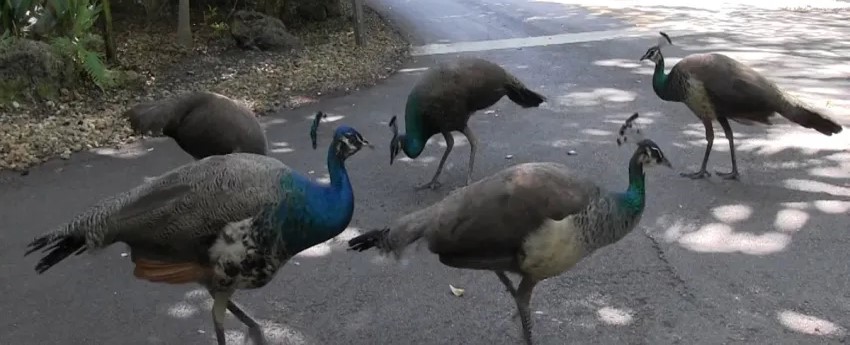
Coral Gables’ iconic peafowl have long been admired for their brilliant plumage and serene strut. But for many residents, especially in neighborhoods near Cocoplum, Cartagena Circle, and Old Cutler Road, the birds’ booming cries, scratched vehicles, and territorial behavior have become a source of escalating frustration.
The Coral Gables City Commission adopted a Peafowl Mitigation Policy a few years ago, creating a new pathway for residents and the city to manage the birds’ growing presence—without violating longstanding animal protection laws.
A growing clash between charm and nuisance
Peafowl were introduced to parts of South Florida decades ago and have since made themselves at home in leafy residential pockets of Coral Gables. Their presence, once seen as ornamental, has increasingly raised quality-of-life concerns.
Residents have reported early-morning squawking, roof damage, broken tiles, flowerbed destruction, and aggressive behavior during mating season. Some neighborhoods have even created informal social media groups to track roaming birds and alert each other of noise disturbances.
Yet for years, municipal hands were tied. A 2001 Miami-Dade County ordinance prohibited the trapping, removal, or harm of peafowl, their eggs, or nests—regardless of the severity of disruption. That left local governments unable to respond, even when residents pleaded for relief.
A policy window opens—and Coral Gables acts
In 2022, after years of advocacy from city officials and affected neighborhoods, the Miami-Dade County Commission passed a new ordinance allowing municipalities to opt out of the peafowl protection ban. With that authority, cities could design and adopt their own humane mitigation plans, subject to county review.
Coral Gables was among the first to pursue the opportunity. In October 2022, the City Commission approved a resolution requesting county approval for its mitigation framework. That request was granted in early 2023, and city staff began developing procedures for humane removal in consultation with wildlife experts and community stakeholders. The finalized policy passed unanimously after that.
What the policy allows
The newly adopted Peafowl Mitigation Policy includes several key provisions:
- Private Property: Residents may now hire licensed professionals to humanely capture and relocate peafowl from their property. At no point may birds, nests, or eggs be harmed, destroyed, or transported out of state without proper authorization.
- Public Spaces: The city has allocated funds to support removal of peafowl from city-owned land and public rights-of-way. These operations will be coordinated through the Code Enforcement Division and conducted by trained wildlife handlers.
- No Feeding: Residents are strongly discouraged from feeding peafowl, as this contributes to flock expansion and increases neighborhood conflicts. The city may issue warnings or citations to repeat violators under existing nuisance ordinances.
Regional comparisons and future options
Coral Gables is not alone in grappling with this challenge. The Village of Pinecrest has piloted a sterilization program that uses vasectomy procedures on male peafowl to reduce population growth. In Coconut Grove, where peafowl are more numerous, neighborhood associations have taken the lead in advocating for removal programs amid noise and damage complaints.
City officials in Coral Gables say they are watching these approaches closely and remain open to evaluating other science-based solutions, including sterilization, nesting deterrents, and habitat modification.
Guidance for residents
Residents seeking relief from peafowl on their property should contact the Coral Gables Code Enforcement Division at 305-441-5777. The city can provide guidance on licensed removal specialists and will dispatch professionals for eligible public property removals.
The city also encourages residents to report repeated disturbances or aggressive peafowl behavior, which may help shape future wildlife planning.
A humane path forward
With its policy, Coral Gables is signaling thoughtful urban wildlife management—one that prioritizes both neighborhood livability and animal welfare. Officials say the policy reflects the city’s broader values: beauty, balance, and responsibility.
As one Code Enforcement staffer noted in a recent public meeting, “It’s about coexistence—not elimination.”
In Coral Gables, the call of the peacock may not be silenced—but it will be managed with care.


This Post Has 12 Comments
A welcome decision. As I read, I see a problem. These lovely birds roam the streets and public spaces, but as soon as you walk by them, they run into private properties or fly onto the roofs of the houses. I see the problem as a city hired trapper is about to catch, but then, they move 3 feet and are in the yard of the homeowner. So what happens?
City should adopt a policy that would allow the homeowners to give permission to enter their property. All you need is a signed permission and disclaimer.
These are natural birds for the area…the only problem I see is them flying on top of the cars and scratching them..just shoe them away and problem solved.Again i don’t see the problem here..A lot of people with a lot of time on their hands to complain about nothing…You want to complain, complain about the obvious genocide happening in the middle east under the illusion of war…whole families starving and the international media barred from recording it…Now thats something everyone should be complaining about…
Peacock problem in Miami?- let’s blame Israel, of course….it makes perfect sense. The two are so related.
Coral Gables is starting to be a Totalitarian state. Because harmless birds cause a bit of nuisance, some noise, some dirt, we use the power of the state to selectively exterminate them. What is next ? Squirrels ? Not far fetched. Just look at what happened to a squirrel named Peanut in New York.
A problem easily solved with a BB gun and good aim. All animals need predators. It keeps the ecosystem healthy.
Does the Peafowl Mitigation Policy include chickens? Because we currently have 6 chickens roaming around Santillane Ave and Salzedo they start crowing at 6:30 in the morning. If anyone needs wings for their Sunday BBQ, you can get a dozen for free.
I am so glad that CG is starting to manage the peacock population. Fortunately, I live on the north side of US 1 where there are less of them but occasionally I hear and see them. They are pretty but such a nuisance in so many ways and I hope with some intervention their numbers will dwindle. Non native animals, besides parrots, seem to always cause issues because they have no predators to keep the population in check.
If one doesn’t like nature perhaps Coral Gables isn’t the right place to live. Try NYC or Brickell…
Maybe you live in a condo or your car is in a garage, but those of us with yards and cars have had peacocks tear up our gardens, scratch our cars, perch and poop on our roofs, and during mating season have our sleep interrupted at 3am by a loud screeching sound.
Peacocks are not native to South Florida.
I love nature, but peacocks can be destructive and disruptive. I’m glad they can now be legally humanely relocated.
In Miami Shores some homeowners have several motions sensor lawn sprinklers that turn on when they are close. They say it works pretty well.
Shouldn’t we be more concerned with the infestation of iguanas in our neighborhood? They do kill native species all around us.
you have a great blog here! would you like to make some invite posts on my blog?