
By Coral Gables Gazette staff
The most improbable fact about the original Raggedy Ann and Andy dolls is not that they still exist. It is that they have spent the better part of seven decades on Segovia Street.
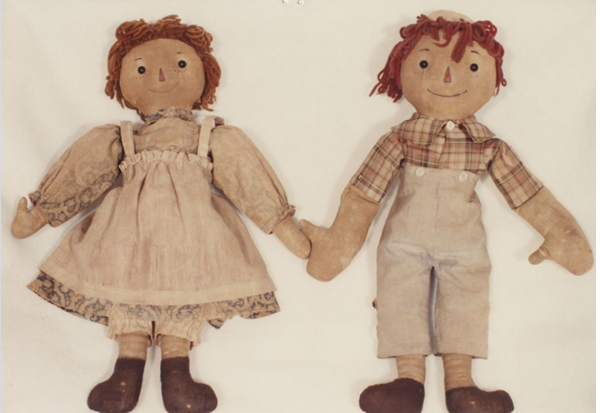
Since 1953, the dolls created by the man who invented Raggedy Ann — and later preserved and donated by his family — have rested in the collection of the Coral Gables Branch Library, a permanent and quietly cherished fixture among the institution’s art and artifacts. The Miami-Dade Public Library System will mark that history with a two-day celebration on Friday, June 12, and Saturday, June 13, opening the library’s doors to film screenings, activities for all ages, and the rare pleasure of a selfie beside objects that helped shape American children’s culture.
An artist, a rag doll, and a publishing phenomenon
Johnny Gruelle — his full name was John Barton Gruelle — was born in Arcola, Illinois, on Christmas Eve 1880 and grew up in Indianapolis, where his father Richard was a painter associated with the Hoosier Group of American Impressionists. The household’s artistic atmosphere was formative: the poet James Whitcomb Riley was a family acquaintance, and Gruelle would later draw from Riley in the most durable way possible, fusing the names of two Riley poems — “The Raggedy Man” and “Little Orphant Annie” — into the name of his most famous creation.
Gruelle built a career as a political cartoonist and illustrator before turning to children’s books. He patented the Raggedy Ann doll design in 1915 and introduced the character publicly three years later through the P.F. Volland Company’s publication of Raggedy Ann Stories. The book and the doll that accompanied it became major commercial successes almost immediately. Raggedy Andy followed in 1920, and by the end of World War II the series had sold in the millions.
The family’s connection to South Florida deepened in Gruelle’s final years. He and his wife Myrtle relocated to the Miami area in 1932, and he died of heart failure at his son Worth’s home in Miami Springs on January 9, 1938, two weeks after his 57th birthday. He had spent the last chapter of his life in the region that would later become the permanent home of his most famous creations.
A widow’s gift, a library’s treasure
Fifteen years after Gruelle’s death, his widow Myrtle donated the original Raggedy Ann and Andy dolls — along with books from the family collection — to the Coral Gables Branch Library. The year was 1953, more than two decades after the library began as a Woman’s Club lending library in 1927. The Gruelle donation arrived as both a gesture of local affiliation and a statement of permanence.
The dolls have been on display ever since, joined over the decades by other artifacts in a collection that includes a 15-foot ceramic tile mural by artist Kay Pancoast and a series of oil paintings. Visitors who know to look will find Raggedy Ann and Andy tucked among the holdings of what remains, despite its branch status within the Miami-Dade system, one of Coral Gables’ more quietly distinguished cultural spaces.
The 1941 Fleischer short and a family collaboration
The screening at the center of the two-day celebration offers its own layer of history. The 1941 animated short Raggedy Ann and Raggedy Andy was produced by Fleischer Studios — the Betty Boop and Popeye powerhouse — and released by Paramount on April 11, 1941, in Technicolor. The film was co-written by Worth Gruelle, Johnny’s son, who helped shepherd his father’s characters into animation three years after Johnny’s death. Running just under 18 minutes, the short opens in a small toy shop and unfolds into a fantasy origin story set in the mythical land of Ragland, where sentient needles, threads, and paintbrushes collaborate to bring the two dolls into being.
The film has since been restored by the UCLA Film and Television Archive. It depicts Raggedy Ann and Andy as sweethearts rather than the siblings of the books — a creative choice that gave the story its emotional through-line and its closing image of the two dolls with their hands sewn together.
What to expect at the library
The Friday, June 12 event runs from 2 to 3 p.m. The Saturday, June 13 session runs from 10 to 11 a.m. Both days will feature the film screening with popcorn, hands-on activities for all ages, and time with the historic dolls. Guests are encouraged to bring their own favorite doll or stuffed animal for photos alongside the originals — an invitation that, given what the originals represent, carries more weight than the typical selfie opportunity.
The event is free and open to all ages.
Coral Gables Branch Library, 3443 Segovia St., Coral Gables. Friday, June 12, 2–3 p.m.; Saturday, June 13, 10–11 a.m. Free. All ages. For information: 305-442-8706 or capleybr@mdpls.org.

Author: Coral Gables Gazette News Staff
Originally established in 1996 and relaunched as a digital publication in February 2025, the Coral Gables Gazette is an independent local news organization dedicated to factual, objective and accountable community journalism. Our newsroom reports on the people, policies, institutions and events shaping Coral Gables, Florida, providing residents with timely, informative coverage of the issues affecting their community. Our reporting includes City Hall, local government, municipal elections, public spending, real estate development, business, education, arts and culture, and neighborhood affairs throughout the City Beautiful. We follow City Commission decisions, examine public records and report on the businesses, organizations and individuals contributing to Coral Gables. We believe informed residents are essential to a healthy, engaged community. Stories published under the Coral Gables Gazette News Staff byline are prepared or compiled by the publication's editorial team. We strive for accuracy, fairness, transparency and clear distinctions between news reporting, opinion and advertising. Readers are encouraged to submit news tips, corrections, editorial inquiries and story suggestions through our Contact page and learn more about our standards through our Editorial Policy.











COME BACK BACKUS!
“The dolls have been on display ever since, joined over the decades by other artifacts in a collection that includes a 15-foot ceramic tile mural by artist Kay Pancoast and a series of oil paintings.” This is a significant statement that mentions “a series of oil paintings” which most probably refers to the A.E. Backus oil painting “Florida Landscape” that was hanging in the library for decades. The library also was in possession of five (5) Prints/Drawings by A.E. Backus.
BUT WHERE ARE THEY?
An inventory list compiled a few years ago by a member of the Library Advisory Board (LAB) included details of the several prints and oil painting that were part of the Coral Gables Library Collection.
This list, along with a letter from the LAB was officially presented to the City Commission.
Additionally, below is a recent statement from then chair of the Library Advisory Board:
“We prepared an exhibit with the inventory list and photos of the items and presented it to the Commission. I argued that the items “belonged” to the Library as they were gifted specifically to the Library (we had Mrs. Merrick’s letter) and if they had to be removed temporarily they should be identified as such and returned to the library after the renovation. The Backus items were black and white signed sketches. ”
List of Backus artworks from inventory list:
Five (5) Prints/Drawings by A.E. Backus (Albert Ernest “Bean” Backus Pencil Etchings : located on walls
1. “Canal Bank, Florida” 1972
2. “Rue des Religieus, Cap Haitian, Haiti” 1956
3. “Navy Island, Jamaica” 1971
4. “Lake Yale, Florida” 197?
5. “Old Pine, Florida” 1968
Oil Painting
“Florida Landscape”
by A.E. Backus
(Albert Ernest ‘Bean’ Backus)
(b.1906 – 1990)