
By Coral Gables Gazette staff
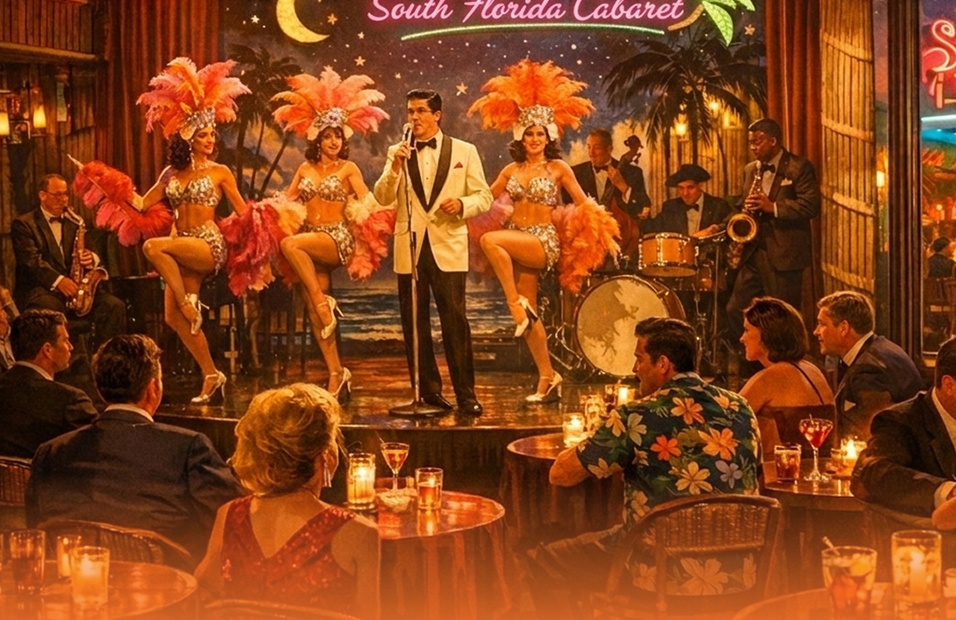
Picture Miami Beach in 1962. The hotels along Collins Avenue are full. The air smells like salt and gardenia. A singer steps to the microphone in a small room where the tables are close together and the lights are low, and the piano begins. The city outside is loud and new and full of itself. In here, the music is the only thing.
That is the world that Friday night’s performance at the University of Miami’s Frost School of Music is designed to conjure. “A South Florida Cabaret,” presented in partnership between Frost and IlluminArts and featuring Grammy-winning pianist Craig Terry as artist-in-residence, takes a group of emerging vocal artists and asks them to do something that conservatory training rarely demands: tell a story, inhabit a city, make the audience feel a time and a place that no longer exists. The performance begins at 7:30 p.m. on the Hormel Innovation Stage at the Knight Center for Music Innovation, 5513 San Amaro Drive in Coral Gables.
The art of collaborative piano
Terry occupies a specific and demanding corner of the classical music world. He is a collaborative pianist, which means his instrument is not the solo piano but the relationship between the piano and the human voice. It is a discipline that requires technical fluency, acute listening, and a particular kind of musical generosity: the ability to support a singer’s interpretation without subordinating the music to it, to lead without appearing to lead, to shape a performance from the bench.
Terry has built one of the most distinguished careers in that field. He served as assistant conductor at the Metropolitan Opera after completing its Lindemann Young Artist Development Program, then spent eleven seasons at the Lyric Opera of Chicago before becoming music director of the Lyric’s Ryan Opera Center, one of the country’s most respected training programs for young opera singers. He has performed with Renée Fleming, Joyce DiDonato, Jamie Barton, Lawrence Brownlee, and dozens of other leading voices on stages across North America, Europe, and Asia.
The Grammy came in 2020, awarded for Best Classical Solo Vocal Album for “Songplay,” a recording he made with DiDonato for Warner Classics. The album was Terry’s project as much as DiDonato’s: he arranged all the music and served as musical director, drawing Baroque arias and American jazz standards into the same emotional conversation. DiDonato described it as a project with no boundaries and no rules. Terry was the one who built the structure that made that freedom possible.
IlluminArts and the case for site-specific music
IlluminArts began in 2013 when Miami mezzo-soprano Amanda Crider, sitting through a perfectly competent classical recital in Washington, found herself bored. The music was good. The hall was traditional. The program was printed. Something was missing. From that experience came the organization she founded to present classical vocal music in ways that correspond to how 21st-century audiences actually engage with art: in specific places, around specific ideas, in conversation with the visual world.
Over the years IlluminArts has brought performances to the Perez Art Museum Miami, Vizcaya Museum and Gardens, the Bass Museum, the de la Cruz Collection, and Oolite Arts, among others. It has received grants from the Knight Foundation, Miami-Dade County, the City of Coral Gables, and New Music USA. The organization’s approach is not to make classical music more accessible by simplifying it but by surrounding it with context, pairing it with place, and asking audiences to bring their full attention rather than their prior associations.
Friday’s performance marks the first collaboration between IlluminArts and the Frost School of Music. That partnership places emerging Frost vocal students alongside one of the most experienced collaborative pianists working today, in a format that blurs the line between classical recital and theatrical storytelling. It is a combination that neither institution could produce alone.
Why 1960s Miami
The cabaret format has a particular history in Miami. In the years between the end of World War II and the transformation of the city into an international metropolis, Miami Beach and the neighborhoods around it supported a dense nightclub culture. Performers who had built careers in New York stopped in Miami on their way south. The city’s hotel ballrooms and supper clubs drew audiences who wanted music close, intimate, and live. Cabaret was not a genre in that context so much as a condition: a small room, a singer, a pianist, and no distance between the music and the people hearing it.
The Frost students performing Friday have been asked to do more than sing repertoire from that era. They have been asked to curate it, to build a program that functions as a portrait of a city at a particular moment. The immersive visuals that will accompany the performance are designed to place the audience inside that moment rather than in front of it. Terry’s role is not only to accompany but to mentor, to bring the weight of his experience to young singers who are learning that classical training and theatrical imagination are not separate skills.
Music as civic memory
There is something fitting about a tribute to 1960s Miami taking place in Coral Gables, a city whose own identity was built in an earlier era and has been maintained with unusual care ever since. The Frost School of Music, situated on a campus designed to reflect Mediterranean architectural ideals, is not an accidental setting for an evening about civic memory and musical culture. The university and the city grew up together, and both have understood from early on that culture is not an amenity. It is part of the infrastructure.
On Friday evening, the Hormel Innovation Stage will go dark, the visuals will begin, and a pianist who has performed at the world’s great opera houses will settle in at the bench and listen for the voice beside him. The singers are students still, building careers, learning the particular discipline of telling someone else’s story with your whole self. The city outside will be what it always is: loud, new, alive. Inside, for two hours, it will be 1962 again.

Author: Coral Gables Gazette News Staff
Originally established in 1996 and relaunched as a digital publication in February 2025, the Coral Gables Gazette is an independent local news organization dedicated to factual, objective and accountable community journalism. Our newsroom reports on the people, policies, institutions and events shaping Coral Gables, Florida, providing residents with timely, informative coverage of the issues affecting their community. Our reporting includes City Hall, local government, municipal elections, public spending, real estate development, business, education, arts and culture, and neighborhood affairs throughout the City Beautiful. We follow City Commission decisions, examine public records and report on the businesses, organizations and individuals contributing to Coral Gables. We believe informed residents are essential to a healthy, engaged community. Stories published under the Coral Gables Gazette News Staff byline are prepared or compiled by the publication's editorial team. We strive for accuracy, fairness, transparency and clear distinctions between news reporting, opinion and advertising. Readers are encouraged to submit news tips, corrections, editorial inquiries and story suggestions through our Contact page and learn more about our standards through our Editorial Policy.










Thông qua hệ thống tường lửa WAF 5 lớp và công nghệ mã xác thực 2AF, sân cầu 66b triều khúc ẩn danh tuyệt đối mọi tài khoản người chơi đồng thời, mã hóa toàn bộ hoạt động khi hội viên truy cập, sử dụng dịch vụ, sản phẩm. Vì thế, bạn hoàn toàn có thể yên tâm khi cá cược tại đây. TONY04-17
The game’s values align with its community’s expectations.