
By Coral Gables Gazette staff
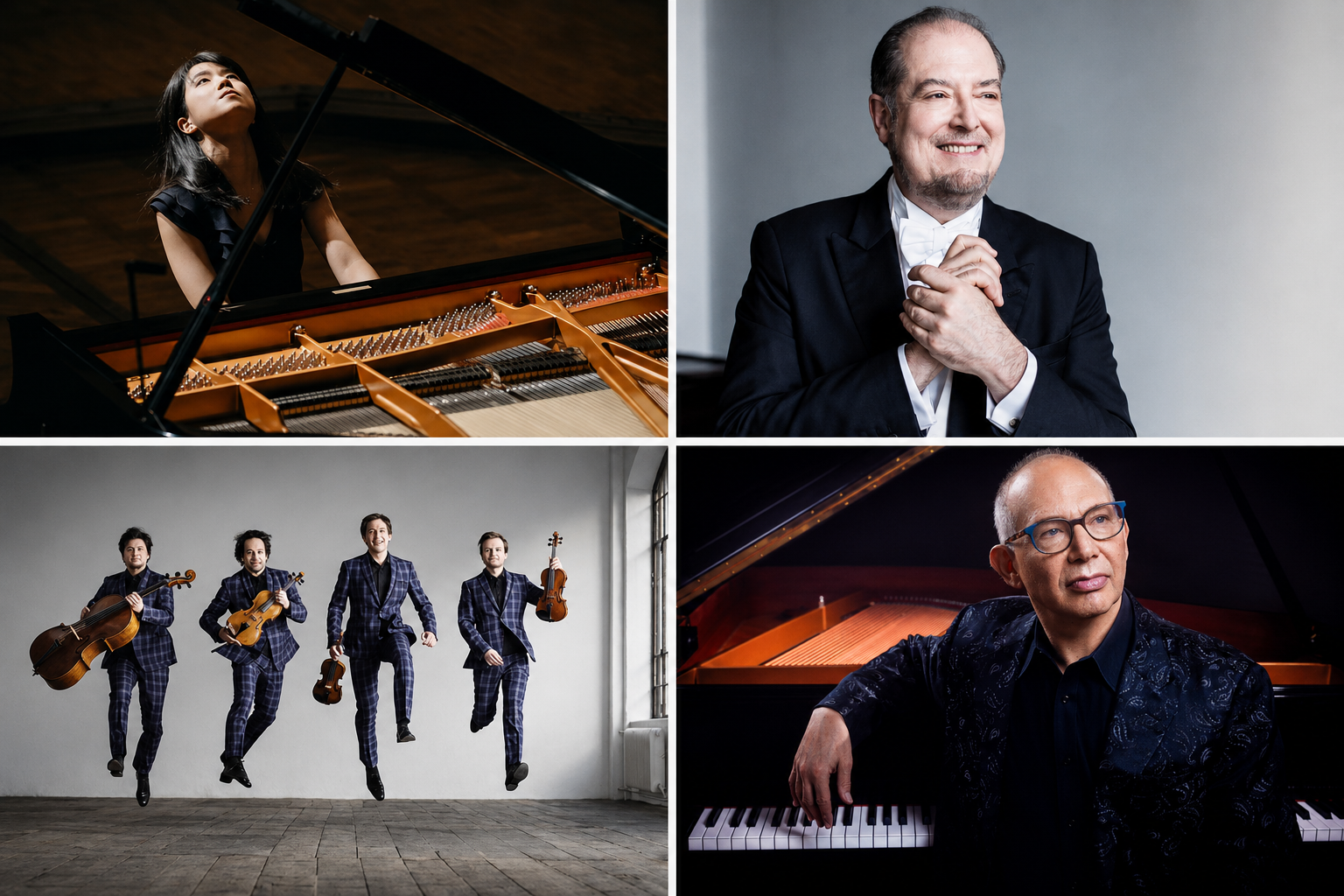
Forty-five years separate the Warsaw breakthroughs of the two pianists at the center of the 7th Frost Chopin Academy & Festival at the University of Miami. Garrick Ohlsson won the International Chopin Competition in Warsaw in 1970, a landmark American victory that stood alone for more than half a century. Kate Liu won the audience’s heart at the same competition in 2015, taking third prize, the Best Mazurka Prize and the Polish National Radio Audience Award. That they appear on the same Coral Gables festival roster this month is one of the more quietly remarkable things happening in South Florida’s classical music calendar.
The festival runs Sunday to Sunday, June 14 through 21 at the University of Miami’s Frost School of Music, with a pre-festival evening at the Coral Gables Museum on June 13. Artistic director Kevin Kenner — himself a laureate of the 1990 Chopin Competition — has built a seven-day program that moves from intimate Chopin recitals to chamber music to a jazz trio finale, with 24 young pianists from three continents woven through every concert alongside the guest artists. Open lessons, lectures and panel discussions are free to the public throughout the week.
Pre-festival encounter at the museum
The week opens a day early at the Coral Gables Museum on Saturday, June 13, at 6 p.m., with a panel and performance featuring Liu, Kenner, Cambridge Professor John Rink — one of the leading authorities on Chopin’s manuscripts and performance history — and pianist and media producer Ben Laude in conversation about musical interpretation and the specific challenges Chopin presents to performers. The evening is framed as a behind-the-scenes sampler of what follows: live performance, open discussion and a rare opportunity to hear artists at this level talking through the music before playing it. Complimentary admission is available for students and museum members.
The opening: Liu and the Romantic imagination
Liu’s opening recital on Sunday, June 14, at 4 p.m. is titled “Between Dance and Dream.” The program places Chopin beside Schumann and Brahms, inviting listeners to hear the mazurka, the sonata, the character piece and the early Romantic sonata as related forms of Romantic expression. She opens with the Mazurkas, Op. 50 — miniatures of intricate national character — before moving to the Piano Sonata No. 2 in B-flat minor, whose third movement, the “Marche funèbre,” is among the most recognized in the piano repertoire. After intermission, the program turns to Schumann’s Arabeske and the Brahms Piano Sonata No. 1 in C major, written when Brahms was 19 and already reaching for symphonic scale.
Liu released her debut album of Beethoven and Brahms sonatas on Orchid Classics in 2025. That she chooses to open this festival with Brahms alongside Chopin says something about where her artistic attention currently sits — and gives the recital a structural argument beyond the Chopin repertoire alone.
Ohlsson: a half-century of Chopin mastery
Ohlsson won the Gold Medal in Warsaw in 1970 and went on to build a career commanding more than 80 concertos across the full span of the piano literature. Most recently, the Chopin Competition invited an American to chair its jury for the first time in the competition’s history, and Ohlsson assumed that role for the 19th edition in October 2025. He arrives in Coral Gables as one of the most credentialed Chopin figures on the international stage.
His Tuesday, June 16, recital at 7:30 p.m. — “Visions in Counterpoint” — places Chopin in conversation with Brahms and Shostakovich, emphasizing structure and counterpoint rather than treating Chopin as a purely lyrical composer. The program includes Chopin nocturnes, preludes and the Piano Sonata in B major, Op. 58, alongside Brahms’ Variations and Fugue on a Theme by Handel and Shostakovich’s Prelude and Fugue in E minor. Three academy participants — Sabrina Chen, Zhenyi Long and Natasha Wu — are also listed on the program, each performing movements from the Chopin B major Sonata.
The chamber voice: Apollon Musagète and Schubert’s darker register
The Polish Apollon Musagète Quartet carries a strong connection to Warsaw’s Fryderyk Chopin Institute and its annual festival circuit. Their Thursday, June 18, program at 7:30 p.m. — titled “Death and the Maiden” — pairs solo Chopin performances by four academy participants with Schubert’s String Quartet No. 14 in D minor. The work, composed in 1824 as Schubert confronted his own illness, draws its title from a song he had written seven years earlier; all four movements return to the tension between the song’s two figures, resistance and the inevitability of death. It is one of the pillars of the chamber repertoire, and Apollon Musagète brings a serious record with the work.
The quartet returns the following evening, June 19, at 7 p.m., for “In Harmony,” a mixed program featuring Schumann’s String Quintet in E-flat major alongside Chopin’s First Piano Concerto performed by concerto and chamber audition winners from the academy, with Frost faculty artist Brian Powell on double bass.
The jazz close: Rosenthal reimagines the canon
The festival ends Sunday, June 21, at 4 p.m. with a deliberate pivot. Ted Rosenthal — a winner of the Thelonious Monk International Jazz Piano Competition and a faculty member at both the Juilliard School and the Manhattan School of Music — released Classics Reimagined: Impromp2 in late 2025. The album takes themes by Chopin, Brahms, Dvořák, Beethoven and others and recasts them for jazz trio, treating each classical piece as raw material: extracting motifs and colors and reshaping them into new rhythmic and harmonic terrain. The festival program presents the album as a bridge between classical tradition and contemporary improvisation.
The decision to close a Chopin festival with jazz is not a gimmick. Kenner frames it directly in his program notes: Chopin was himself a master improviser, and Rosenthal’s trio represents something like a 21st-century extension of that instinct. The closing concert opens with academy participants performing Chopin, then passes the stage to the trio for the second half — a structural argument that the music connects across time and genre, not just within the tradition.
The academy: 24 pianists, three continents, open doors
Threaded through every concert is the Frost Chopin Academy itself, which brings together 24 young pianists — nearly half under 18, drawn from the United States, Canada, Japan, South Korea, China, Turkey and Thailand, among other countries — for a week of open lessons, workshops and performances alongside the guest artists. Wednesday’s “Stars of the Academy” concert at 7:30 p.m. features the youngest participants in a full Chopin program. A lecture by Professor Rink takes place Tuesday at 4 p.m. Discussion panels moderated by Laude are scheduled Wednesday and Thursday. All are free and open to the public.
Pre-Festival Encounters: Saturday, June 13, 6–7:30 p.m. Coral Gables Museum, 285 Aragon Ave. Complimentary for students and museum members.
Frost Chopin Academy & Festival: June 14–21. Maurice Gusman Concert Hall, Newman Recital Hall, and Hormel Music Innovation Stage, University of Miami Frost School of Music, 1314 Miller Dr., Coral Gables. General admission $25; senior admission $20; students and youth under 18 free. All open lessons, lectures and panel discussions: free. frostchopinfestival.com.

Author: Coral Gables Gazette News Staff
Originally established in 1996 and relaunched as a digital publication in February 2025, the Coral Gables Gazette is an independent local news organization dedicated to factual, objective and accountable community journalism. Our newsroom reports on the people, policies, institutions and events shaping Coral Gables, Florida, providing residents with timely, informative coverage of the issues affecting their community. Our reporting includes City Hall, local government, municipal elections, public spending, real estate development, business, education, arts and culture, and neighborhood affairs throughout the City Beautiful. We follow City Commission decisions, examine public records and report on the businesses, organizations and individuals contributing to Coral Gables. We believe informed residents are essential to a healthy, engaged community. Stories published under the Coral Gables Gazette News Staff byline are prepared or compiled by the publication's editorial team. We strive for accuracy, fairness, transparency and clear distinctions between news reporting, opinion and advertising. Readers are encouraged to submit news tips, corrections, editorial inquiries and story suggestions through our Contact page and learn more about our standards through our Editorial Policy.












References:
Hitnspin bonus code http://images.google.com.tj
References:
Hitnspin auszahlung dauer http://lginis.yoo7.com
References:
Hitnspin registrierung http://images.google.gy/url?sa=t&url=https://undrtone.com/energyslice33
References:
Online pokies with payid australia real money
https://aiviu.app/@deliaabigail49?page=about
References:
Online pokies australia payid real money https://wirsuchenjobs.de
References:
Payid pokies aus gitbaz.ir
References:
Lollybet Free Spins http://clients1.google.com.sv/
References:
Lollybet App https://www.gcores.com/link?https://croys.top/numbers88b5249=https://croys.top/numbers88b5249
References:
Lollybet Bonus ohne Einzahlung cse.google.ac
References:
Lollybet seriös http://www.google.gp
References:
%random_anchor_text% https://dealshandler.com/qcocoral104960
My husband and i got really fortunate Edward managed to finish up his investigation via the precious recommendations he had while using the web site. It is now and again perplexing to simply always be giving away procedures which often the rest may have been trying to sell. And we also do know we have got you to give thanks to because of that. The entire explanations you made, the straightforward web site menu, the relationships you can make it easier to promote – it’s all wonderful, and it’s helping our son and our family consider that that idea is fun, and that is especially pressing. Many thanks for all!