By Coral Gables Gazette staff
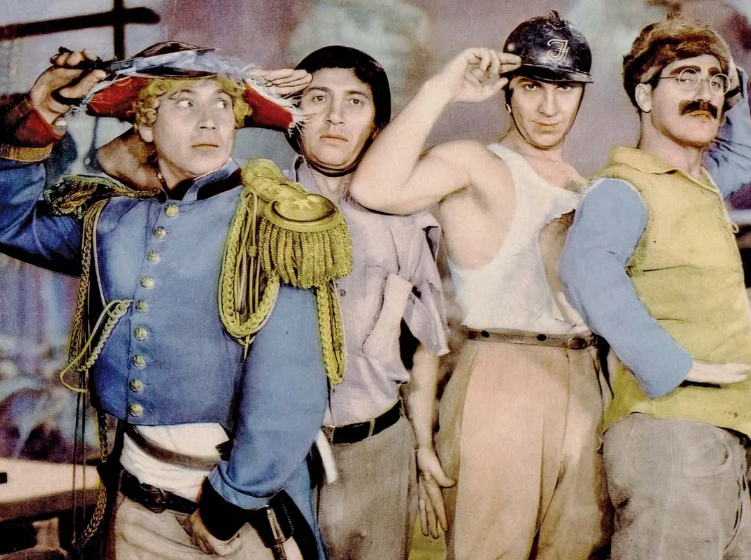
Picture four brothers dressed as soldiers, fighting a war that no one can quite remember starting, in a country whose name — Freedonia, Land of the Spree and Home of the Knave — exists only to be mocked. One of them is conducting a battle from inside a foxhole while wearing a coonskin cap. Another is communicating entirely in honks and pantomime. A third is playing piano in the rubble. And the man who declared the war in the first place is trading insults with the enemy ambassador while the bombs are still falling.
This is Duck Soup, released by Paramount Pictures on November 17, 1933, directed by Leo McCarey, and starring Groucho, Harpo, Chico, and Zeppo Marx in the last film the four brothers would make together. It runs 68 minutes. It contains no wasted motion. And on Wednesday, April 1 — April Fool’s Day, chosen with full deliberation — the Coral Gables Branch of the Miami-Dade Public Library System will screen it as part of its ongoing Silver Screen Mornings series.
What the film is
Duck Soup is a political farce about a bankrupt fictional nation whose wealthy benefactress, Mrs. Gloria Teasdale — played with deadpan magnificence by Margaret Dumont, the Marx Brothers’ most invaluable foil — refuses to provide further financing unless an entirely unqualified man named Rufus T. Firefly is installed as prime minister. Groucho plays Firefly. Within minutes of taking office, Firefly has insulted every diplomat in the room, declared war on a neighboring country over a personal slight, and delivered an inaugural address that is largely a series of puns.
The neighboring country of Sylvania has dispatched two spies — played by Chico and Harpo — to gather intelligence on the new prime minister and manufacture a pretext for annexation. The plot is, in the technical sense, a structure designed to hold gags together. But McCarey’s direction strips away the connective tissue that padded earlier Marx Brothers comedies, producing something closer to a sustained assault than a conventional film.
The centerpiece is the mirror sequence, in which Harpo — disguised as Groucho — encounters the real Groucho in a darkened hallway and attempts to pass himself off as a reflection in a missing mirror. The routine has roots in vaudeville and silent film, has since appeared in films, television shows, and cartoons, and no one has ever executed it with more precision or made it seem more genuinely unhinged.
What the film means
The Library of Congress deemed Duck Soup “culturally, historically, or aesthetically significant” in 1990 and selected it for preservation in the National Film Registry. That designation came more than five decades after the film’s release — a timeline that tells its own story.
When Duck Soup opened in November 1933, at the height of the Great Depression, audiences and critics found its political cynicism uncomfortable rather than liberating. The country wanted reassurance. The Marx Brothers offered chaos. The film was released the same year Adolf Hitler took power in Germany — not because the brothers anticipated what was coming, but because the same uncertainty and nationalistic momentum that made their satire sting was already in the air.
The Marx Brothers relished the fact that their ridicule of dictators so offended Benito Mussolini that he banned the film in Italy. That response confirmed something the film’s confused original reception had obscured: Duck Soup was not merely silly. It was, beneath the wordplay and the honking, a sustained argument that political authority is a performance, that war is an exercise in mutual absurdity, and that the people most eager to lead are generally the least qualified to do so. Rufus T. Firefly does not become more dangerous when he becomes prime minister. He was always dangerous. The office simply gives the chaos a title.
Playwright Eugène Ionesco, the defining voice of the Theatre of the Absurd, cited the Marx Brothers among his primary influences. That lineage matters. What looks like slapstick is also philosophy — a sustained argument that the systems human beings construct to organize themselves are held together by convention, and that convention, examined closely, is mostly costume and bluster.
Silver Screen Mornings
The Coral Gables Branch has built Silver Screen Mornings into one of the more quietly essential film programs in South Florida. The series runs on Wednesday mornings and draws from the full range of American and international cinema — Hitchcock, Kubrick, John Ford, Italian neorealism, Hollywood musicals. Recent screenings have included Strangers on a Train, Bad Day at Black Rock, and An American in Paris. The programming does not condescend to its audience, and the audience — adults 18 and older, gathering in a public library on a Wednesday morning to watch films that most streaming platforms have buried — does not ask it to.
Screening Duck Soup on April Fool’s Day is an act of programming intelligence. The film is about foolishness — about the particular kind of foolishness that wears epaulettes and waves flags and announces itself as seriousness. Watching it in a library, in a room with strangers, on the morning designated by tradition for pranks and reversals, returns the film to something like its original conditions: a shared experience of laughter at the expense of power, in a year when that laughter has never felt more earned.
Groucho, asked once to explain the title, declined to be helpful. “Take two turkeys,” he said, “one goose, four cabbages, but no duck, and mix them together.” That is also, more or less, the plot.
DUCK SOUP What: Silver Screen Mornings screening, Coral Gables Branch, Miami-Dade Public Library System When: Wednesday, April 1, 10 a.m. – 12 p.m. Where: Coral Gables Branch Library, 3443 Segovia St., Coral Gables Admission: Free. Ages 18 and older. Information: 305-442-8706 or capleybr@mdpls.org