By Coral Gables Gazette staff
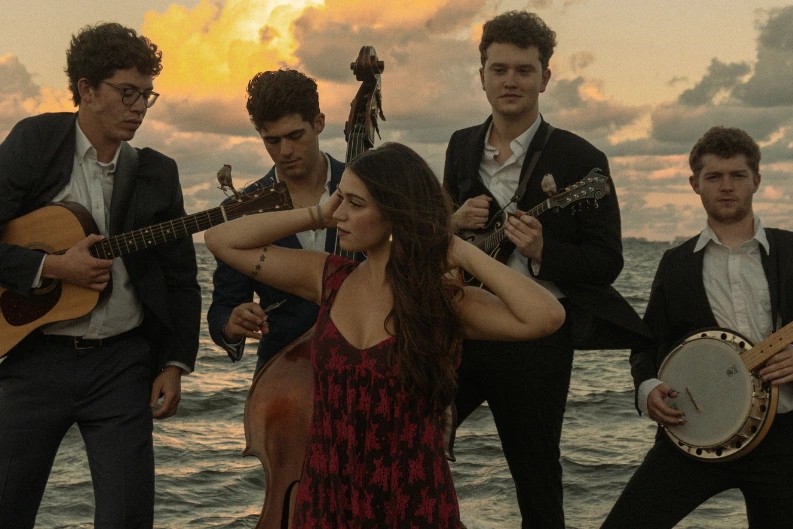
Picture five college students on Miracle Mile on a Thursday evening, the sun going down behind the buildings, a banjo and a mandolin and a standup bass filling the open air of McBride Plaza with something that sounds like it came from the mountains of Appalachia and also, unmistakably, like a Justin Bieber song you have heard approximately eight hundred times.
That is the Wire Jays, and they are closing out the fifth anniversary season of Music at McBride Plaza on Thursday, March 26, from 5:30 to 7:30 p.m. at 150 Miracle Mile in downtown Coral Gables. The concert is free, outdoors, and open to everyone. It is also the final show of a season that has brought six free concerts by Frost School of Music ensembles to the heart of Coral Gables’ commercial district since January.
How a banjo cover of “Baby” changed everything
The Wire Jays formed at the Frost School of Music last year when five Modern Artist Development and Entrepreneurship students needed an ensemble credit. Faculty member Brian Russell helped them get started. Tucker Motyka played piano but owned a banjo. Fritz Sullivan came in as a guitarist who played a little mandolin. “We’re all scrambling to get as good as possible on these instruments,” Sullivan told the Frost School’s news office recently. “But it’s working out.”
Working out is something of an understatement. Their cover of Justin Bieber’s 2010 hit “Baby” went viral on Instagram, garnering millions of views and nearly 600,000 likes. The arrangement placed Vivienne Frederick’s Bieber vocal impression alongside Sullivan’s delivery of Ludacris’s rap verse — on a mandolin-driven newgrass backing that had no earthly business working as well as it did. It worked spectacularly.
“That really put us on the map,” Sullivan said. “Our singer Vivienne does a great Bieber vocal impression, and I do the Ludacris rap. It’s crazy. I go home, and people tell me, ‘Oh my God, I saw your band on Instagram, it was amazing!’”
The band received no direct payment for the viral video. What they received instead was harder to put a price on: exposure. Bookings improved. Festival dates followed. A club in Louisiana flew them in for two shows. “We would not be getting gigs like that without the online success,” Sullivan said. “Clubs can look us up and see we have a solid following. It’s been very helpful getting us into higher-profile venues that pay well.” The “Baby” cover was not a stunt. It was, it turned out, a calling card.
What newgrass actually is
Newgrass is not a novelty genre. It emerged in the late 1960s and early 1970s from musicians who loved traditional bluegrass but wanted to push it somewhere the old guard had not followed — toward jazz improvisation, rock energy, and music from outside the Appalachian tradition. Tony Rice, David Grisman, and the New Grass Revival are its founding figures. What they built was an approach to acoustic string music that treated the banjo, mandolin, fiddle, guitar, and bass not as nostalgic instruments but as vehicles for whatever the player needed them to carry.
The Wire Jays describe themselves as a band that aims to bring bluegrass into the 21st century, taking risks and creating new sounds with classic string-band instruments. Their pop covers are the most visible expression of that mission, but the band plays mostly originals. The covers of Chappell Roan, Maroon 5, and Bieber are the doorway. The original music is the room.
Five friends heading to Nashville
The Wire Jays are Frederick, Motyka, Sullivan, guitarist Benji Dienstfrey, and bassist Nick Grande. Frederick, Motyka, and Dienstfrey will graduate this semester. Sullivan and Grande are juniors. The plan, by consensus, is to hold the band together in Miami until the remaining two graduate next year, then relocate to Nashville as a unit.
Sullivan has already been building a parallel solo profile. At last December’s Winter Wonderful fundraising gala at the Frost School, he performed an original song he wrote as a send-off tribute to departing Frost School Dean Shelton G. “Shelly” Berg — a piece inspired by a songwriting trip to Napa Valley where he first met Berg. “That helped me write a send-off tribute for him, with lyrics about how much he’s done for the school and how much we’ll miss him,” Sullivan said. “It was a cool honor. I didn’t realize ahead of time how big it would be.”
Five seasons of music on Miracle Mile
Music at McBride Plaza has been placing free outdoor concerts on Miracle Mile since its founding, presenting Frost School ensembles in the kind of setting — open air, no admission, no advance planning required — that turns a Thursday evening errand into a civic experience. The series runs every other Thursday from January through March. Thursday’s Wire Jays show is the sixth and final concert of the fifth anniversary season.
On Thursday evening, five musicians who started a band to earn a class credit and ended up flying to Louisiana for gigs will set up on Miracle Mile and play the music that got them there. Some of it will be original. Some of it will be familiar in ways you will not immediately be able to explain. The banjo will do something unexpected. The mandolin will follow. Before long — because this is what newgrass does when it is working — you will not be entirely sure where the Appalachians end and Coral Gables begins.

Author: Coral Gables Gazette News Staff
Originally established in 1996 and relaunched as a digital publication in February 2025, the Coral Gables Gazette is an independent local news organization dedicated to factual, objective and accountable community journalism. Our newsroom reports on the people, policies, institutions and events shaping Coral Gables, Florida, providing residents with timely, informative coverage of the issues affecting their community. Our reporting includes City Hall, local government, municipal elections, public spending, real estate development, business, education, arts and culture, and neighborhood affairs throughout the City Beautiful. We follow City Commission decisions, examine public records and report on the businesses, organizations and individuals contributing to Coral Gables. We believe informed residents are essential to a healthy, engaged community. Stories published under the Coral Gables Gazette News Staff byline are prepared or compiled by the publication's editorial team. We strive for accuracy, fairness, transparency and clear distinctions between news reporting, opinion and advertising. Readers are encouraged to submit news tips, corrections, editorial inquiries and story suggestions through our Contact page and learn more about our standards through our Editorial Policy.