
By Coral Gables Gazette staff
The clean fact in Coral Gables’ latest financial report is that the city’s pension liability shrank again.
The more complicated fact is that the same number can move dramatically for reasons City Hall does not control.
The city’s net pension liability fell by $44.78 million in fiscal year 2025, dropping to $136.3 million. Its funded ratio — a key measure of pension health — rose to 78.83 percent, up from 70.85 percent a year earlier.
Those are strong numbers. They also require some caution.
Coral Gables has spent years paying more than required into its pension system, and that policy has produced a real long-term improvement. But in any given year, the headline pension number can be moved as much by investment performance and actuarial assumptions as by city policy. This year, markets helped. In other years, they have not.
What the funded ratio measures
A pension plan’s funded ratio compares the assets set aside for future benefits with the total benefits the plan is projected to owe. A higher ratio means plan assets cover more of the city’s projected pension obligations; a lower one means the unfunded gap is wider.
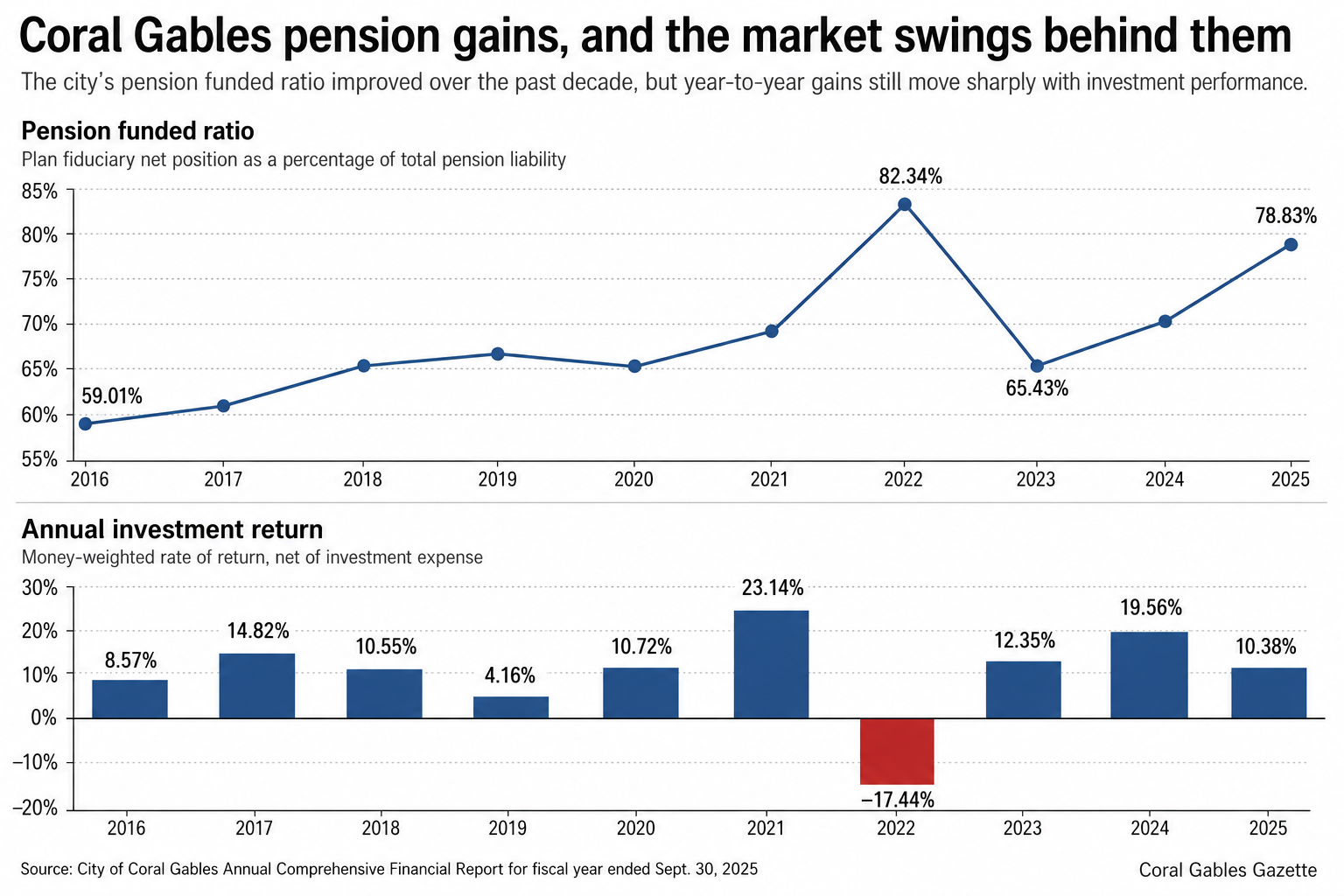
By that measure, Coral Gables had one of its strongest years in the past decade. The city’s 78.83 percent funded ratio was the second-highest figure shown in the 10-year schedule included in the report. The highest was 82.34 percent in 2022.
But the same table also shows how quickly the number can move. The funded ratio fell to 65.43 percent in 2023 before climbing again in 2024 and 2025.
That movement means pension accounting is highly sensitive to the value of the assets inside the fund.
Markets move the headline number
The city’s pension report shows two forces working at the same time.
One is the city’s contribution policy. Coral Gables made about $30.9 million in pension contributions for the year, above the actuarially determined contribution of about $21.4 million.
The other is investment performance. The city’s pension note reported $84.2 million in net investment income for the year, a much larger single-year force than the city’s annual extra payment above the actuarial target.
That makes the yearly pension number harder to read.
The city’s paydown policy works gradually. Investment markets can move the reported liability quickly.
The paydown policy still matters
None of this diminishes what Coral Gables has done over the past decade.
In 2015, the City Commission adopted a policy of paying more than the actuarially required amount toward the pension shortfall, with the goal of reducing the unfunded liability faster than the standard schedule would allow. Since fiscal year 2016, the city has contributed $55.35 million in additional funds toward that liability, including $9.55 million in October 2024.
That policy shows up most clearly in the long-term trend.
The city’s net pension liability as a percentage of covered payroll has fallen from 622.94 percent in 2016 to 288.45 percent this year. That is a substantial improvement, even with setbacks along the way. As recently as 2023, the same ratio stood at 479.69 percent.
That is the more durable story: A decade-long reduction in pension burden relative to payroll.
The assumptions matter, too
The city’s pension numbers also depend on actuarial assumptions, including how much the plan expects to earn on its investments over time.
For the 2025 report, the city used a 7.15 percent discount rate, down from 7.20 percent the prior year. At that rate, the city’s net pension liability was $136.3 million. If the rate were one percentage point lower, the liability would rise to about $201.2 million. If it were one percentage point higher, it would fall to about $81.5 million.
That range means the number is a projection, not a bank balance.
It also means pension progress should be judged over time, not by a single year’s improvement.
What the numbers actually show
The city’s 2025 pension results are good. The liability fell. The funded ratio rose. The city continued contributing more than required. The long-term trend is materially better than it was a decade ago.
But the reason matters.
A single year’s improvement, on its own, can say less about whether the city’s discipline is working than the longer trend, because annual pension results are heavily influenced by market performance. The city controls its contribution policy. It does not control the market return or the assumptions that shape the liability calculation.
That distinction is central to how residents should understand the city’s finances.
Coral Gables has earned credit for its pension discipline. But the city’s own financial report shows why that discipline should be measured in years, not in one favorable annual result.
The question is whether Coral Gables keeps drawing a clear line between the part of the pension story it controls and the part it does not.







Other than Fire & Police personnel, WHY DOES CORAL GABLES STILL EVEN HAVE A PENSION PROGRAM?!!! THIS IS OUTRAGEOUS!!!
Pay better compensation for regular staff, put in place a 401k and END this antiquated benefit!!!
AGREED. And annually paying the City Manager, City Attorney and other senior City employees 25% of their salary for retirement is CRAZY. In 2026, the City paid City Manager Iglesias $306,800 as salary and an additional $76,700 for retirement. The City paid City Attorney Suarez $268,687 as salary and an additional $67,172 for retirement. If we had an independent search committee participate in the selection of a City Manager (another broken promise by Lago, Anderson and Lara), the City Manager’s compensation would be compatible with other municipalities. Instead, the City overpays its senior officials so that the potential loss of excess compensation is an incentive to serve the mayor and his voting bloc rather than residents. This must change.
yjskwy