
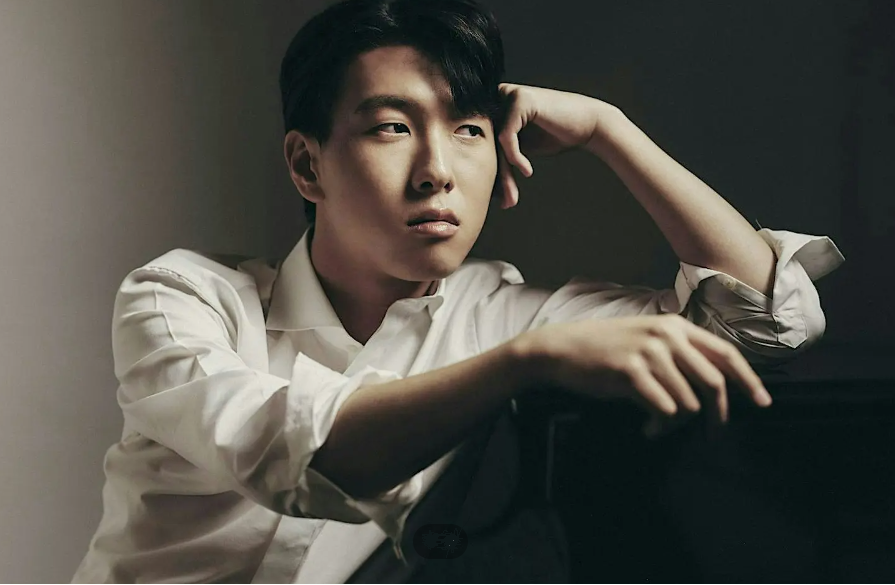
By Coral Gables Gazette staff
When pianist Saehyun Kim won the 2025 Long-Thibaud Competition in Paris just before his 18th birthday, the jury made an unusual decision: it declined to award a second prize.
The message was unmistakable. A major young pianist had arrived.
Kim brings that momentum to Coral Gables on Saturday, May 23, when he performs a solo recital for the Mainly Mozart Festival at the Knight Center for Music Innovation on the University of Miami campus. The program — built around sonatas by Schubert, Mozart, and Chopin — places extraordinary artistic demands on any pianist, let alone one still in his teens.
A young pianist drawing unusual attention
International piano competitions regularly produce promising young musicians. The intensity of attention surrounding Kim’s victory in Paris suggested something rarer: the arrival of a pianist many in the classical music world already believe could become a major international artist.
Born in South Korea in 2007, Kim won not only the First Grand Prize at the 2025 Concours International Long-Thibaud, but also the Audience Prize, the Prize of the Press Jury, and the Prize of the City of Paris Conservatories. He won performing Rachmaninoff’s Piano Concerto No. 3 with the Orchestra of the Republican Guard — one of the most technically and emotionally demanding concertos in the repertoire.
What followed deepened the impression.
Later that same evening, Kim repeated the concerto during the competition’s winners concert without advance notice and then performed two additional solo works afterward. Critics and jurors openly treated the performance as something beyond a routine competition victory. Alain Lanceron, chairman emeritus of Warner Classics, described Kim as “a player in a class of his own,” while the French music publication Diapason declared the following day: “A great pianist has won the Long-Thibaud.”
In the months since, Kim’s career has accelerated quickly. He performed at Paris’s annual Concert de Paris before an audience of roughly 400,000 people gathered near the Eiffel Tower on Bastille Day, signed an exclusive recording contract with Warner Classics, and emerged as one of the most closely watched young pianists of his generation.
His debut album, Chopin – Fauré, is scheduled for release in September 2026.
Kim is currently completing a dual degree program at Harvard College and the New England Conservatory, where he studies with HaeSun Paik and Dang Thai Son.
Three sonatas, three different worlds
The Coral Gables recital offers something very different from a competition performance.
Competitions reward projection, command, stamina, and immediate impact. Solo recital playing demands something quieter and ultimately more difficult: sustained concentration, interpretive patience, and the ability to hold emotional tension across large musical structures without theatrical excess.
Kim’s program reflects that challenge directly.
The evening opens with Schubert’s Piano Sonata No. 18 in G Major, D. 894, one of the composer’s most spacious and inward works. Written in 1826, the sonata unfolds with unusual calmness and lyric breadth, often moving at a pace that leaves little room for superficial display. Its famously expansive opening movement demands patience, tonal control, and emotional restraint from the pianist.
After intermission, the program shifts dramatically with Mozart’s Piano Sonata No. 3 in B-flat Major, K. 281. Where the Schubert searches inward, Mozart’s writing requires clarity, elegance, rhythmic precision, and a sense of conversational wit that can disappear quickly under heavy-handed playing. The transparency of Mozart often exposes pianists more ruthlessly than larger Romantic works.
The evening concludes with Chopin’s Piano Sonata No. 2 in B-flat minor, Op. 35 — among the most emotionally turbulent works in the piano repertoire and home to the famous Funeral March. Unlike the introspective Schubert or poised Mozart, the Chopin sonata moves through violence, grief, lyricism, fragmentation, and explosive virtuosity with startling emotional volatility.
Together, the three sonatas form less a survey of piano literature than a study in radically different conceptions of musical expression.
Why this recital matters
The recital’s significance lies not simply in Kim’s age, but in the unusual combination of youth and artistic seriousness surrounding his emergence.
Young virtuosos frequently impress audiences through technical brilliance alone. What has drawn unusual attention to Kim is the growing belief among critics, teachers, and presenters that his playing possesses musical maturity beyond what is typically expected from performers his age.
The Schubert in particular will likely become the evening’s real test.
Its long, unhurried architecture demands inward concentration and emotional confidence that many pianists spend decades trying to develop. It is the kind of work that separates technical command from deeper interpretive authority.
That challenge makes the recital especially compelling within the intimate acoustics of the Knight Center for Music Innovation, one of the finest spaces in Miami-Dade County for solo piano performance. Presented by the Miami Chamber Music Society as part of the Mainly Mozart Festival, the concert continues the organization’s effort to bring internationally recognized soloists to South Florida audiences in settings that reward close listening rather than spectacle.
What to know
Saehyun Kim performs Saturday, May 23, at 7:30 p.m. at the Knight Center for Music Innovation, 5513 San Amaro Drive, Coral Gables. Doors open at 7 p.m. Tickets are available through Eventbrite. Additional information is available through the Miami Chamber Music Society.

Author: Coral Gables Gazette News Staff
Originally established in 1996 and relaunched as a digital publication in February 2025, the Coral Gables Gazette is an independent local news organization dedicated to factual, objective and accountable community journalism. Our newsroom reports on the people, policies, institutions and events shaping Coral Gables, Florida, providing residents with timely, informative coverage of the issues affecting their community. Our reporting includes City Hall, local government, municipal elections, public spending, real estate development, business, education, arts and culture, and neighborhood affairs throughout the City Beautiful. We follow City Commission decisions, examine public records and report on the businesses, organizations and individuals contributing to Coral Gables. We believe informed residents are essential to a healthy, engaged community. Stories published under the Coral Gables Gazette News Staff byline are prepared or compiled by the publication's editorial team. We strive for accuracy, fairness, transparency and clear distinctions between news reporting, opinion and advertising. Readers are encouraged to submit news tips, corrections, editorial inquiries and story suggestions through our Contact page and learn more about our standards through our Editorial Policy.











References:
Hitnspin verifizierung http://wiki.desmume.org/api.php?action=https://campus.tdea.edu.co/cas/logout?url=https://de.trustpilot.com/review/der-wikinger-shop.de
References:
Hitnspin verifizierung http://stove.ru/
References:
Lollybet Bonus ohne Einzahlung http://2.ownskin.com/wap_theme_download.oss?t=f94ugk26&c=3&h=hci.cs.umanitoba.ca/?URL=https://lollybet.com.de/&lang=en
References:
Lollybet Einzahlung google.tl
References:
Lollybet Support images.google.co.ke
References:
Lollybet Kontakt http://toolbarqueries.google.ng/url?q=https://hellomusic.app/lauricottrell1
References:
Payid pokies instant withdrawal https://citylexicon.de/coralguinn923
References:
Lollybet Auszahlung https://www.noviny.sk/galeria/23991-den-vitazstva-nad-fasizmom/6444f30a-2dbd-47a3-b742-80655848a56e?back_url=https://io.321.it/aida58e440
References:
Lollybet No Deposit Bonus http://maps.google.com.au/url?q=https://allbio.link/mamiecormi
References:
Lollybet No Deposit Bonus https://1.pexeburay.com