
By Coral Gables Gazette staff
The Coral Gables City Commission on Tuesday directed City Manager Peter Iglesias to develop a plan for what could become a maintenance improvement district — a mandatory assessment on commercial property owners that would fund centralized beautification services across the city’s commercial corridors.
The proposal, sponsored by Mayor Vince Lago and supported by the Coral Gables Chamber of Commerce, would replace the city’s current patchwork system of individual property compliance with a unified, city-managed program covering pressure cleaning, landscaping, alley maintenance, and deficiency reporting. City Manager Peter Iglesias, who used the term “maintenance improvement district” to describe the concept, told the commission he expects to return with a formal plan, cost estimates, and a proposed timeline at the next commission meeting.
The assessment would apply to commercial properties throughout the central business district and beyond, including corridors along Ponce de Leon Boulevard, Southwest Eighth Street, and Sunset Drive. Miracle Mile and Giralda Plaza storefronts would be excluded from the front sidewalk program, which already has dedicated maintenance, but the alleys behind those blocks would be included.
A problem visible block by block
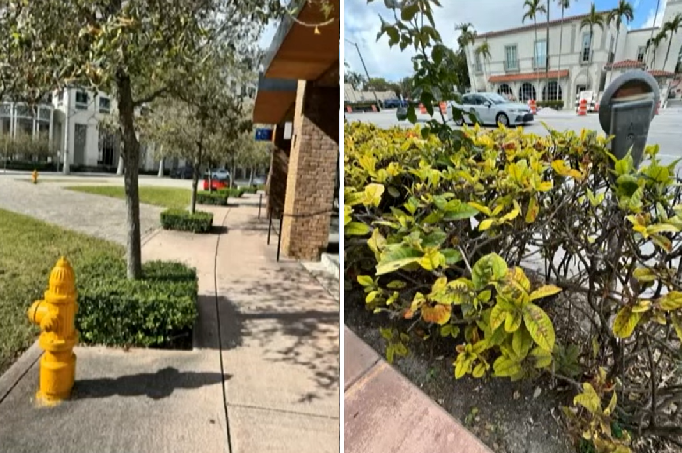
Lago opened the discussion with a slideshow presentation prepared by city staff documenting conditions across Coral Gables’ commercial corridors. The images showed a stark divide between well-maintained blocks and those exhibiting years of neglect: diseased shrubs unchanged for two to three decades, exposed irrigation lines, broken and unevenly patched sidewalks, blocked storm drains, leaning signs, abandoned parking meter poles, and alleys littered with garbage and potholes.
The mayor drew a direct connection between the visual evidence and a structural problem in how the city currently enforces maintenance standards. Under existing rules, building owners are responsible for the landscaping and sidewalks fronting their properties — a fact Lago said many business owners do not know. The city is responsible only for medians.
Lago also noted a fundamental flaw in the current pressure-cleaning ordinance he previously sponsored, which requires business owners to clean their front sidewalks twice a year. The problem, he said, is that a compliant owner ends up with a clean sidewalk next to a dirty one, creating what he described as an alternating pattern that does not serve the city’s appearance. “It’s clean, dirty, clean, dirty,” he said. “Doesn’t make sense.”
He also flagged a specific safety concern: three different pavement surfaces — Miracle Mile streetscape tile, concrete, and a third material installed as part of a development agreement — within 40 feet of each other near Ponce de Leon Boulevard, creating uneven conditions that he said he regularly watches people trip on. “That should be uniform,” he said, calling for a review of the relevant development agreements to determine who is responsible for maintenance and how the surfaces can be standardized.
Chamber backs the plan
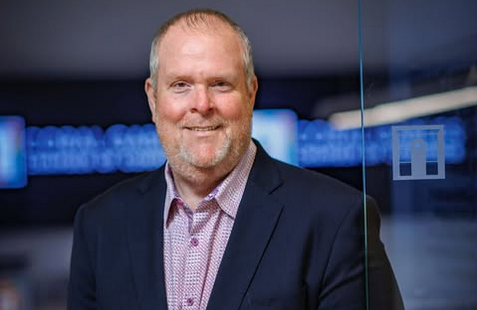
Jorge Arrizurieta, president and CEO of the Coral Gables Chamber of Commerce, attended the meeting at the mayor’s invitation and spoke in support of the proposal. He said the chamber’s board had discussed the initiative and expressed broad support, describing a well-structured assessment program as an important step toward ensuring the downtown maintains the level of excellence expected in the City Beautiful.
Arrizurieta noted one area where he hoped the proposal would be extended: the alleys behind Miracle Mile. While those storefronts are excluded from the front sidewalk component of the program, he said the rear alleys “require attention and ongoing maintenance” and play a critical operational role for small businesses in the area. Lago confirmed those alleys would be included in the program.
Lago told the commission he had presented the concept to the chamber’s board before bringing it to a vote, saying he did not want to move forward until he had heard from the business community first. “I wasn’t going to move forward and bring it to the commission until I spoke to the business community,” he said.
The economy of scale argument
Supporters of the plan argued that collective action would reduce costs for individual property owners while producing better and more consistent results. Commissioner Ariel Fernandez cited a personal example in which a group of property owners who began pressure cleaning collectively achieved a 25 to 30 percent cost reduction compared with what each had paid individually.
Iglesias confirmed the logic. “There are economies of scale of pressure cleaning three blocks in a row, of landscaping three blocks in a row,” he said. “That would be cheaper and easier to do with that methodology than having each individual 25 or 50-foot-wide business do it on their own. It would also be more consistent.”
Commissioner Richard Lara framed the proposal in straightforward terms. “We’re not looking to increase or burden businesses,” he said. “They have an existing obligation to maintain this. We’re looking to, if done correctly, maybe even reduce their expense.” He added that the program would also reduce the city’s enforcement burden, calling the current alternative — code enforcement action against individual non-compliant properties — “expensive, time consuming, and will not further the cause.”
Officials said the assessment could be apportioned by linear frontage rather than applied as a flat fee, meaning larger properties with more street exposure would pay more than smaller ones. City Attorney Cristina Suarez said a consultant would likely be needed to develop the apportionment methodology, noting that similar processes have been used in other contexts in the city.
A conversation 15 years in the making
Fernandez noted that the idea has been discussed for years without advancing, citing informal conversations with Lago dating back roughly 15 years. The difference now, he said, is that the business community has signaled its support — a precondition both he and the mayor identified as essential.
Vice Mayor Rhonda Anderson connected the proposal to a broader pattern of collective action she has advocated for in other contexts, including a co-op model for septic-to-sewer conversions. She said mobilization costs alone — for pressure cleaning, plumbing, or other services — represent a significant expense that economies of scale can reduce meaningfully. She also offered a pointed assessment of the current alley conditions. “Sometimes you go by these alleys when walking or biking, and it just about knocks you off your feet because it smells so bad,” she said.
Lago also tied the proposal to a broader fiscal argument: as Tallahassee debates potential property tax reforms that could reduce municipal revenues from residential properties, the city’s commercial corridors become more important as a tax base. “We need to make sure these property values stay strong,” he said. “We need to make sure we’re putting our best foot forward.”
What comes next
The city manager told the commission the plan would require several steps before it could be formally established: identifying the precise district boundaries, cataloging all affected property owners, analyzing the cost of each proposed service, and developing the legal framework for the assessment. He said he would provide a status update and preliminary schedule at the next commission meeting and indicated the city may seek an outside consultant to assist given the scope of the work.
The city attorney noted that once a proposed plan is complete, it would need to return to the commission for a formal public hearing before the assessment could be imposed. The full process, she said, would involve multiple steps and take several months at minimum.
For Coral Gables, a city whose identity is built on a standard of beauty that dates to George Merrick’s original vision, the proposal represents an attempt to close the gap between that standard and what visitors and residents actually encounter on its commercial streets. “If we don’t take these necessary steps,” Lago said, “I think we’re going to fall very short of what the City Beautiful standard is.”








Nice to hear the city wants to improve properties in the business district. However, it would also be nice to see improvements made in residential areas, as in many neighborhoods the sidewalks are in deplorable condition. Tree roots belonging to city trees have damaged sidewalks, and repair has been made using black asphalt patches or sanding down raised edges, instead of replacing our iconic pink sidewalks with compatible materials.