
By Coral Gables Gazette staff
With the World Cup underway across North America, Miami Stadium hosting seven matches and FIFA’s Legal and Compliance Division operating from a corporate office in Coral Gables, the Coral Gables Museum is bringing one of soccer’s oldest surviving objects to the city next week.
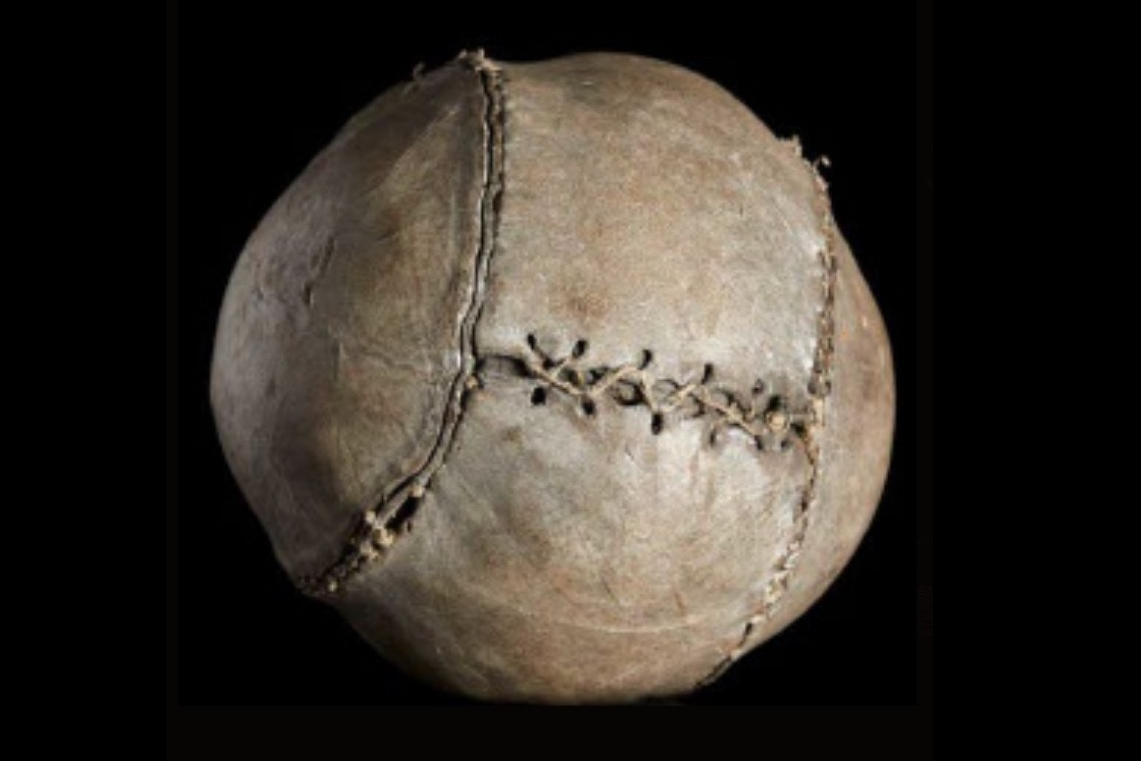
A stitched leather football dating to between 1540 and 1570 will go on public view at the museum, marking the first public presentation in the United States of what is recognized as the world’s oldest known football.
The artifact, part of the collection of the Stirling Smith Art Gallery and Museum in Stirling, Scotland, will be presented Monday-Saturday, June 22-27 as part of Diplomacy and the Beautiful Game: From Scotland to Brazil to Haiti, an exhibition that uses soccer to explore migration, diplomacy and cultural exchange.
The full exhibition opened June 12 and runs through July 19 in the museum’s Zahner Center, timed to coincide with the FIFA World Cup. But the football itself will be in Coral Gables for a limited run, with extended museum hours during its visit.
A rare object, here for a limited run
The football was discovered during restoration work at Stirling Castle in the 1980s, hidden behind wooden paneling inside the Queen’s Chamber, where it had remained for more than four centuries.
Its survival is unusual. Leather is a fragile organic material that deteriorates with light, moisture and handling, and few objects of its kind from the 16th century survive in any condition. The stable conditions inside the castle walls helped preserve the ball, allowing it to remain intact across nearly five centuries.
Made of stitched leather panels and originally inflated with a pig’s bladder, the ball predates modern rules, organized leagues, international tournaments and soccer associations. Its form is noticeably different from a contemporary soccer ball, reflecting an era when the game varied from one community to another and was played according to local custom rather than standardized regulation.
The Queen’s Chamber is part of the royal apartments associated with Mary, Queen of Scots, one of Scotland’s most recognizable historic figures. Museum materials note that no historical evidence directly links her to the object, leaving the ball’s presence behind the paneling a mystery.
That mystery is part of the appeal. The object survives not as a trophy or official relic, but as something more intimate: a piece of early sporting life that was hidden, forgotten and rediscovered centuries later.
From Stirling Castle to Coral Gables
The timing gives the object an unusual local resonance. Coral Gables is not hosting a match, but it is part of the World Cup’s South Florida footprint. FIFA’s Legal and Compliance Division operates from its Miami corporate office at 396 Alhambra Circle, placing part of the sport’s modern administrative machinery inside the city at the same moment Miami Stadium is drawing international teams and fans.
That makes the museum’s exhibition more than a historical sidebar. It places the sport’s early material culture — a small leather ball hidden for centuries inside a Scottish castle — in the same community where the modern global game is being administered, watched and celebrated.
The June 24 World Cup match between Brazil and Scotland gives the exhibition another point of connection. The show places special emphasis on the relationship between the two countries, tracing how Scottish migration and engineering helped shape parts of Brazil’s development and, through Charles Miller, its soccer history.
Soccer, diplomacy and cultural exchange
The football is the centerpiece, but the surrounding exhibition uses the sport as a way to tell a broader story about movement, identity and international connection.
One section traces Scottish engineer John Miller and his son Charles Miller, whose family history became intertwined with Brazil’s development and football heritage. John Miller was part of Brazil’s 19th-century railway and infrastructure expansion. Charles Miller, educated in England, later returned to São Paulo carrying footballs, rulebooks and knowledge of the organized game, helping introduce soccer to Brazil in ways that shaped one of the world’s great sporting cultures.
The exhibition also features the Spirit of Brazil Tartan, created through a student design competition at Largs Primary School in Scotland and commissioned to commemorate 200 years of diplomatic relations between Brazil and the United Kingdom. Inspired by the colors of the Brazilian flag, the tartan is presented as a symbol of educational exchange, friendship and cultural diplomacy.
Another section focuses on Haiti through photographs by Brazilian photojournalist Antônio Gaudério, who documented the Brazil-Haiti soccer match held in Port-au-Prince in 2004. Organized under United Nations auspices and known as the Peace Match, the event took place during a period of political instability and drew large crowds across the city. Gaudério’s photographs, shown in the United States for the first time, preserve a visual record of a moment when sport became part of a broader international effort to support public engagement and reconciliation.
Materials from Museu Pelé in Santos, Brazil, highlight the life and legacy of Pelé, while additional sections extend the exhibition’s reach to Nigeria and Miami.
Together, the exhibition places a familiar sport inside a larger historical frame. Soccer becomes a way to examine migration, diplomacy, education, city-building and the ties that form between communities across borders.
A World Cup connection
The museum is pairing the exhibition with related programming tied directly to Brazil and Scotland.
On June 24, visitors can attend a screening of Only a Game, a 1974 BBC documentary filmed around the world on the day Scotland faced Brazil during that year’s World Cup in West Germany. Narrated by Sir Ian Holm, the 45-minute documentary captures how soccer was experienced simultaneously in different countries and communities during one of the sport’s defining eras.
The documentary screening will be followed by a live watch party for the 2026 Brazil-Scotland World Cup match taking place in Miami.
For visitors, the pairing compresses nearly five centuries of soccer history into a single afternoon: a 16th-century Scottish football, a 1974 documentary about Brazil and Scotland, and a live 2026 World Cup match being played in South Florida.
If you go
The world’s oldest known football will be on view June 22 through 27 at the Coral Gables Museum, 285 Aragon Ave. Extended hours are scheduled June 22 through 26 from 9 a.m. to 5 p.m. and June 27 from 9 a.m. to 6 p.m.
The full exhibition, Diplomacy and the Beautiful Game: From Scotland to Brazil to Haiti, runs through July 19 in the museum’s Zahner Center. Museum admission applies.
The June 24 program begins with a 4:30 p.m. screening of Only a Game, followed by a 6 p.m. live screening of Brazil vs. Scotland. RSVP is recommended. More information is available at CoralGablesMuseum.org.











Điều mình thích ở slot365 đăng nhập là mọi thao tác đều nhanh gọn và tiện lợi. TONY07-08