
By Coral Gables Gazette staff
The Coral Gables City Commission voted 4-1 to approve the site plan for The Mark, a 393-unit mixed-use development at 1250 South Dixie Highway, and to expand the University Station Rapid Transit District Overlay to include the Gables Waterway properties at 6100 Caballero Boulevard at its April 14 meeting. Commissioner Melissa Castro voted no on all four items. Every other commissioner voted yes while stating on the record that the county’s Rapid Transit Zone left them with no meaningful alternative.
“A vote against the city RTZ is a vote in favor of the county RTZ,” Mayor Vince Lago told the commission before casting his vote. “We have no other choice.”
“A vote against the city RTZ is a vote in favor of the county RTZ.”
mayor vince lago
The four items — an alley vacation and site plan approval for The Mark, and Comprehensive Plan and Zoning Code amendments expanding the overlay — were framed by the commission majority as the city’s best available defense against a county zoning instrument that would produce larger, less controlled development with no local input, no city impact fees, and no architectural or use restrictions.
The Mark: Site plan and alley vacation
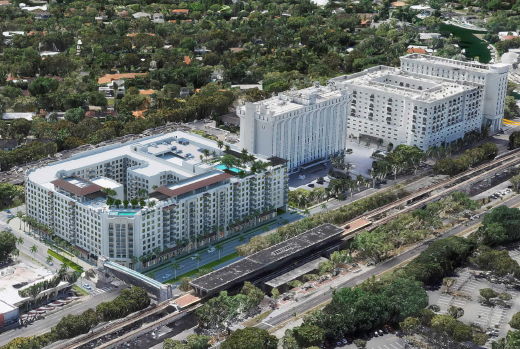
Architect Javier Font of Behar Font and Partners presented the approved design for The Mark: an 8-story Mediterranean mixed-use building with 393 residential units, 17,000 square feet of retail along US-1 turning the corner onto Mariposa Avenue, an internalized 670-space parking garage with no parking visible from any street, and rooftop amenities including two pool areas and a gym. The building’s floor-to-area ratio is 3.46 against a maximum of 3.5. Height: 105 feet.
The alley vacation approved covers a 45-foot wide, 125-foot long public right of way that has functioned as the shopping center’s northernmost driveway since 1952. It is a prerequisite for the project’s footprint. Staff conditions require the developer, LCD Acquisitions LLC, to withdraw its pending county application before the vacation takes effect — if it does not, the vacation is null and void. The developer must build within two years of approval.
Planning and Zoning Assistant Director Jennifer Garcia confirmed that under the county RTZ the same property could support a 150-foot building, property line to property line, with no setbacks, no parking requirements, and no city control over uses or signage. The city would receive no impact fees.
Lago told the commission the city conducted more than a dozen negotiating sessions with the developer to arrive at the approved project. “By negotiating, we lowered the building by 45 feet,” he said. “By negotiating, we controlled setbacks. By negotiating, we controlled usages.” Those usages include bars, gentleman’s clubs, gun stores, and pet stores — permitted under the county RTZ but not under city zoning.
City Manager Peter Iglesias described the county RTZ alternative in plain terms: “A box. A box from property line to property line, 150 feet high, no parking.” He confirmed the city would have lost an estimated $6 to $7 million in impact fees had the developer pursued the county route. Those fees, he said, fund parks, mobility, police, fire, and building permits.
Vice Mayor Rhonda Anderson voted yes while acknowledging the project’s evolution. “While I wish I could turn back time and go back to 2024 when this was a smaller and more compatible development, the time I cannot reverse,” she said. She addressed Castro’s no vote directly: “A no vote on this item is a yes vote for live local, is a yes vote for larger development through the county RTZ.”
Commissioner Richard Lara said the project represents a compromise that “falls squarely to the benefit of the residents” and called it “an enhancement to the City Beautiful.” He referenced delays on The Mark that he said nearly pushed the project to the county entirely. “The win for the city is this vote of a yes today,” he said.
Public realm proffers secured as conditions of approval include a multi-use pedestrian path connecting the neighborhood to the bridge across US-1, an extended sidewalk along Mariposa, improved sidewalk and pedestrian infrastructure along Madruga, bike boulevard markings extending beyond the property, signal retiming at Mariposa and US-1, and a speed cushion on Hardy Road and Madruga Avenue.
The overlay expansion
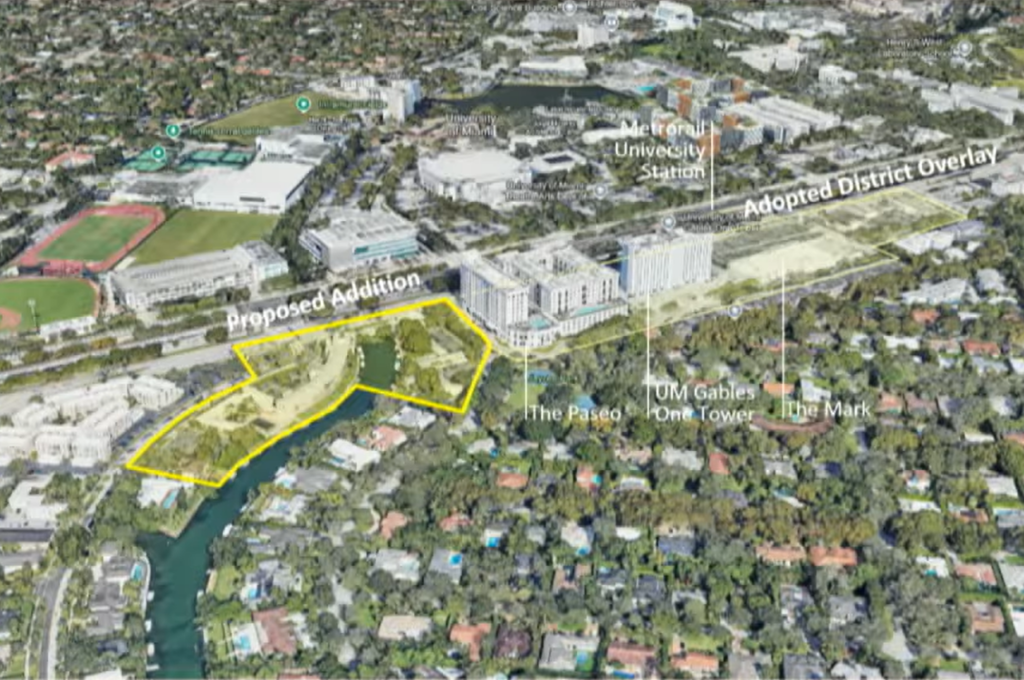
Votes amended the city’s Comprehensive Plan and Zoning Code to expand the University Station overlay to include the Gables Waterway properties and 6100 Caballero Boulevard. The amendments rezone multiple parcels to Multi-Family High Density for most of the affected area, scaling down to MF2 and MF3 adjacent to single family and duplex neighborhoods.
Garcia confirmed that the property owner at 6100 Caballero Boulevard is already communicating with the county about incorporation into the RTZ subzone. The city’s overlay version allows 120-foot height for MF4 properties — rising to 150 feet with 10 percent additional open space provided — against the county RTZ’s uniform 150-foot maximum with no setbacks and no parking. The city requires 25 percent open space against the county’s 10 percent, and imposes a 50-foot landscape setback from single family properties where the county requires none.
“We no longer have an ability to control our own zoning code.”
commissioner ariel fernandez
Anderson confirmed she met with the County Commissioner Raquel Regalado in an effort to scale back the county RTZ on the Gables Waterway property and was told there was no flexibility. She also reported that a meeting with Sen. Ileana Garcia (R-Miami) regarding a traffic light on Caballero Boulevard is moving in a positive direction.
Federal Judge Cecilia Altonaga appeared via Zoom to ask whether the city would be willing to trade impact fee revenue for concessions on scale at the Gables Waterway, citing the waterway’s manatee habitat. Lago responded directly: “Would I give up the money to find a better project? 110 percent. But the developer has the development rights to go to the RTZ and circumvent us anyway. They’re going to pay it to the county or they’re going to pay it to the city in one form or another. I’d rather have those monies go to the city.”
Fernandez addressed the developer from the podium. “You bought a property in Coral Gables,” he said. “Try to live up to those Coral Gables standards and respect the residents who have owned their properties around this project for 40 and 50 years.” He also called for additional community meetings and a more visual presentation to help residents understand the difference between the county RTZ and the city’s version. “We no longer have an ability to control our own zoning code,” he said. “Something that as a city we have always been proud about protecting.”
Resident Lisa DeTournay, who said she has fought development on the Gables Waterway property since 2004 and previously lost in both Miami-Dade Circuit Court and the Third District Court of Appeal, told the commission the Mahi Canal — a documented manatee habitat — would be completely shaded even under the city’s RTZ version.
Castro’s dissent
Castro voted no on all four items. “My strong opinion is that the city should have taken a stronger stance, shown some resistance, and at very least sued the county — showed the residents that we’re here for them before continuing this route, like the City of Miami did,” she said. She added: “I will continue to vote no on upzoning on a corridor that is highly congested. The quality of life next to the homes that live on this parcel is going to be really bad.”
The commission majority responded that the City of Miami has not bonded its RTZ lawsuit. Lago said the reason is straightforward: “The city of Miami knows they’re going to lose this lawsuit.” Iglesias cited a prior case in Edgewater where stopping a development project cost the city $5.5 million. Anderson, noting her litigation background, called the lawsuit path “a dead loser” that would cost residents money and accelerate the developer’s move to the county route.
Lago concluded his remarks with a preemptive rebuttal of anticipated political messaging. “What you will witness after this vote is taken is a political onslaught of misinformation,” he said. “It will come from the blogs and it will come from a select few in this community.” He said his yes vote was dictated by civic responsibility rather than political convenience. “I would love nothing more than to vote no and then send out an email tomorrow saying I voted against this upzoning. But the moment that we vote no is the moment that they go the county route.”
What comes next
The Mark moves toward a building permit. The developer has two years to build.
No site plan has been submitted for the Gables Waterway property. The overlay framework approved April 14 establishes the zoning under which any future application would be reviewed. Whether the developer pursues the city route or continues toward the county will determine whether the commission’s investment in the overlay framework produces the outcome the majority voted for.

Author: Coral Gables Gazette News Staff
Originally established in 1996 and relaunched as a digital publication in February 2025, the Coral Gables Gazette is an independent local news organization dedicated to factual, objective and accountable community journalism. Our newsroom reports on the people, policies, institutions and events shaping Coral Gables, Florida, providing residents with timely, informative coverage of the issues affecting their community. Our reporting includes City Hall, local government, municipal elections, public spending, real estate development, business, education, arts and culture, and neighborhood affairs throughout the City Beautiful. We follow City Commission decisions, examine public records and report on the businesses, organizations and individuals contributing to Coral Gables. We believe informed residents are essential to a healthy, engaged community. Stories published under the Coral Gables Gazette News Staff byline are prepared or compiled by the publication's editorial team. We strive for accuracy, fairness, transparency and clear distinctions between news reporting, opinion and advertising. Readers are encouraged to submit news tips, corrections, editorial inquiries and story suggestions through our Contact page and learn more about our standards through our Editorial Policy.










Can someone answer why would the developer go the city route instead of the county route?
Great question!
@Bill It’s obvious that the city is negotiating with developers to offer them more than the county does. Pretty sure Commissioner Castro said that in the last sunshine meeting about RTZ. The administration and 3 or 4 Stooges are probably making a good penny, and the residents are paying high prices.
I have one question. How in the world will anyone be able to live in this congested mess? US1 can not handle the extra people. It is a mess now. We will not be able to drive anywhere with no infrastructure increase. Anywhere this density is occurring does not have plans to deal with this much traffic. Right now the surrounding neighborhoods have traffic that has doubled in usage. South Gables is a mess in the morning and afternoon with people zipping through streets to avoid the congestion of Old Cutler and Kendall Drive to Red Road. Our neighborhoods are becoming unsafe to walk and ride bikes. This will extend to all of the parallel streets along US1. Now South Miami has approved another apt monstrosity where Deli Lane is, one next to the bike shop on Sunset, 1 thousand apts and a hotel at Sunset Place and tentative 600 units where City Hall and the library is. The County leaders are so out of touch thinking people will take the Metrorail that only goes to downtown and the airport. Cars are used to go west, to Miami Beach, Key Biscayne and the surrounding areas. This is just total destruction of our quality of life in Dade County. Who can stop this madness?