
By the Coral Gables Gazette editorial board
Earlier this week, we argued that the discussion at Tuesday’s Sunshine Neighborhood Meeting on the University Station Rapid Transit Overlay District and the vote at Tuesday’s City Commission meeting should describe the same set of decisions. We pointed to the gap between a public input session centered on a single site — 6100 Caballero Boulevard — and a commission vote that encompasses broader density reclassifications and site plan approval for a major development along South Dixie Highway.
The April 14 agenda, published after that editorial, contains an item that makes the argument more concrete than we could have known.
Item E-3 is an ordinance to vacate a public alley.
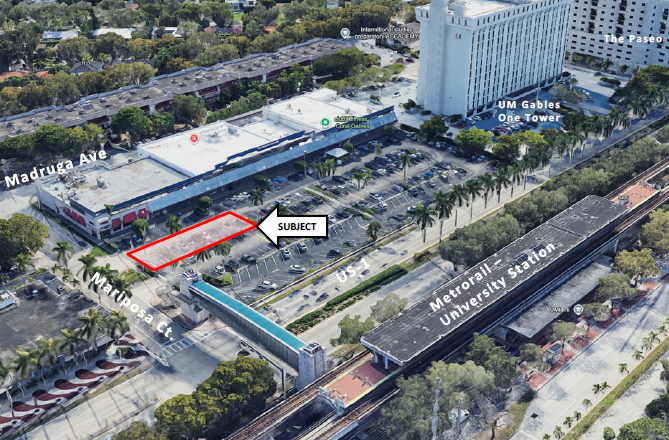
The alley in question is 45 feet wide and approximately 125 feet long, located at 1250 South Dixie Highway — the current site of the University Shopping Center, where Landmark Properties has proposed The Mark, a mixed-use development of two eight-story towers with 393 residential units. The Mark’s site plan is also on the April 14 agenda, listed as E-4 and linked directly to E-3 as related items. The two items share a lobbyist. They are designed to move together.
The alley vacation is on first reading. That means Tuesday’s vote is not final. A second commission vote will be required before the vacation takes effect. But first reading is consequential — it is the commission’s initial public commitment to a course of action, the moment at which the city signals its intent. The Mark’s site plan resolution, listed as the related item immediately following, incorporates the alley in its own legal description — meaning the commission will vote Tuesday to approve a site plan that includes land the city has not yet formally agreed to give up. That vote, unlike the alley vacation, requires only one reading. It is final on Tuesday.
What it is not is something that was discussed at the April 7 Sunshine Neighborhood Meeting.
The meeting was called to consider proposed amendments to the University Station Rapid Transit Overlay District, including the addition of 6100 Caballero Boulevard. Residents who attended heard about those amendments. They did not hear about a 45-foot public alley at 1250 South Dixie Highway that the city is being asked to give up permanently — because the alley was not part of the meeting’s stated subject.
That gap is a civic technicality.
A public alley is public infrastructure. It belongs to the city and, by extension, to its residents. When a city votes to vacate an alley, it is making an irreversible decision about a public asset — one that, once given up, cannot be reclaimed. The decision may be the right one. The Mark may be a development that serves the corridor well, and the alley vacation may be a reasonable accommodation. We take no position on those questions here.
What we take a position on is the process.
The Sunshine meeting was the designated moment for public input on the University Station overlay and the decisions connected to it. The alley vacation at 1250 South Dixie is directly connected to those decisions — it is listed on the commission agenda as a related item to The Mark’s site plan, which is itself evaluated under the overlay framework. Residents attending the Sunshine meeting to understand what the commission would be voting on a week later could not have known about E-3 from the meeting notice.
We understand the structural constraints within which the city is operating. The RTZ framework limits what Coral Gables can demand from developers. The overlay was built under time pressure and coordination requirements that explain why multiple items appear together in a single legislative moment. None of that is the commission’s fault.
But the standard we called for last week — that the notice match the vote — applies here with particular force. When a city asks the public to engage with a planning process, the public deserves to know that the process includes a vote to vacate a public alley. Because the vote is consequential. And because residents who showed up Tuesday night to have their say on the University Station corridor had no way of knowing it was coming.
The commission will vote on E-3 on Tuesday. A second reading will follow at a future meeting. Between now and then, the city has an opportunity to do what the original editorial asked: ensure that the public record reflects the full scope of the decisions residents are being asked to engage.
The alley at 1250 South Dixie is a small piece of ground. The principle it represents is not.









Kudos to the Gazette team for raising this issue in their public forum in a manner that is well reasoned and helpful to residents that pay attention to matters of importance in the city. Numerous significant building projects have been granted wavers to eliminate alleys, or integrate them in building plans in a manner that compromises their simple purpose to some degree. This issue draws attention to the master plan for this property, and casts a light on the process, the timing and critical sequence of decisions.
We’ve been here before … 30 years ago the issue was that the public should have the right to vote on the use of City owned property, i.e., the development of Merrick Park when the city gave away a portion of the rights to the canal so they could build on it. Nothing’s changed. They still do whatever they “see fit”.